
Benefits vs Features Why Audience Segmentation Wins | 2025
Introduction
There’s an ongoing debate in marketing: Should you focus on selling benefits or features? Most marketers treat this as an either/or decision, but that’s missing the point entirely.
The real answer is understanding who your audience is and what they need to hear.
In this post, we will explore why segmentation is the key to creating effective campaigns and show you exactly how to match your message to your audience.
You will walk away with a clear framework for deciding when to use benefits, features, or both.
The real answer is understanding who your audience is and what they need to hear.
Key Takeaway
Core Insight
- The benefits vs features debate is a false choice. Different audiences need different types of information to make decisions. The key is matching your message to your audience’s information processing style.
The Three Audience Types
- General Consumers: Want emotional benefits and simple outcomes
- Technical Buyers: Need detailed specifications and proof of capability
- Business Decision-Makers: Require both features and clear business benefits
Implementation Framework
- Analyze your audience through interviews, data, and surveys
- Tailor messaging to each segment’s information preferences
- Test different approaches to validate what works
- Optimize based on performance data and customer feedback
Success Factors
Segmentation works when you:
- Speak each audience’s language,
- Provide the information they need to decide, and
- Remove friction from their decision-making process.
The Problem: The False Choice Between Benefits and Features
Marketing teams waste countless hours debating whether to highlight product features or focus on customer benefits. This creates two problems:
- Problem 1: You end up with one-size-fits-all messaging that doesn’t resonate with anyone.
- Problem 2: You miss opportunities to connect with different audience segments who process information differently.
The truth is that different audiences have different information needs. Technical buyers want specifications. General consumers want outcomes. Business decision-makers want both.
The Solution: Match Your Message to Your Audience
Instead of choosing between benefits and features, successful companies use audience segmentation to deliver the right message to the right people.
Here’s how this works in practice across three distinct audience types:
General Consumers: Lead with Benefits
Apple’s iPod approach perfectly demonstrates benefit-focused messaging. Instead of promoting technical specifications like storage capacity or file formats, Apple sold the experience: “1,000 songs in your pocket.”
This strategy works brilliantly for general consumers who value ease of use and emotional connection over raw specifications.
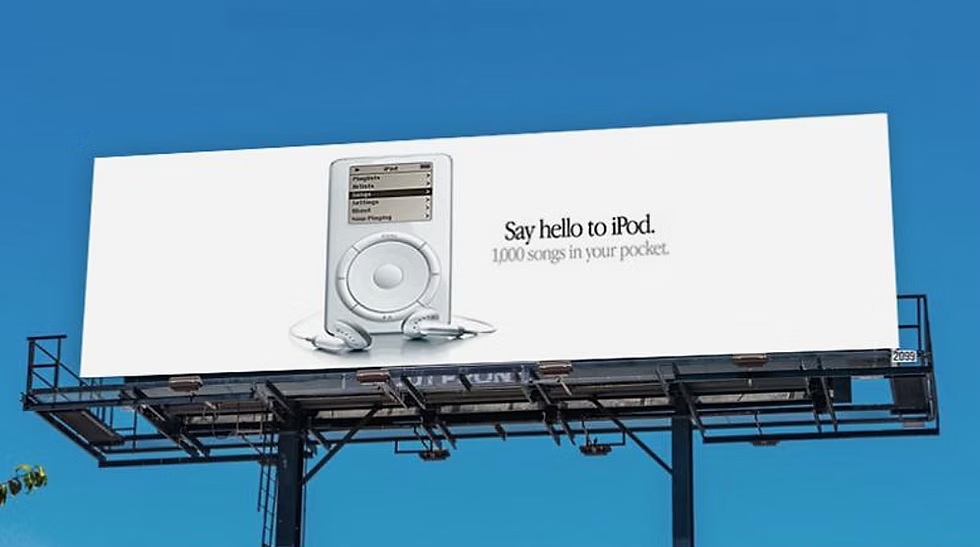
Ad Breakdown: Apple iPod Billboard “Say hello to iPod. 1,000 songs in your pocket.”
What This Ad Focuses On: BENEFITS
Main Message:
“Say hello to iPod.1,000 songs in your pocket.”
There’s no mention of:
- Storage size (e.g. 5GB)
- File types supported
- Battery life
- Screen resolution
- Any technical specification
And yet… it’s one of the most memorable product messages of all time.
Who This Speaks To:
| Segment | Appeal | Why It Works |
|---|---|---|
| General Consumers | ✅✅✅ | Emotional + practical. Solves a real pain: “I want all my music, easily.” |
| Technical Buyers | ❌ | No specs, no hardware info. |
| Business Decision-Makers | ✅ | For enterprise bulk buying (schools, retail), the simplicity and clarity of value proposition is a plus. |
What It Gets Right
- Incredibly clear value proposition: The user instantly understands what they gain.
- Focuses on the experience, not the specs: “1,000 songs in your pocket” is about freedom, simplicity, and delight.
- Minimalist design reinforces simplicity: Clean background, product front-and-center, short text.
- No hard selling: The tone is warm, inviting (“Say hello…”).
What It Could Improve (for Feature-Driven Buyers)
- There’s zero information for people who care about technical details.
- Some users might want to know: Can I create playlists? How long does the battery last? Is it compatible with my Windows PC?
Apple solved this by having product detail pages and specs online or in-store, but the billboard itself was optimized solely for emotional impact.
Messaging Matrix Alignment
| Audience Type | Lead With | Support With | This Ad Delivers |
|---|---|---|---|
| General Consumers | ✅ Benefits | ❌ No Features | ✅✅✅ |
| Technical Buyers | ❌ Features | ❌ Outcome Logic | ❌ |
| Business Decision-Makers | ✅ Benefits | ❌ Use-Case Proof | ✅ |
Insight
This is a pure top-of-funnel awareness ad, designed to:
- Grab attention
- Anchor the product in the consumer’s mind
- Plant the benefit as a memory hook
Specs come later, once the user is already emotionally invested.
Technical Buyers: Focus on Features
Consider a gamer shopping for a new laptop. Gaming audiences are highly technical and prioritize specifications when making purchase decisions. They want to know:
- How much RAM does it have?
- What’s the graphics card?
- Is there an advanced cooling system?
- What’s the refresh rate and response time?
For this segment, detailed features are essential to build trust and prove the product can deliver peak performance.
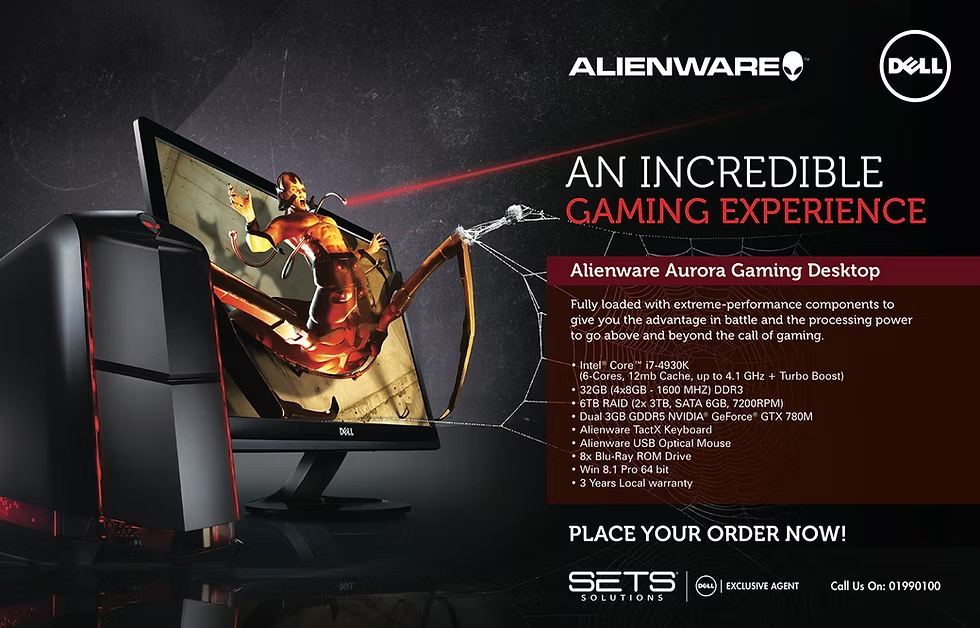
Ad Breakdown: Alienware Aurora Gaming Desktop
Headline: “An Incredible Gaming Experience” (This is the only benefit-driven line in the ad, it hints at emotion and performance, but doesn’t anchor the rest of the message.)
What the Ad Actually Focuses On: FEATURES
Core Feature Stack (Verbatim):
- Intel® Core™ i7-4930K (6-Cores, 12MB Cache, up to 4.1 GHz + Turbo Boost)
- 32GB DDR3 RAM (4x8GB, 1600 MHz)
- 6TB RAID (2x 3TB, SATA 6GB, 7200RPM)
- Dual 3GB GDDR5 NVIDIA® GeForce® GTX 780M
- Alienware TactX Keyboard & USB Optical Mouse
- 8x Blu-Ray ROM Drive
- Win 8.1 Pro 64-bit
- 3 Years Local Warranty
The message is:
“Here are all the technical specs that make this machine a BEAST.”
There’s no fluff, no story, and no lifestyle benefit beyond the visual (a character blasting out of the screen). That visual, though, implies immersion and power, enough to leap off the screen.
Who This Speaks To:
| Segment | Appeal | Why It Works |
|---|---|---|
| Technical Buyers (Gamers, Developers) | ✅ | High-performance specs validate decision-making. These buyers expect a feature-rich ad. |
| General Consumers | ❌ | Too much jargon. No clear emotional benefit. |
| Business Decision-Makers | ❌ | Irrelevant unless buying for dev or rendering workloads. |
What It Gets Right
- Specs-first storytelling: For gamers and performance-focused audiences, this works.
- Bold visual: The “game character blasting out of the monitor” is a compelling metaphor for immersion and power.
- Urgent CTA: “Place Your Order Now” with contact number reinforces action.
What It Could Improve (for Benefit-Savvy Segments)
- No reference to what these specs enable. E.g., “Run any AAA game on ultra settings,” “Stream + game without breaking a sweat,” etc.
- Could add a benefit callout section like: “Zero Lag. Max Performance. Total Control.”
- Could use testimonials or awards to build emotional proof.
Messaging Matrix Alignment
| Audience Type | Lead With | Support With | This Ad Delivers |
|---|---|---|---|
| General Consumers | Benefits | Light Features | ❌ No benefits |
| Technical Buyers | Features | Outcome Logic | ✅ Specs-heavy |
| Business Decision-Makers | Benefits + Features | Use-Case Proof | ❌ Not applicable |
Business Decision-Makers: Blend Both Approaches
When selling B2B SaaS solutions to decision-makers like CTOs and CFOs, you need both:
- Features that demonstrate security, scalability, and integration capabilities
- Benefits like cost savings, operational efficiency, and enhanced customer experience
CTOs need to know the solution will work technically, while CFOs need to understand the business impact.
The Process: How to Implement Audience-Driven Messaging
Step 1: Analyze Your Audience Systematically
Don’t rely on assumptions. Use concrete methods to understand your segments:
- Customer interviews: Conduct conversations with each major segment to understand their decision-making process
- Behavioral data analysis: Review website analytics, email engagement, and sales data to identify patterns
- Survey existing customers: Ask directly about what information influenced their purchase decision
- Persona development: Create detailed personas that include information preferences, not just demographics
Step 2: Tailor Your Messaging
- General consumers: Lead with benefits and emotional outcomes, support with simple feature explanations
- Technical buyers: Lead with detailed specifications, explain how features deliver performance
- Business decision-makers: Present features as proof points for the benefits you’re claiming
Step 3: Test and Optimize
- A/B testing: Test benefit-focused vs. feature-heavy messaging with different audience segments
- Channel-specific testing: What works in email may not work in social media ads
- Behavioural triggers: Automatically adjust messaging based on engagement with previous content
The Outcome: Why This Approach Works
Segmentation addresses the core challenge: different audiences process and evaluate information differently.
When you align your messaging with audience preferences, you:
- Increase engagement by speaking their language
- Build trust by providing the information they need
- Drive conversions by removing decision-making friction
Implementation Challenges and Solutions
Effective segmentation does come with challenges:
- Resource Constraints: Smaller companies may struggle to create multiple message variants. Start with your largest or most profitable segments first.
- Message Consistency: Managing different messaging approaches while maintaining brand consistency requires careful coordination across teams.
- Measurement Complexity: Different segments may require different success metrics, making campaign performance analysis more complex.
Ready to Stop Guessing and Start Converting?
The debate between benefits vs. features doesn’t have a one-size-fits-all answer. Audience segmentation is the real key to effective marketing.
Master this distinction, and your marketing will become significantly more effective.
Schedule Your Free Marketing Audit - We’ll show you exactly how to identify your key segments and optimize your messaging approach.
FAQ: Common Segmentation Questions
What’s the difference between audience segmentation and customer personas?
- Audience segmentation divides your market based on shared characteristics and behaviours.
- Customer personas are detailed profiles representing specific segments. Segmentation is the strategy; personas are the tactical tool.
How many audience segments should I create?
- Start with 2-3 primary segments based on your most important customer types. Too many segments become difficult to manage and execute effectively. You can always add more segments as you scale.
Can I use the same content for multiple segments?
- You can use the same core content but should adjust the messaging, headlines, and emphasis. For example, the same product demo can highlight technical specs for engineers and business outcomes for executives.
How do I know if my segmentation is working?
- Track conversion rates, engagement metrics, and cost per acquisition by segment. If you see significant differences in performance between segments, your segmentation is providing value.
What if my audience doesn’t fit neatly into these categories?
- Many audiences are mixed. Use a layered approach: lead with benefits in headlines to capture general attention, then provide detailed features in expandable sections for technical buyers.
How often should I review and update my segments?
- Review quarterly based on performance data and customer feedback. Major changes to your product, market, or business model may require more frequent updates.
What’s the biggest mistake companies make with segmentation?
- Creating segments based on assumptions rather than actual customer data and behavior. Always validate your segments through interviews, surveys, and performance testing.
Glossary: Key Marketing Terms
- **Audience Segmentation:**The practice of dividing your target market into distinct groups based on shared characteristics, behaviours, or information processing preferences.
- **Benefits-Focused Messaging:**Marketing content that emphasizes outcomes, results, and emotional value rather than product specifications. Example: “Save 20 hours per week” instead of “Automated workflow engine.”
- **Conversion Rate:**The percentage of people who take a desired action (purchase, sign-up, download) out of the total number who saw your message or visited your page.
- **Customer Persona:**A detailed, semi-fictional profile representing a specific segment of your audience, including demographics, goals, challenges, and information preferences.
- **Dynamic Content:**Website or email content that automatically changes based on user behaviour, traffic source, or other data points to deliver personalized messaging.
- **Features-Focused Messaging:**Marketing content that highlights product specifications, capabilities, and technical details. Example: “256GB storage, 8-core processor” instead of “Store all your files and run any program.”
- **Progressive Profiling:**Gradually collecting information about prospects over time through forms, behaviour tracking, and interactions to better segment and personalize messaging.
- **Technical Buyers:**Decision influencers who evaluate products based on specifications, capabilities, and technical fit rather than business outcomes or emotional benefits.
Common Mistakes to Avoid
1: Assuming Rather Than Researching
- What it looks like: Creating segments based on demographics or job titles without understanding actual information preferences and decision-making processes.
- Why it fails: People in the same role may have very different information needs. A CTO at a startup processes information differently than a CTO at an enterprise company.
- Better approach: Interview customers from different segments to understand how they actually evaluate and purchase solutions like yours.
2: Over-Segmenting Too Early
- What it looks like: Creating 8-10 detailed segments before you have enough data or resources to execute effectively.
- Why it fails: Spreads resources too thin and makes it impossible to create quality content for each segment.
- Better approach: Start with 2-3 segments based on your most important customer types. Add more segments only after you’ve proven success with the initial ones.
3: Inconsistent Brand Messaging
- What it looks like: Your technical content sounds completely different from your consumer-facing content, creating brand confusion.
- Why it fails: Customers may encounter multiple touchpoints and inconsistent messaging undermines trust and brand recognition.
- Better approach: Maintain consistent brand voice and core value propositions while adjusting the emphasis and detail level for different segments.
4: Set-and-Forget Segmentation
- What it looks like: Creating segments once and never updating them based on new data or market changes.
- Why it fails: Customer preferences, competitive landscape, and your product offering all evolve over time.
- Better approach: Review segment performance quarterly and adjust based on customer feedback, market research, and performance data.
5: Features-Only for All Technical Audiences
- What it looks like: Assuming all technical buyers only care about specifications and don’t need business context.
- Why it fails: Even technical buyers need to understand business impact, especially when they’re recommending solutions to non-technical decision-makers.
- Better approach: Provide technical details but always connect features to business outcomes and user benefits.
6: Ignoring Channel Differences
- What it looks like: Using the same messaging approach across email, social media, paid ads, and website content without considering platform context.
- Why it fails: Different channels have different user expectations and attention spans.
- Better approach: Adapt your segment-specific messaging to each channel while maintaining consistency in core value propositions.
7: Not Testing Assumptions
- What it looks like: Implementing segmentation strategy without A/B testing different messaging approaches.
- Why it fails: You never know if your segmentation assumptions are correct or if there are better ways to communicate with each audience.
- Better approach: Systematically test benefits-focused vs. features-focused messaging with each segment and optimize based on results.
Quick Reference Checklist
Before Launching Segmented Campaigns:
- Have you interviewed customers from each target segment?
- Do you have enough traffic/audience size to test effectively?
- Are your tracking and analytics set up to measure by segment?
- Have you created content variations for each approach?
- Do you have a testing timeline and success metrics defined?
Red Flags That Your Segmentation Needs Work:
- Similar conversion rates across all segments
- Customer feedback mentions confusion about your messaging
- High bounce rates on segment-specific landing pages
- Sales team reports leads don’t match expected segment profiles
- Segments based primarily on demographics rather than behavior