
A CRM request
Written as contact records, pipeline stages and a dashboard.
It reaches lead ownership, duplicates, stage definitions, a migration, permissions and operator training.Research
The distance between the solution a business asks to buy and the operating conditions that must be corrected for that solution to work.
The request
A business asks for Zoho CRM, a website, workflow automation, a Microsoft 365 cleanup, reporting, or an AI agent. That request describes where the pressure became visible. The operating problem is wider than the line item.
Written as contact records, pipeline stages and a dashboard.
It reaches lead ownership, duplicates, stage definitions, a migration, permissions and operator training.Written as a new site.
It reaches intake, follow-up, content ownership, booking, payment and the CRM.Written as an agent or a pilot.
It reaches workflow rules, source data, a reviewer, privacy and an acceptance test.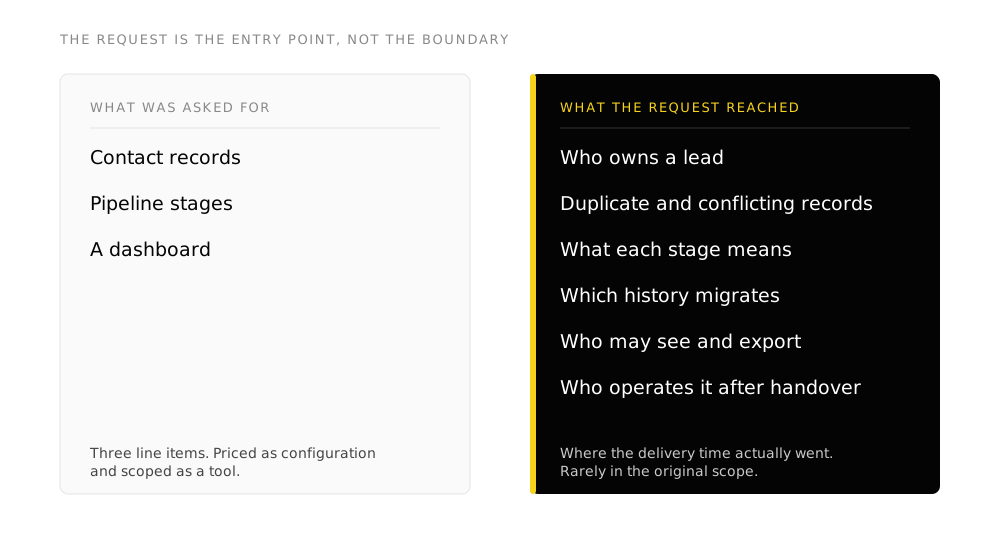
How we know this
The requested tool tells you where the pressure is visible. Mapping tells you what the business has to change. The claims below are bounded by the evidence that produced them.
Discovery, sales, delivery, partner, meeting, client-folder and CRM records. Repeated records were grouped around each organization, and each organization was given comparable weight, so one long engagement could not outweigh a short one.
Different questions draw on different subsets, so no single figure would describe the base honestly. The underlying records are client material. No organization, person, engagement value or meeting is identifiable.
What follows is limited to conditions that showed up across organizations. Industry-wide prevalence and universal failure rates sit outside this evidence.
The chain
Organizations entered and left this sequence at different points. Fixing one visible symptom left the remaining operating pressure in place. A new CRM cannot create a shared sales process by itself. A dashboard cannot correct records that staff define differently. Automation cannot resolve a handoff nobody owns.
The work has no shared description and no named next action.
Systems, spreadsheets, inboxes and memory each hold a piece of the same fact.
Follow-up depends on someone remembering.
Reporting needs reconciliation before anyone can trust it.
Privacy, permissions and administrator questions arrive late.
Ownership and backup coverage stay unresolved.
The last step runs on whatever the earlier steps left undefined.
Six patterns
The full write-up, with the worked composite and the discovery questions, is the Insights article. This is the record of the findings.
More leads, records, staff, services and tools each add control work the growth request does not name. The delivery requirement is the path from inquiry to ownership, action, status, reporting and review.
The subscription is the visible cost. The operating cost sits in the handoffs, reconciliation, administration and missed information between systems. Moving an unclear process into one platform centralizes the ambiguity.
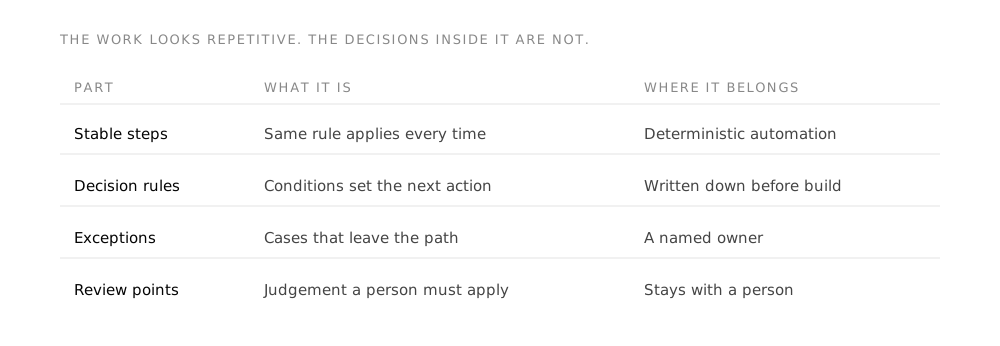
Staff experienced the work as repetitive while the next action lived in someone's head. Separate stable steps, decision rules, exceptions and review points before anything is automated.
Migration copies useful history and existing disorder together. Required fields, the owner, validation, duplicate handling and the questions management will ask have to be set before configuration closes.
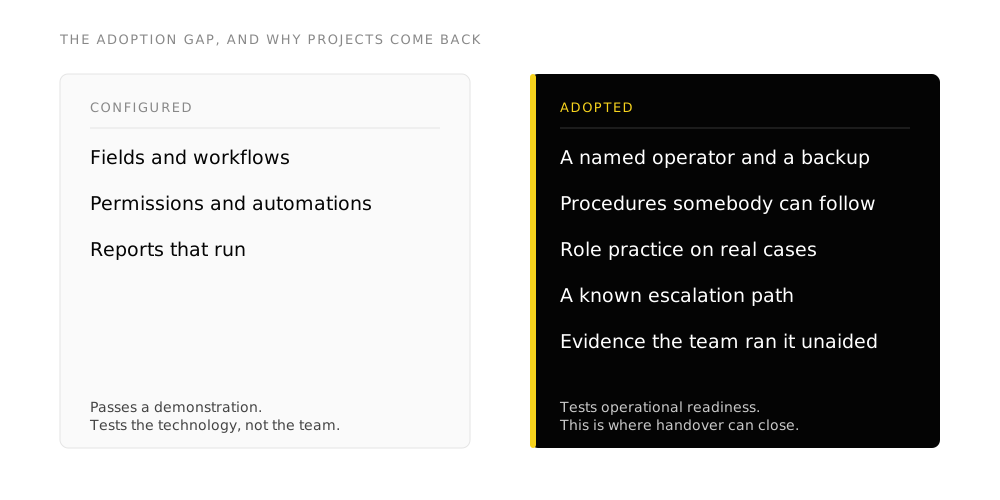
A configured system has fields, workflows, permissions, automations and reports. An adopted system has a named operator, a backup, procedures, role-based practice, an escalation path and evidence the team completed the work.
The workable cases had a bounded task, usable source material, written rules, a human reviewer, privacy controls, an owner and a testable output. One team can hold a ready use case beside a process that still needs mapping.
Before automation
A fixed rule belongs in automation. Interpretation may belong in an AI-assisted step. Accountability stays with a named person.
The Adoption Gap
We call the unresolved distance the Adoption Gap: a system can be configured and the team can still be unable to operate it without continued intervention. The contract should name both technical acceptance and operational handover.
The Operational Foundation Stack
A dependency model, not a fixed order of work. A website may launch before a full CRM program. An AI pilot may help document a workflow. The project still has to account for the layers its chosen outcome depends on. AI started at layer seven carries forward whatever was left undefined beneath it.
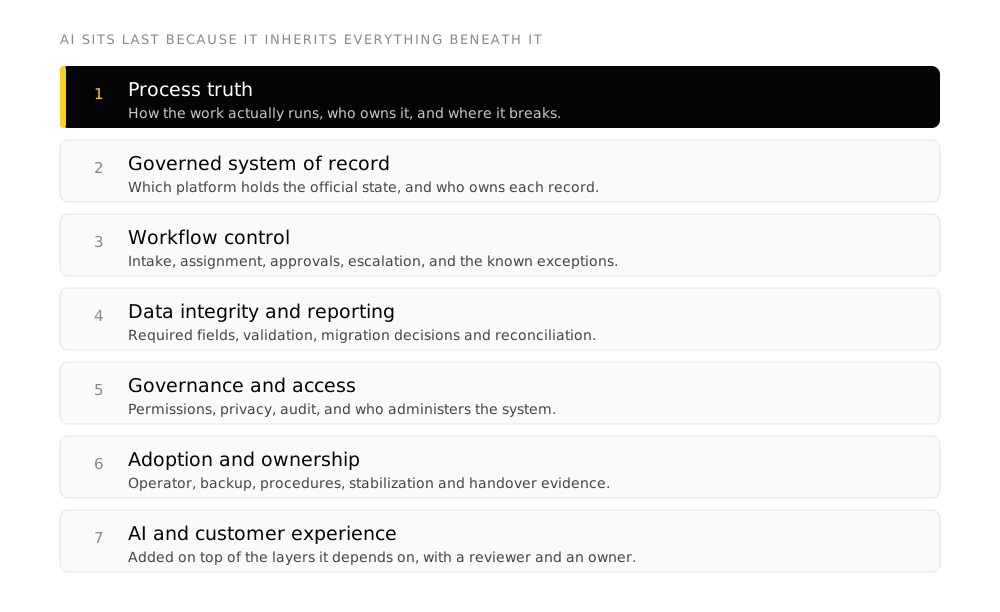
AI on the stack
Readiness sits with the workflow. The question changes from where the organization can use AI to which bounded workflow has enough operating definition to test safely.
Scope Stacking
CRM, website, automation, migration, reporting, AI, training and ongoing support can enter as one request. Several desired outcomes then compete, dependencies stay inside line items, and acceptance becomes a matter of opinion. A paid mapping phase turns that stack into one operating outcome with a sequence.
One composite
Assembled from conditions that recurred. Every organization stays anonymous, and no single client is described. The business asks for a CRM because leads are being missed. Inquiries arrive by email, forms, referrals and direct messages. Staff copy details into spreadsheets. One person remembers the follow-ups. The team expects automation to fix response time. The original request stays valid. The operating scope is wider.
Trigger, response standard, owner, backup, stages, decisions, exceptions and the completion point.
Contact, organization and opportunity structure, and which system holds each official state.
Required fields, service categories, assignment, follow-up, reminders and escalation.
Useful history cleaned, migration reconciled, role-based access and an administrator.
Operator and backup trained on real inquiries, exceptions tested, procedures written, workflow stabilized.
Classification or drafting, after the workflow, source data, review rule, owner and acceptance standard are clear.
The projects in this evidence that closed cleanly had these conditions defined. The ones that returned as support did not. Counts stay off this page for the reason in the method above.
Where projects come back
Questions
Terms
FusionMap defines how the work runs today, where the operating gaps sit, which workstreams belong in the implementation, and what sequence to follow.