
What We Learned from Mapping Two Years of Client Pain Points
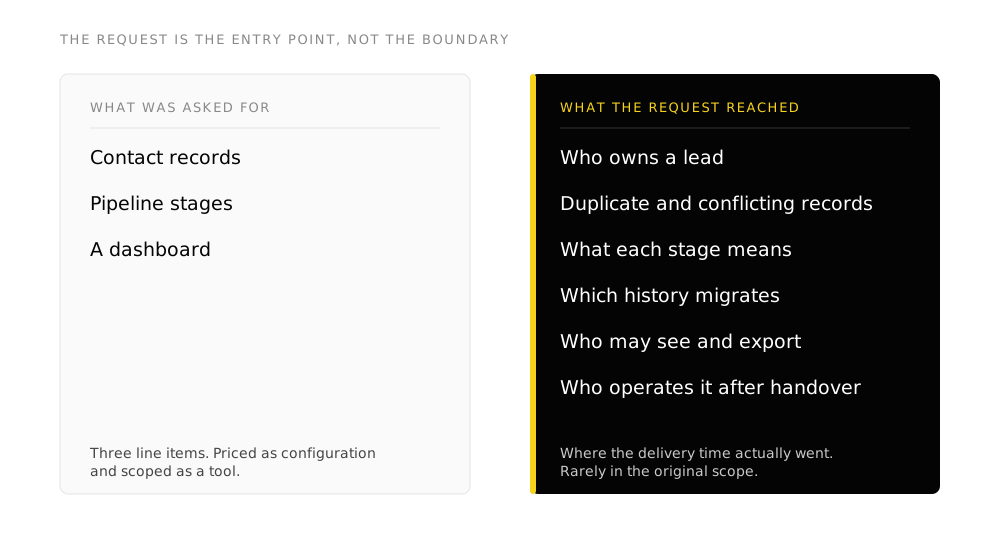
A business asks for Zoho CRM, a website, workflow automation, Microsoft 365 cleanup, reporting, or an AI agent. That request describes where the pressure has become visible. It rarely describes the full operating problem.
The CRM request reaches lead ownership, duplicate records, stage definitions, migration, reporting, permissions, and training. The website request reaches intake, customer follow-up, content ownership, booking, payment, and CRM integration. The AI request reaches workflow rules, source data, review responsibility, privacy, and acceptance testing.
This article sets out what two years of our own delivery evidence says about that distance. You will get the six patterns that recurred across organizations, the seven operating layers any technology project depends on, and the discovery questions that surface real scope before a proposal is written. It is written to be used on your own project before you buy anything.
The central finding is the Request-to-Operations Gap.
TL;DR
- A technology request is an entry signal. It marks where the pressure became visible, not the boundary of the work.
- The pains connect. Process, records, handoffs, data, access and adoption formed one chain across the evidence rather than separate problems.
- Growth creates operating load. More leads, records, staff, services and tools each add control work that the growth request does not name.
- Manual work often hides a decision. Separate stable steps, rules, exceptions and review points before automating anything.
- Configuration and adoption are different completion states. Operational completion needs a named operator, backup coverage, procedures, stabilization and handover.
- Broad requests need mapping before pricing. Mapping turns a stack of requested tools into one operating outcome with a defensible sequence.
Start with the Request-to-Operations Gap
The requested technology matters. It tells us where the business feels the pain. Discovery follows that signal into the process around the technology:
- What starts the work?
- Who owns the next action?
- Where is the official record?
- Which handoffs depend on memory?
- What data must be complete and accurate?
- Who can see, change, approve, or export that data?
- How will the team operate the new process after handover?
- What evidence will prove the change works?
These questions change the shape of an engagement. A software configuration becomes an operating decision. A migration becomes a decision about record ownership and future reporting. An automation becomes a controlled workflow with exceptions and escalation. An AI idea becomes a testable use case with a reviewer and an accountable owner.
The gap also explains a commercial pattern that recurred throughout the evidence. A proposal can be accurate about the requested tool and incomplete about the conditions required for adoption. The missing work returns later as migration issues, permission questions, unclear decisions, training requests, reporting gaps, and continued support.
The pains arrived as one chain, not a shopping list
Across the evidence base, the pain categories appeared as connected operating conditions rather than as separate items.
Fragmented systems increased repeated entry and reconciliation. Manual handoffs weakened follow-up and reporting. Unclear ownership made data quality difficult to maintain. Weak permissions and shared access created governance risk. Training delivered without clear ownership produced short-term knowledge rather than independent operation.
The practical unit of analysis is the chain:
- The process and its owner are unclear.
- Records spread across systems, spreadsheets, inboxes, and people’s heads.
- Staff copy information and carry handoffs manually.
- Data quality falls and reporting needs reconciliation.
- Access, privacy, and administrator questions get harder to control.
- Training covers the tool while ownership and continuity stay unresolved.
- Automation and AI inherit the ambiguity from every earlier step.
Organizations entered and exited this chain at different points. Fixing one visible symptom left the remaining operating pressure in place.
A new CRM cannot create a shared sales process by itself. A dashboard cannot correct records that staff define or enter differently. Automation cannot resolve a handoff when nobody owns the exception. Training cannot create accountability when no operator or backup has been named.
The technology begins to work when the surrounding operating decisions become explicit.
Six patterns recurred across the evidence
1. Growth requests became operating-control work
Early conversations focused on lead generation, follow-up, visibility, websites, marketing, and customer experience. Those are legitimate commercial needs.
Delivery then placed pressure on a different set of conditions: clean records, workflow ownership, permissions, migration, reporting, staff capability, and stabilization.
The shift happens because growth creates operating load. More leads create more records to route and maintain. More customer interactions create more follow-up commitments. More staff create access and accountability questions. More services create exceptions. More tools create integration and reconciliation work.
The sales outcome and the operating controls belong in one scope. A growth project needs a defined path from inquiry to ownership, action, status, reporting, and review. Without that path, the business gains activity while management visibility stays weak.
2. Fragmentation created compound operating cost
Disconnected tools repeatedly appeared alongside manual work, weak follow-up, data-quality problems, governance questions, and cost pressure.
Every additional system creates operating decisions:
- which system holds the official record
- which fields must match
- who updates each record
- how status moves between systems
- who receives access
- what happens when an integration fails
- how reporting reconciles conflicting data
- how staff learn the full workflow
The subscription is the visible cost. The operating cost sits in the handoffs, reconciliation, administration, support, and missed information between systems.
Consolidation reduces that pressure when the work also defines record ownership, data standards, workflow rules, permissions, and a migration decision for each source. Moving unclear processes into one platform centralizes the ambiguity.
Evaluate fragmentation through information flow. Map what must move through the business, who owns it at each stage, and where its official state should live.
3. Manual work was a decision problem before it was an automation problem
Repeated entry, spreadsheet reconciliation, document handling, reminders, follow-up, and reporting created obvious automation opportunities. The evidence also showed why some of that work resisted automation.
The task contained an undocumented decision. Staff knew how to interpret an exception, select a category, correct a source label, approve a request, or decide the next action. The business experienced the work as repetitive while the workflow ran on judgement held in people’s heads.
Automation design should separate four parts:
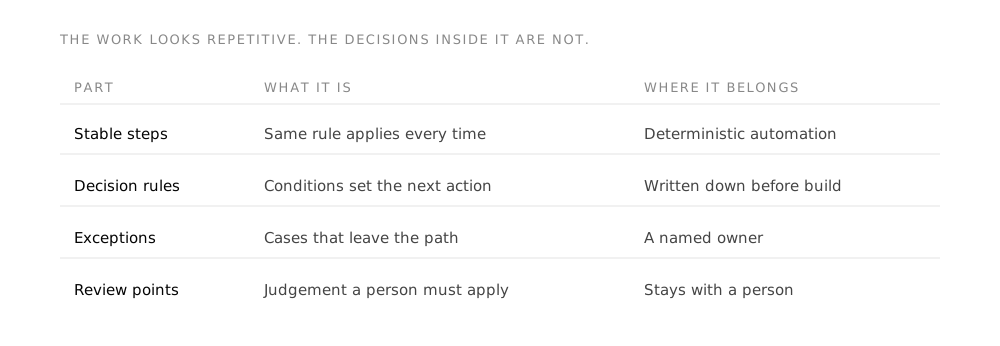
- Stable steps
Actions that follow the same rule every time.
- Decision rules
Conditions that determine the next action.
- Exceptions
Cases that leave the normal path.
- Review points
Decisions that require a qualified person.
This separation prevents brittle automation. It also shows where AI may help and where a deterministic workflow is sufficient. A fixed rule belongs in automation. Interpretation may belong in an AI-assisted step. Accountability stays with a named person.
The exercise improves the process before technology enters. Duplicate approvals, unnecessary transfers, missing decisions, and steps that exist only because an older system required them all surfaced this way.
4. Data quality was an operating discipline, not a cleanup task
Migration and reporting problems appeared across CRM, finance, documents, marketing, member management, and AI work. The symptoms varied: duplicate records, inconsistent labels, missing fields, locked documents, scattered histories, weak categorization, and reports that required manual reconciliation.
Data quality is created through daily operating rules. The business has to define:
- which records are required
- which fields control workflow or reporting
- who creates and updates the record
- what validation happens at entry
- how duplicates are prevented or resolved
- which historical data should migrate
- how corrections are approved
- how management knows the data is reliable
This is why migration deserves its own workstream. Copying data preserves useful history and existing disorder together. A migration plan needs selection, cleanup, mapping, validation, exception handling, approval, and reconciliation.
Reporting requirements should shape the data model before configuration is complete. If management needs to compare service lines, track referral sources, measure stage movement, or separate programs, the system has to capture those distinctions consistently at the point of work.
AI raises the standard further. An AI workflow processes information quickly and still produces weak output from inconsistent source data or unclear categories. The source, labels, validation rules, reviewer, and audit trail need one design.
5. Configuration and adoption were different completion states
Training, access, ownership, backup coverage, documentation, and stabilization recurred throughout the delivery evidence. We call the unresolved distance the Adoption Gap.
A configured system has fields, workflows, permissions, automations, and reports. An adopted system has a named operator, backup coverage, usable procedures, role-based training, known escalation paths, and evidence that the team can complete the work.
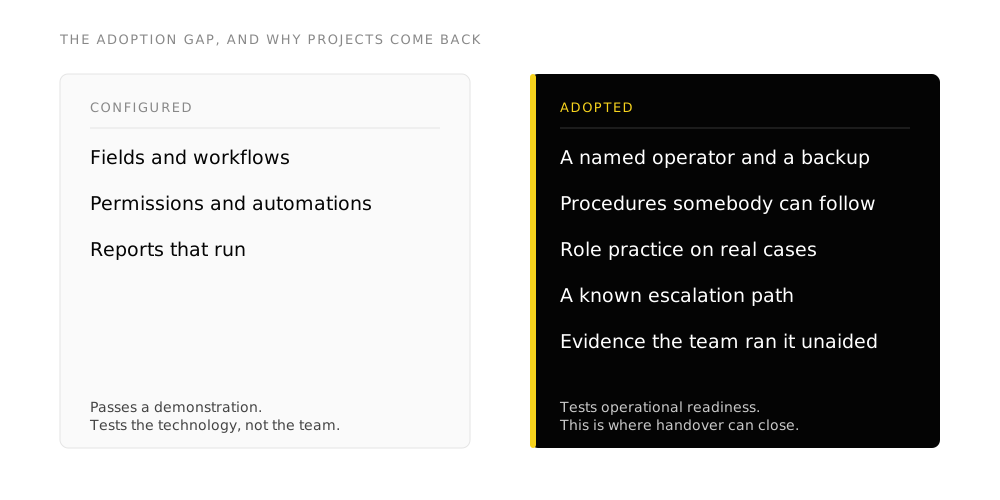
This changes acceptance criteria. “The workflow runs” tests the technology. “The assigned operator can complete the workflow, handle a known exception, confirm the result, and recover when something fails” tests operational readiness.
Training needs a job context. General product tours create awareness. Role-based practice builds capability. The operator should use real scenarios, complete the required steps, interpret the output, and know when to escalate.
Stabilization belongs in the delivery plan because real use exposes exceptions that configuration sessions cannot predict. A defined stabilization period gives the team a controlled path to report issues, adjust rules, confirm ownership, and close the handover.
The contract should name both completion states: technical acceptance and operational handover.
6. AI readiness belonged to a workflow, not to a company
Broad AI interest appeared across the evidence. The strongest opportunities shared a narrower structure: a defined task, available source material, known rules, a human reviewer, privacy controls, and a measurable output.
An AI use case can move from interest to implementation when seven conditions are defined:
- The workflow has a clear start and finish.
- The source data is available and usable.
- Business rules and known exceptions are documented.
- A qualified person reviews the output.
- Access, privacy, and audit requirements are known.
- The business has named an accountable owner.
- Acceptance can be tested against a defined standard.
These conditions shift the conversation from “Where can we use AI?” to “Which bounded workflow has enough operating definition to test safely?”
That protects the business from funding a broad concept with no acceptance standard, and it makes the commercial scope clearer. The team can define inputs, outputs, review effort, error handling, permissions, test cases, and the threshold for moving beyond a pilot.
Readiness sits with the workflow rather than the organization. One team can hold a ready use case beside another process that still needs mapping, data cleanup, or ownership decisions.
Scope Stacking is the warning sign in discovery
A single discovery conversation can accumulate CRM, website, automation, migration, reporting, AI, training, governance, and ongoing support. We call this Scope Stacking.
It signals that several connected operating problems have entered one conversation. Treating them as one undifferentiated implementation creates four risks:
- several desired outcomes compete for priority
- dependencies stay hidden inside line items
- client and delivery responsibilities stay unclear
- acceptance becomes subjective
The answer is a paid mapping phase with a defined output: the process inventory, current-state evidence, desired operating outcome, owners, system boundaries, data requirements, workstreams, dependencies, risks, and acceptance gates.
Mapping creates a defensible sequence. One workstream may need to start first because every later workstream depends on its records, ownership, or decisions. Another may be deferred because it adds complexity before the operating foundation exists.
Scope becomes credible when every workstream connects to one operating outcome and has a stated reason for appearing in the plan.
The Operational Foundation Stack
The recurring pain and solution evidence supports a seven-layer sequence for digital adoption and AI work.
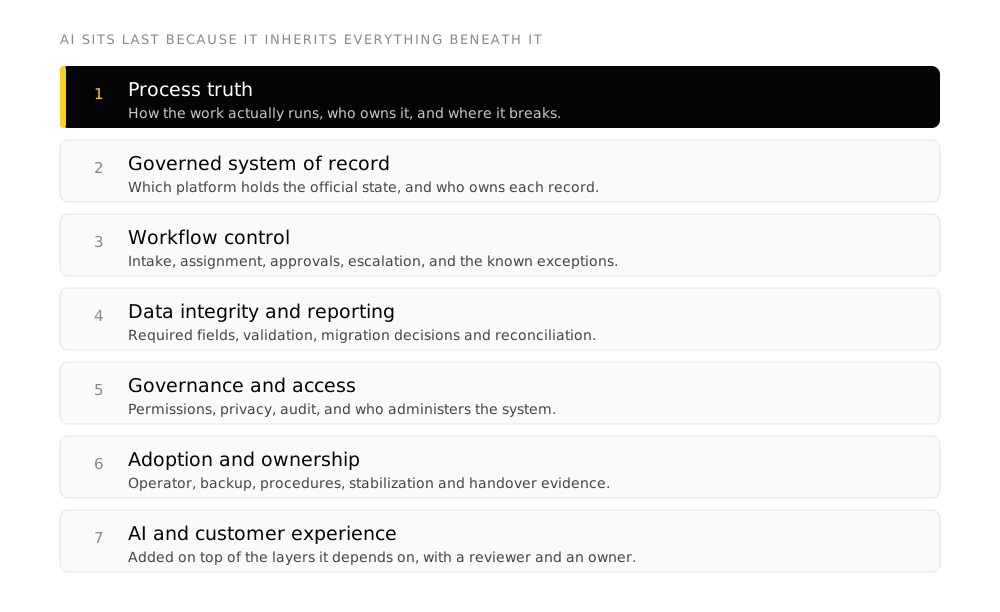
- Process truth. Map the current process, desired outcome, owner, backup, dependencies, exceptions, evidence state, and decision points. This gives the project a shared description of how work happens and what has to change.
- Governed system of record. Decide where customer, member, project, financial, document, and communication data belongs. Define which platform holds the official state and who owns each record.
- Workflow control. Build intake, assignment, handoffs, approvals, follow-up, reminders, and escalation around the improved process. Include the normal path and the known exceptions.
- Data integrity and reporting. Clean and migrate data. Define required fields, labels, validation, reporting logic, reconciliation, and management visibility.
- Governance and access. Set permissions, consent, privacy controls, shared-data boundaries, audit requirements, and administrator responsibility. Match access to roles and real operating needs.
- Adoption and ownership. Train the operator and backup. Document procedures. Test real scenarios. Set escalation, stabilization support, and handover evidence. Close the Adoption Gap before declaring operational completion.
- AI and customer experience. Add AI, advanced automation, portals, websites, and marketing journeys on top of the operating layers they depend on. Each tool then has a clear role and a testable outcome.
The stack is a dependency model rather than a fixed order of work. A website may launch before a full CRM program. An AI pilot may help document a workflow. The project still has to account for the layers its chosen outcome depends on.
What the full pattern looks like in one business
This is a composite illustration assembled from recurring conditions in the research. Every organization, person and engagement stays anonymous, and no single client is described here.
The business asks for a CRM because leads are being missed. Discovery finds inquiries arriving through email, website forms, referrals, and direct messages. Staff copy contact details into separate spreadsheets. Nobody owns the response standard. Service categories differ across documents. Management cannot see which inquiries are active. One employee remembers most follow-ups. Shared accounts provide broad access. The team expects automation and AI to fix response time.
The original request stays valid. The operating scope is wider.
- Map the inquiry-to-decision process
Define the trigger, response standard, owner, backup, stages, decisions, exceptions, and completion point.
- Define the official records
Set the contact, organization, and opportunity structure, then decide which system holds each official state.
- Standardize intake and routing
Agree required fields and service categories, then build assignment, follow-up, reminder, and escalation rules.
- Prepare the data and access model
Clean the useful history, reconcile the migration, and configure role-based access and administrator responsibility.
- Close the Adoption Gap
Train the operator and backup on real inquiry scenarios, test exceptions, document procedures, and stabilize the workflow.
- Add AI to a stable step
Test AI-assisted classification or drafting only after the workflow, source data, review rule, owner, and acceptance standard are clear.
The CRM is still part of the answer. What changes is everything around it.
The outcome of scoping this way is a project that can be accepted. Ownership of every inquiry is named rather than assumed. The official record sits in one place, so reporting stops requiring reconciliation. Exceptions have a route instead of stalling on the one person who remembers. Handover has a test the team can pass or fail, which means the engagement has an end. AI enters against a defined workflow with a reviewer, so it can be assessed rather than argued about.
We are not attaching numbers to those outcomes here, for the reason given at the top: the evidence is client material and no single figure would describe it honestly. What we can say is that the projects in our evidence that closed cleanly had these conditions defined, and the ones that returned as support did not.
Avoid these implementation mistakes
- Buying the requested tool before mapping its process. Configuration starts while ownership, handoffs and exceptions stay unresolved. Map the operating outcome first.
- Treating migration as file transfer. Existing duplicates, labels and conflicting records move straight into the new system. Define selection, cleanup, validation, approval and reconciliation.
- Building reports after configuration. The distinctions management needs are missing from the data model. Define the management questions before finalizing fields.
- Automating undocumented decisions. Exceptions become failures or silent workarounds. Separate stable rules, judgement, exceptions and human review.
- Delivering general product training. Staff see features without practising their actual job. Train by role, with real scenarios.
- Ending the project at configuration. Real use exposes unresolved rules and ownership. Include stabilization and operational handover.
- Recording a proposed solution as approved work. Recommendation, approval, implementation and result are four different states. Keep them distinct in proposals, CRM and project records.
Frequently asked questions
Does every technology project need process mapping?
The depth should match the risk. A contained configuration may need only a short workflow definition. Cross-functional CRM, Zoho One, data migration, automation or AI work requires a documented process, owner, system boundary, data decision and acceptance criteria.
Can a business begin with a tool it has already selected?
Yes. Discovery should confirm the operating outcome and test how the selected tool supports it. The process evidence controls the configuration and reveals the required work around data, access, adoption and integration.
How should a business decide what to automate first?
Choose a workflow with recurring volume, clear rules, visible delay or error, available data, and a named owner. Document the exceptions and review points before selecting the automation method.
Where should AI enter the plan?
At a bounded workflow. Define the input, rules, exceptions, reviewer, owner, controls and measurable output before implementation.
Why include training and stabilization in implementation scope?
The system creates value through use. Role-based training builds operator capability. Stabilization captures real exceptions, corrects workflow rules, and confirms that ownership can transfer from the implementation team.
What should a paid mapping phase produce?
The process inventory, current-state evidence, desired outcome, owners, system boundaries, data and integration needs, risks, workstreams, dependencies, and acceptance gates required to price and plan the implementation.
Terms used in this article
- Request-to-Operations Gap
- The distance between the solution a business asks to buy and the operating conditions that must be corrected for that solution to work.
- Adoption Gap
- The distance between a system being configured and the team being able to operate it without continued intervention.
- Scope Stacking
- The accumulation of several connected operating problems into one undifferentiated technology request during discovery.
- System of record
- The designated place where the official version of a business record is maintained.
- Operational handover
- The point where trained internal operators can run the process, handle known exceptions, and escalate through a defined path.
- Stabilization
- The controlled period after initial use when the team reports issues, corrects workflow rules, confirms ownership, and closes the handover.
Key takeaways
- The requested tool is an entry signal into a wider operating problem.
- Pain points connect through process, systems, handoffs, data, governance and adoption, and they arrived as one chain across the evidence.
- Growth outcomes depend on operating controls that usually become visible only during delivery.
- Fragmentation compounds administration, reconciliation, access, reporting and support work well beyond the subscription line.
- Configuration reaches completion before adoption does, unless ownership, training, stabilization and handover are in scope.
- AI becomes implementable when a bounded workflow meets the seven readiness conditions.
- Process mapping controls Scope Stacking before it reaches the proposal and the delivery plan.