
How Real Estate Professionals Use AI to Close More Deals
How Can I Use AI in My Business? The Real Estate Professional’s Complete Guide to AI Agents
Introduction
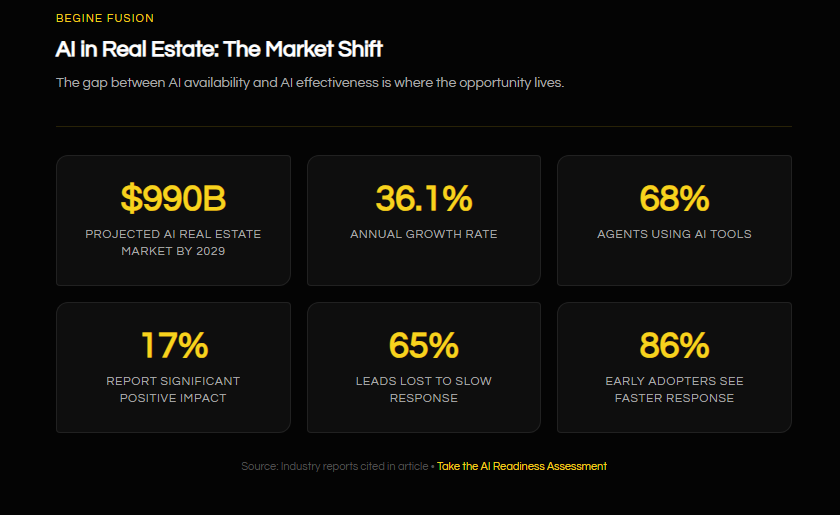
The AI real estate market grew from $222.65 billion in 2024 to over $303 billion in 2025, according to The Business Research Company, and is projected to reach $990 billion by 2029. That is not a typo. The growth rate is 36.1% annually, making real estate one of the fastest AI-adopting industries in the world.
Yet the National Association of Realtors’ 2025 Technology Survey tells a different story at the individual level: while 68% of agents report using AI in some form, only 17% say it has had a significant positive impact on their business. The gap between AI availability and AI effectiveness in real estate is enormous, and it comes down to how agents are using these tools.
Most agents treat AI like a fancy autocomplete: they use ChatGPT to write a listing description, maybe generate a social media caption, and call it a day. That approach misses the point entirely. AI agents are not content generators. They are autonomous systems that can qualify leads at 2 AM, generate comparative market analyses in minutes instead of hours, process contracts with 99.5% accuracy, and maintain consistent follow-up across hundreds of prospects simultaneously.
This guide covers the specific AI use cases that are producing measurable results for real estate professionals right now, how to implement them in phases without disrupting your current business, and what to watch out for along the way.
What AI Agents Actually Do in Real Estate
An AI agent is not the same thing as a chatbot on your website. A chatbot answers questions from a script. An AI agent makes decisions, takes actions, and manages workflows autonomously within the boundaries you set.
Here is a concrete example. A chatbot on a real estate website can answer “What are your office hours?” and maybe capture a visitor’s email. An AI agent monitors your lead sources 24/7, responds to every inquiry within minutes (not hours), asks qualifying questions about budget, timeline, location preferences, and pre-approval status, scores the lead based on their responses, routes high-priority leads to you with a complete briefing, and enrolls lower-priority leads into a personalized nurture sequence that adapts based on their engagement. The chatbot captures information. The agent manages an entire business function.
For real estate professionals, this distinction matters because the industry’s biggest operational problem is responsiveness. Sixty-five percent of leads are lost because agents respond too slowly, according to industry data. The average agent response time is 4 to 6 hours. By then, the prospect has already contacted three other agents. AI agents eliminate this gap entirely by operating around the clock and responding in minutes, not hours.
These agents are not replacements for the relationship-building, local market expertise, and negotiation skills that define great agents. They are systems that handle the operational workload (lead response, scheduling, documentation, follow-up) so you can focus your time on the high-value activities that actually close deals.
Current State of AI in Real Estate
Adoption Rates and Market Reality
According to the NAR 2025 Technology Survey, 68% of Realtors have used AI tools, with 20% using them daily, 22% weekly, and 27% a few times per month. ChatGPT dominates at 58% usage among agents using AI, followed by Google Gemini at 20% and Microsoft Copilot at 15%. AI-generated content specifically is used by 46% of agents.
At the brokerage level, adoption is even higher. Eighty-seven percent of brokerage leaders report that agents in their firms use AI tools, and 72% of real estate firms globally plan to increase their AI investment by 2026. The generative AI segment in real estate specifically was valued at $488 million in 2025 and is projected to reach $1.43 billion by 2035, according to Precedence Research.
The Adoption Gap
The gap is not between users and non-users. It is between surface-level adopters and systematic implementers. The NAR survey found that 59% of agents using AI are “still learning about it,” while only 8% consider themselves proficient enough to teach others. This means the vast majority of AI-adopting agents are using basic text generation (writing listing descriptions, social media posts) without touching the operational use cases that drive actual business results: lead qualification, automated follow-up, market analysis, and document processing.
Two-thirds of agents say their primary motivation for technology adoption is saving time, while 64% want to enhance client experience. AI agents address both, but only when implemented as workflow systems rather than isolated tools.
Regional Differences
North America leads global AI adoption in real estate, with the United States accounting for the largest share. Urban markets with higher transaction volumes and technology-forward brokerages are adopting fastest. Smaller markets and independent agents lag behind, creating a competitive advantage window that is narrowing rapidly.
Core AI Use Cases in Real Estate
1. Lead Qualification and Instant Response
What it does: AI lead qualification agents respond to every inquiry within minutes, 24 hours a day, 7 days a week. They ask qualifying questions about budget, timeline, property preferences, and financing status, then score each lead and route them based on priority. Hot leads go directly to you with a complete briefing. Warm leads enter automated nurture sequences.
How it works: The agent connects to your website forms, Zillow/Realtor.com/Redfin lead feeds, social media DMs, and phone systems. When a new inquiry arrives, it initiates a conversational qualification flow via text, email, or chat. Natural language processing interprets the prospect’s responses and maps them against your ideal client criteria. A scoring algorithm assigns a priority level, and routing rules determine next steps.
Real-world example: A Denver solo agent named Jennifer had a 4.5-hour average lead response time and a 2.8% conversion rate. After implementing an AI lead qualification system, her response time dropped to 4 minutes and her conversion rate increased to 11.2%, resulting in 80 deals per year, a 300% increase, according to a case study published by The Shift AI. Martinez Real Estate in Austin saw their conversion rate jump to 9.6% and average agent revenue grow by 159% after deploying AI lead response systems.
Measurable outcome: Real estate professionals using AI lead qualification consistently report response time reductions from hours to minutes and conversion rate improvements of 200 to 400%, with 86% of early AI adopters reporting improved lead response times.
2. Listing Content Generation
What it does: AI listing agents generate complete property descriptions, social media posts, email campaigns, and marketing materials from property data and photos. They adapt tone and emphasis based on property type, price point, and target buyer demographic.
How it works: The agent pulls property details from your MLS feed (square footage, bedrooms, bathrooms, features, location data) and combines them with neighborhood information, school ratings, walkability scores, and recent comparable sales. Natural language generation models produce descriptions that highlight the property’s strongest selling points while matching your personal brand voice and brokerage standards.
Real-world example: Properties with well-written, detailed descriptions receive 40% more inquiries than those with basic or templated listings, according to MindStudio’s real estate analysis. Agents using AI listing generators report reducing description writing time from 20 to 30 minutes per listing to under 3 minutes, while producing more consistent and higher-quality output.
Measurable outcome: AI-generated listing descriptions combined with optimized photography and virtual tour integration have been shown to reduce days on market by 10 to 15% and increase inquiry volume by 30 to 40%.
3. Scheduling and Showing Automation
What it does: AI scheduling agents manage the entire showing and appointment workflow: coordinating between buyers, sellers, and listing agents; sending confirmations and reminders; handling cancellations and rescheduling; and optimizing showing routes for agents conducting multiple property tours in a day.
How it works: The agent integrates with your calendar, MLS showing systems, and communication channels. When a buyer requests a showing, the agent checks listing availability, cross-references your calendar, proposes available times, confirms with all parties, sends preparation reminders to sellers, and provides the buyer with property details and directions.
Real-world example: The average real estate agent spends 10 to 15 hours per week on scheduling, translating to approximately 500 to 750 hours per year on calendar management alone. AI scheduling agents reduce this to under 2 hours per week of oversight, freeing 8 to 13 hours weekly for client-facing activities.
Measurable outcome: Agents implementing AI scheduling report reclaiming 400 to 600 hours annually and reducing no-show rates by 25 to 35% through automated reminder sequences.
4. Document Processing and Contract Review
What it does: AI document agents extract key terms, dates, conditions, and obligations from real estate contracts, purchase agreements, lease documents, and disclosure forms. They flag missing information, identify unusual clauses, create summary sheets for quick review, and track document completion status across multiple transactions.
How it works: The agent uses natural language processing trained on real estate legal documents to parse contract language, identify standard versus non-standard clauses, and extract critical data points (closing dates, contingency deadlines, financing terms, inspection windows). It compares each document against templates and flags deviations for human review.
Real-world example: Relos, a San Francisco-based proptech company, used AI to process over $100 million in real estate transaction volume, saving 45 to 60 minutes per contract while maintaining 99.5% accuracy across more than 120 transactions in four months. Organizations using specialized contract AI solutions report a 60% reduction in review time and a 30% improvement in risk identification.
Measurable outcome: AI document processing reduces contract review time by 60 to 95% (from 4 to 8 hours to 15 to 20 minutes for commercial leases) while maintaining accuracy rates of 95% or higher.
5. Comparative Market Analysis (CMA) Generation
What it does: AI CMA agents generate complete market analyses by pulling comparable sales data, analyzing price trends, calculating adjustments for property differences, and assembling polished presentation-ready reports with charts, photos, and pricing recommendations.
How it works: Machine learning models process square footage, bedroom and bathroom ratios, condition factors, lot size, location variables, and neighborhood trends to identify the most relevant comparables. The agent calculates adjustments automatically and generates a formatted report that matches your brokerage standards.
Real-world example: What used to require three hours of gathering MLS data and formatting spreadsheets is now a 5-minute process with AI CMA tools. Platforms like CMAGPT and Saleswise AI achieve approximately 95% appraisal-grade accuracy without manual calculations. As new sales close, AI agents refresh CMA data automatically so pricing recommendations reflect current market conditions.
Measurable outcome: AI CMA generation reduces analysis time from 2 to 3 hours to under 10 minutes while maintaining appraisal-grade accuracy, allowing agents to provide more frequent and more current market intelligence to clients.
6. Follow-Up and Nurture Automation
What it does: AI follow-up agents maintain consistent, personalized contact with prospects across your entire database. They adapt message frequency, content, and channel based on each prospect’s engagement level, stage in the buying or selling process, and communication preferences.
How it works: The agent tracks every interaction with each prospect (email opens, website visits, listing views, response patterns) and builds an engagement profile. Using this data, it determines the optimal follow-up timing, message content, and communication channel for each individual.
Real-world example: Industry data shows that converting a real estate lead requires 8 to 12 touchpoints before a buyer or seller makes a decision. Most agents give up after 2 to 3 attempts. AI nurture agents maintain consistent contact through all 12 touchpoints without manual effort, ensuring no lead falls through the cracks.
Measurable outcome: AI-powered follow-up systems increase lead-to-client conversion rates by 35 to 50% by maintaining consistent contact through the full 8 to 12 touchpoint cycle that most agents abandon prematurely.
7. Property Management and Maintenance Prediction
What it does: For agents who manage rental properties or work with investor clients, AI property management agents handle tenant communications, maintenance request routing, lease management, and predictive maintenance scheduling.
How it works: The agent integrates with property management software, IoT sensors, and tenant communication channels. For maintenance prediction, it analyzes equipment age, usage patterns, maintenance history, and manufacturer specifications to forecast when systems need service.
Real-world example: Emergency repairs cost 3 to 5 times more than planned maintenance. For a 20-unit building, predictive maintenance AI delivers 15 to 20% cost reductions through proactive scheduling. AI-powered tenant communication reduces property manager workload by 30 to 40% while improving response times and satisfaction scores.
Measurable outcome: Property management AI reduces maintenance costs by 15 to 20%, decreases tenant response times by 50 to 70%, and reduces administrative workload by 30 to 40%.
Implementation Strategy for Real Estate Professionals
Phase 1: Lead Response (Weeks 1 to 4)
Start with lead qualification and instant response. This is the highest-ROI entry point for two reasons: the problem is acute (most agents lose leads due to slow response), and the solution is immediately measurable (track response time and conversion rate before and after). Connect the AI agent to your primary lead sources and configure your qualification criteria. Run it alongside your manual process for the first two weeks to validate quality, then transition to AI-first with human oversight. Budget: $50 to $300/month for individual agents, $200 to $1,000/month for teams.
Phase 2: Content and Scheduling (Weeks 5 to 10)
Add listing content generation and scheduling automation. These are the two largest time sinks after lead management. Integrate the listing agent with your MLS feed so new listings automatically generate descriptions, social media posts, and email campaign content. Connect the scheduling agent to your calendar and showing management system. Budget: Add $30 to $100/month for content tools, $50 to $150/month for scheduling.
Phase 3: Intelligence and Documents (Months 3 to 6)
Add CMA generation, market analysis, and document processing. These agents provide competitive differentiation by allowing you to deliver faster, more complete market intelligence and smoother transaction management. Total AI stack at this stage: $230 to $850/month. Result by month 6: You should be saving 15 to 25 hours per week, responding to leads instantly, producing listings and market analyses in minutes, and managing documents with near-zero error rates.
Phase 4: Full Integration (Months 6 to 12)
Connect all agents into a coordinated system. When a new lead comes in, the qualification agent scores them, the CMA agent generates a relevant market report, the scheduling agent proposes showing times, and the follow-up agent begins a personalized nurture sequence. Your role shifts from managing tasks to managing relationships and negotiations.
Challenges and Considerations
Fair Housing Compliance
AI systems that score, qualify, or prioritize leads must comply with Fair Housing Act requirements. If your AI agent asks questions or applies criteria that correlate with protected classes (race, color, religion, national origin, sex, familial status, disability), you are exposed to legal liability regardless of whether discrimination was intentional. Audit your qualification criteria regularly and ensure your AI vendor provides Fair Housing compliance documentation.
Data Privacy and Client Trust
Real estate transactions involve sensitive personal and financial information. Any AI system processing client data must comply with applicable privacy regulations (state-specific data protection laws, CCPA in California, and evolving federal requirements). Be transparent with clients about how AI is used in their transaction. Most clients are comfortable with AI handling scheduling and market analysis but expect human oversight for negotiation and contract decisions.
MLS Data Restrictions
Multiple Listing Service rules govern how property data can be used, displayed, and processed. Not all AI tools are compliant with MLS data sharing policies. Before connecting any AI agent to your MLS feed, verify that the tool’s data usage terms are compatible with your MLS’s Internet Data Exchange (IDX) and RETS policies.
Relationship-Dependent Business Model
Real estate is fundamentally a relationship business. AI that makes your operations faster and more responsive strengthens relationships. AI that replaces personal contact weakens them. The line is clear: automate the operational tasks (lead response, scheduling, documentation, market analysis), keep the human in the relationship tasks (consultations, showings, negotiations, celebrations).
Technology Adoption Across Client Demographics
Your clients span a wide age and technology comfort range. Some appreciate instant AI text responses. Others want a phone call. Ensure your AI agents can adapt their communication channel and style based on client preferences, and always provide an easy path to reach a human when the client wants one.
Results and Outcomes
Real estate professionals who have implemented systematic AI workflows report the following measurable outcomes:
- 300% increase in annual transactions for solo agents implementing AI lead qualification, with conversion rates jumping from 2.8% to 11.2% (Denver agent case study, The Shift AI)
- 159% increase in average agent revenue at Martinez Real Estate in Austin after deploying AI lead response systems
- 4-minute average lead response time replacing 4 to 6 hour industry averages, with 86% of early adopters reporting improved response times
- 60% reduction in contract review time and 30% improvement in risk identification using AI document processing
- 500 to 750 hours saved annually on scheduling alone through AI-powered calendar and showing management
- 99.5% contract accuracy across $100M+ in transaction volume processed by AI at Relos
- 15 to 20% reduction in maintenance costs for property managers using predictive AI on 20-unit buildings
Takeaways
If you are a solo agent handling 20 to 40 transactions per year, start with AI lead qualification and response. The conversion rate improvement alone will likely double your transaction count within 12 months, and the time savings free you to handle the additional volume without burning out.
If you run a team of 3 to 10 agents, implement AI scheduling and follow-up first. The coordination complexity across multiple agents, clients, and properties is where the most time is wasted. A shared AI system ensures nothing falls through the cracks and every lead gets consistent follow-up regardless of which agent is assigned.
If you manage rental properties or work with investor clients, prioritize predictive maintenance and tenant communication AI. The cost reduction from proactive maintenance and the tenant satisfaction improvement from faster response times directly impact your property management revenue and client retention.
If you are a brokerage leader, invest in AI infrastructure that your agents can share: centralized lead qualification, CMA tools, and document processing. Agents who have access to AI tools close more deals, which means higher brokerage revenue per agent.
Frequently Asked Questions
Will AI replace real estate agents?
No. AI replaces the administrative and operational tasks that prevent agents from doing what they are actually paid for: building relationships, providing local market expertise, and negotiating deals. The agents who will struggle are not the ones who refuse to use AI. They are the ones whose only value proposition was administrative efficiency. If your competitive advantage is being responsive and organized, AI levels that playing field. If your advantage is market knowledge, negotiation skill, and client relationships, AI amplifies it.
How do I ensure AI follow-up does not feel impersonal to clients?
Train the AI on your actual communication style by providing examples of your best emails and texts. Set up rules that flag when a prospect’s situation calls for personal contact. Use AI for the consistent 80% of communications and handle the critical 20% personally. Most clients cannot distinguish well-trained AI follow-up from manual messages, and they overwhelmingly prefer consistent contact over sporadic personal outreach.
What about compliance with real estate regulations?
Every AI system you deploy should be audited against Fair Housing requirements, MLS data policies, and state-specific real estate regulations before going live. Work with your broker and legal counsel to establish AI usage policies. The major AI real estate platforms have built compliance safeguards into their systems, but the responsibility for compliance ultimately rests with the agent and brokerage.
How quickly will I see ROI from AI tools?
Lead qualification AI typically shows ROI within 30 days through improved conversion rates. Scheduling and content tools save time immediately but take 60 to 90 days to produce measurable business impact. Document processing and CMA tools pay for themselves within the first quarter for agents handling 3 or more transactions per month. At $230 to $850 per month for a full AI stack, an agent closing even one additional transaction per quarter more than covers the investment.
Sources and References
- AI real estate market ($222.65B in 2024, $303B in 2025, $990B by 2029): The Business Research Company, 2026
- NAR 2025 Technology Survey (68% AI adoption, 17% significant impact): National Association of Realtors, September 2025
- 87% of brokerage leaders report agent AI use: NAR brokerage survey data, 2025
- 72% of firms plan to increase AI investment by 2026: ArtSmart AI industry compilation
- Generative AI in real estate ($488M in 2025, $1.43B by 2035): Precedence Research
- Denver agent case study (300% transaction increase): The Shift AI
- Martinez Real Estate Austin (159% revenue growth): The Shift AI
- Relos: $100M+ volume, 99.5% accuracy: PropTech case study
- AI contract review 60% time reduction: Dioptra industry analysis
- 10-15 hours/week on scheduling: MindStudio agent workflow analysis
- Emergency repairs 3-5x planned maintenance cost: MindStudio predictive maintenance data
- Properties with detailed descriptions receive 40% more inquiries: MindStudio listing analysis
- 8-12 touchpoints required for conversion: real estate industry benchmark data
- CMA time reduction from 3 hours to 5 minutes: CMAGPT platform data
- 95% appraisal-grade CMA accuracy: Saleswise AI platform data
Take the Systems Readiness Assessment
Not sure where AI fits in your real estate business? The Systems Readiness Assessment helps you identify your highest-impact opportunities in under 5 minutes. Whether you are a solo agent, team leader, or brokerage owner, the assessment maps your current workflow against proven AI use cases and shows you exactly where to start.
Take the assessment at beginefusion.com/systems-readiness-assessment