
How Financial Services Firms Use AI to Reduce Risk
How Can I Use AI in Financial Services ?
Financial services runs on data, decisions, and trust. Every loan approval, fraud alert, compliance check, portfolio rebalance, and client onboarding involves processing information against rules, regulations, and risk models. The industry has been using quantitative models for decades, but AI changes the equation by processing volumes and patterns that traditional models cannot handle at speeds that manual processes cannot match.
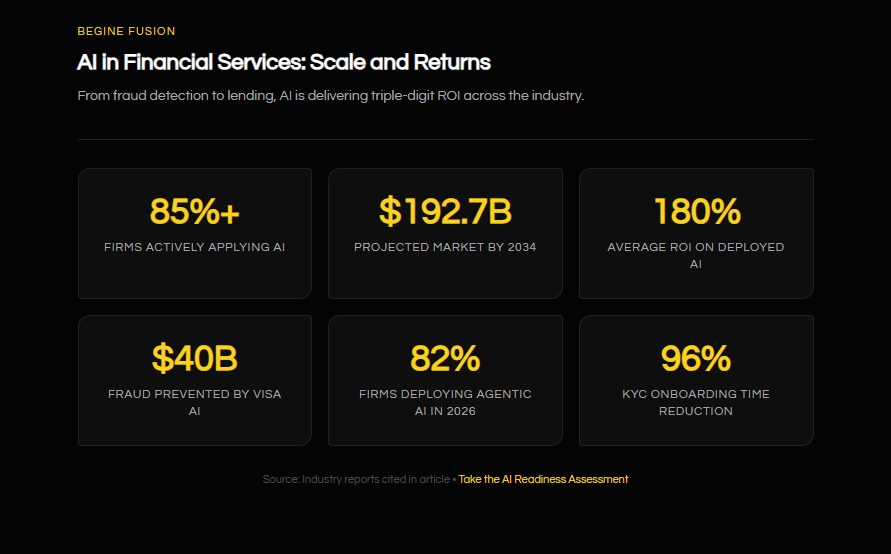
The numbers reflect how fast the shift is happening. Over 85% of financial firms are actively applying AI in areas like fraud detection, IT operations, and risk modeling. The global AI market for banking, financial services, and insurance is projected to reach $192.7 billion by 2034, growing at 22% annually. And deployed AI applications in financial services are averaging 180% ROI, with production-ready implementations hitting 250-350% returns.
This is not theoretical. Banks are cutting customer onboarding from five days to four hours. Lenders are processing applications 20 times faster. Insurance underwriters are reducing cycle times by 60%. And 82% of financial firms are deploying agentic AI in 2026.
This guide covers the specific AI applications that deliver measurable results across financial services, the real performance data behind each one, and a framework for deciding where to start based on your business type.
Fraud Detection and Prevention
Fraud detection is the most mature and highest-ROI application of AI in financial services. It is also the application where AI’s advantage over traditional systems is most dramatic. Rule-based fraud detection systems match transactions against fixed patterns. AI fraud systems analyze hundreds of behavioral signals per transaction in real time, identifying fraud patterns that rules-based systems cannot detect.
The scale of the impact is significant. Visa’s AI fraud prevention system analyzed over 320 billion transactions and prevented more than $40 billion in fraud. Banks using advanced AI models report fraud detection accuracy exceeding 90%. Projections indicate that AI-based fraud systems will save global banks over $12 billion annually by 2026.
The technical improvement is measurable in two directions simultaneously. Modern AI fraud systems using graph neural networks and behavioral analytics reduce false positives by 40-60% while catching 20% more actual fraud than rule-based alternatives. That dual improvement matters because false positives are expensive: every legitimate transaction you block is a customer you frustrate and potentially lose. Reducing false positives while increasing actual fraud detection is a result that traditional systems cannot achieve because the two objectives are in tension under rule-based approaches.
For smaller financial services firms, fraud detection AI is typically consumed as a service integrated into payment processing or banking platforms. For larger institutions, custom models trained on institution-specific transaction patterns deliver the highest accuracy. The implementation path usually starts with real-time transaction scoring, then expands to account takeover detection, synthetic identity detection, and network-level fraud pattern analysis.
The ROI calculation is straightforward: compare your current fraud losses, chargeback costs, and false positive rates against the cost of AI fraud detection. For most financial institutions, the system pays for itself within the first quarter.
Compliance, KYC, and Anti-Money Laundering
Compliance is where financial services firms spend the most money on activities that generate zero revenue. KYC (Know Your Customer) onboarding, AML (Anti-Money Laundering) monitoring, sanctions screening, and regulatory reporting consume massive resources across every financial institution. And the cost of getting it wrong is severe: global enforcement penalties exceeded $4.3 billion in 2024 alone.
AI transforms compliance from a manual, periodic process into a continuous, automated system. The most cited example is HSBC, which deployed an AI-powered KYC platform that reduced customer onboarding time from 5 days to 4 hours, a 96% improvement, while simultaneously increasing compliance accuracy by 25%. That combination of speed improvement and accuracy improvement is characteristic of well-implemented AI compliance systems.
Early adopters of agentic AI in compliance are reporting productivity gains of 200% to 2,000% by deploying AI agents to handle Level 1 alerts. The compliance industry’s biggest operational problem is false positives: traditional AML monitoring systems generate alert volumes that human teams cannot review effectively, leading to alert fatigue and missed genuine risks. AI dramatically reduces the false positive volume while improving detection of actual suspicious activity.
The regulatory environment is evolving to support AI adoption. The defining regulatory theme for 2026 is the pivot from technical compliance to demonstrable effectiveness. FinCEN’s examiners are now assessing whether compliance programs effectively mitigate specific risks, not just whether policies exist on paper. AI systems that continuously monitor and adapt to risk patterns are inherently better positioned for this effectiveness-based regulatory approach than static rule sets.
Perpetual KYC (pKYC) is replacing periodic reviews. Instead of reviewing customer risk profiles every one to three years, AI systems continuously monitor customer behavior and trigger reviews when significant changes occur. This catches risk faster and eliminates the compliance gaps that exist between periodic review cycles.
For financial services firms evaluating AI compliance tools, the starting point is usually automated alert triage for existing AML monitoring, followed by AI-enhanced customer onboarding, and then continuous monitoring. Each step reduces compliance costs while improving actual effectiveness.
Lending and Credit Underwriting
AI in lending is where the technology’s pattern recognition capability directly translates to better business decisions. Traditional credit scoring relies on a limited set of variables from credit bureau data. AI credit models analyze hundreds of additional data points including transaction patterns, employment stability signals, and behavioral indicators to build a more complete picture of borrower risk.
The operational improvements are dramatic. AI-powered lending workflows process applications up to 20 times faster than manual underwriting, cut end-to-end origination cycles by more than 90%, and automate 70-85% of credit applications outright. Operational costs drop 10-50% through intelligent automation, depending on the complexity of the lending portfolio.
The decision quality improvements matter as much as the speed gains. Lenders using AI-powered risk assessment report 25-50% increases in loan approvals without taking on additional risk, combined with 30-40% reductions in delinquency rates. That seems counterintuitive until you understand what AI is doing: it identifies creditworthy borrowers that traditional scoring models would reject, while also identifying high-risk applicants that traditional models would approve. The net result is a larger, healthier loan portfolio.
For commercial lending specifically, banks report 50-75% reductions in time-to-decision. The AI does not replace the loan officer’s judgment on complex deals; it handles the data gathering, document analysis, financial statement extraction, and initial risk assessment that consume the majority of underwriting time.
Regulatory considerations are important. The EU AI Act designates credit scoring as a high-risk AI activity requiring additional oversight and explainability. In the U.S., fair lending regulations require that AI models be explainable and free from prohibited discrimination.
Financial institutions implementing AI lending tools need models that can explain their decisions, not just black-box systems that output approval or denial. This explainability requirement is both a regulatory necessity and good business practice: loan officers who understand why the AI reached its conclusion can make better final decisions.
Wealth Management and Financial Advisory
The financial advisory industry faces a structural challenge: McKinsey projects that nearly 40% of financial advisors are expected to retire within a decade, creating a shortfall of roughly 100,000 professionals. AI is not filling that gap alone, but it is making the remaining and incoming advisors dramatically more productive while extending quality advisory services to client segments that cannot afford traditional advisory fees.
The robo-advisory market reached $6.61 billion in 2023 and is projected to expand at a 33.6% compound annual growth rate through 2030. But the more significant trend is the integration of AI into traditional advisory practices. Over 70% of financial institutions are now using AI at scale, and 41% of financial advisors are already using generative AI tools in their practices.
The practical impact on advisory productivity is substantial. One firm reported completely replacing paraplanners with AI, reducing meeting preparation time from four to six hours down to under one hour. That is not a marginal efficiency gain; it fundamentally changes the economics of client service by allowing advisors to serve more clients with higher quality preparation.
AI in wealth management operates across several functions: automated portfolio rebalancing based on market conditions and client parameters, tax-loss harvesting that runs continuously rather than annually, risk tolerance assessment through behavioral analysis, client communication generation for market updates and portfolio reviews, and retirement planning scenario modeling that incorporates thousands of variables.
For independent financial advisors and smaller RIAs, AI tools are available as platform integrations. Wealthtech platforms now offer AI-powered planning tools, automated compliance documentation, and client engagement analytics that were previously only available to large wirehouses. The cost typically runs $200-1,000 per advisor per month, and the productivity gains justify the investment within the first quarter.
The 65% of firms that believe AI will improve client relationship management and personalization are recognizing the most important application: AI that helps advisors understand and serve their clients better, not AI that replaces the advisor relationship.
Insurance Underwriting and Claims Processing
Insurance is an information-processing business at its core. Underwriting requires evaluating risk across dozens of variables. Claims processing requires verifying coverage, assessing damage, detecting fraud, and calculating payouts. Both functions involve massive data volumes and complex decision trees that AI handles efficiently.
AI underwriting systems analyze far more variables than traditional models. Progressive’s Snapshot program, which collects real driving data and feeds it through machine learning algorithms, delivers 9% more accurate risk pricing. That may sound modest, but in insurance where margins run 3-5%, a 9% improvement in pricing accuracy is the difference between profit and loss on entire portfolios.
Aviva India reduced underwriting cycle time by 60% using AI-powered credit underwriting for life insurance premium financing. Allianz UK’s AI tool saved approximately 135 working days in information gathering since its January 2025 rollout. These are not pilot programs; these are production deployments at major insurers delivering measurable time and cost savings.
Claims processing AI operates on multiple levels. First-notice-of-loss intake can be automated with AI that extracts claim details from customer communications. Damage assessment can be accelerated with computer vision that analyzes photos of vehicle damage or property damage to generate initial repair estimates. Fraud detection runs simultaneously, flagging claims that match known fraud patterns for human review. And payment processing can be automated for straightforward claims that meet all coverage criteria.
The speed improvement in claims processing directly affects customer satisfaction and retention. Customers who experience fast, accurate claims resolution are significantly more likely to renew their policies. The operational cost reduction and the customer retention improvement create a compounding ROI that makes claims processing AI one of the strongest business cases in insurance.
For insurance agencies and brokerages, AI tools are increasingly available through carrier platforms and insurtech partners. The starting point is usually automated data entry and document processing for submissions, followed by AI-assisted risk assessment, and then automated claims intake and processing.
Customer Service and Client Communication
Financial services customer interactions carry higher stakes than most industries. A mishandled inquiry about a suspicious transaction, an incorrect balance, or a misunderstood fee can damage trust that took years to build. AI customer service in financial services must be accurate, compliant, and capable of recognizing when a human needs to intervene.
The performance data from financial services AI deployments mirrors the broader customer service AI trend: 70-85% of routine inquiries handled without human intervention, 60-70% reduction in cost per interaction, and 30% improvement in customer satisfaction scores. The financial services-specific advantage is that AI agents can access account data, transaction history, and policy details in real time, providing answers that phone-based human agents would need minutes to research.
The compliance dimension adds complexity. Customer-facing AI in financial services must comply with regulations around fair lending disclosures, privacy requirements, and suitability standards. The AI must recognize when a conversation crosses from general information into regulated advice territory and route appropriately. Well-implemented systems handle this effectively; poorly implemented systems create compliance risk.
For banks and credit unions, AI customer service typically starts with transaction inquiries, balance checks, and basic account management. For investment firms, it starts with account access, document requests, and general market information. For insurance companies, it starts with policy questions, coverage verification, and claims status checks. Each starting point addresses the highest-volume, lowest-risk inquiries first, building confidence in the system before expanding scope.
Document Processing and Data Extraction
Financial services operates on documents: loan applications, insurance policies, regulatory filings, contracts, financial statements, tax returns, and compliance records. The volume is enormous, and the accuracy requirements are absolute.
AI document processing in financial services uses optical character recognition (OCR), natural language processing (NLP), and machine learning to extract structured data from unstructured documents. The improvements are measured in both speed and accuracy. Tasks that required a human analyst 30-45 minutes of data entry can be completed in seconds with accuracy rates that match or exceed human performance.
The downstream impact multiplies the direct time savings. When data extraction is automated and accurate, every process that depends on that data moves faster: underwriting decisions, compliance reviews, portfolio analysis, and client reporting. Firms that have automated document processing report that the ripple effect across their operations exceeds the direct time savings by a factor of three to five.
For financial services firms processing high volumes of similar document types (mortgage applications, insurance submissions, regulatory filings), document AI delivers the fastest ROI. The implementation is typically low-risk because you can run AI extraction alongside human processing, compare results, and shift volume to the AI system as accuracy is validated.
The technology has matured to the point where AI document processing handles not just standard forms but also unstructured documents like handwritten notes, scanned correspondence, and multi-page contracts with varying formats. For firms still relying on manual data entry teams, the business case is immediate: the cost of AI document processing per page is a fraction of the cost of human processing, and the error rate is lower.
Where to Start: A Decision Framework
Financial services is broad, and the right starting point depends on your specific business type and biggest operational challenge.
Start here if you are a bank or credit union: Fraud detection first. It has the clearest ROI, the most mature technology, and the lowest implementation risk. Follow with AI-powered compliance and KYC automation. Expected impact: 40-60% reduction in false positives within 90 days.
Start here if you are a lender: AI underwriting and credit decisioning. The speed and accuracy improvements are dramatic, and the volume of manual work eliminated is substantial. Expected impact: 50-75% reduction in time-to-decision within 60 days.
Start here if you are an insurance company: Claims processing automation for straightforward claims, combined with AI fraud detection. Expected impact: 30-50% reduction in claims processing time within one quarter.
Start here if you are a wealth management firm or RIA: AI-powered client preparation and planning tools. The productivity gain per advisor is immediate and measurable. Expected impact: 60-80% reduction in meeting preparation time within 30 days.
Start here if compliance costs are your biggest concern: Automated alert triage for AML monitoring, followed by AI-enhanced KYC onboarding. Expected impact: 200%+ productivity improvement in compliance operations within 90 days.
The principle is consistent across all financial services segments: pick one high-impact area, establish baseline metrics, deploy, measure for 90 days, optimize, and then expand. Financial institutions that attempt enterprise-wide AI deployments without this disciplined approach consistently underperform those that start focused and scale.
What Financial Services AI Cannot Do (Yet)
AI in financial services has real limitations that deserve direct acknowledgment. AI cannot replace the relationship trust that clients place in their financial advisor. It cannot navigate novel market conditions it has never seen in training data. It cannot exercise the judgment required in complex, ambiguous situations where regulatory guidance is unclear.
The explainability challenge is particularly relevant in financial services. Regulators increasingly require that AI decisions be explainable, and many advanced AI models are inherently difficult to explain. Financial institutions must balance the accuracy improvements of complex models against the explainability requirements of regulators and the transparency expectations of clients.
Bias in AI models is a documented risk. AI systems trained on historical data can perpetuate or amplify existing biases in lending, insurance, and advisory services. Active monitoring, regular auditing, and diverse training data are necessary safeguards, not optional additions.
The 45% of AI projects that never reach production and deliver zero ROI deserve attention. Financial services AI fails when organizations deploy technology without clear business objectives, attempt to automate processes that are fundamentally broken rather than just slow, or underestimate the data quality and integration work required. The technology works; the implementation discipline determines whether it delivers returns.
Moving Forward
Financial services is in the middle of a structural transformation driven by AI. The firms that are deploying AI effectively are not just reducing costs; they are offering faster service, making better risk decisions, serving more clients per advisor, and detecting fraud and compliance issues that manual processes miss entirely.
The competitive implications are clear. When one bank can onboard a customer in four hours and another takes five days, the customer chooses the faster bank. When one lender can make a credit decision in minutes and another takes weeks, the borrower goes elsewhere. When one insurer processes a claim in hours and another takes months, the policyholder switches carriers at renewal.
The barriers to entry have dropped significantly. AI tools for financial services are available as cloud services, platform integrations, and managed solutions that do not require in-house data science teams. The implementation risk is lower than it was two years ago, and the performance data from early adopters provides clear benchmarks for expected results.
If you want to identify which AI applications would deliver the highest impact for your specific financial services operation, start with a structured assessment of your current processes, costs, and competitive position. That assessment provides the data foundation for an investment decision based on your specific situation rather than industry hype.