
Case Study: IKEA's "ThisAbles" Campaign
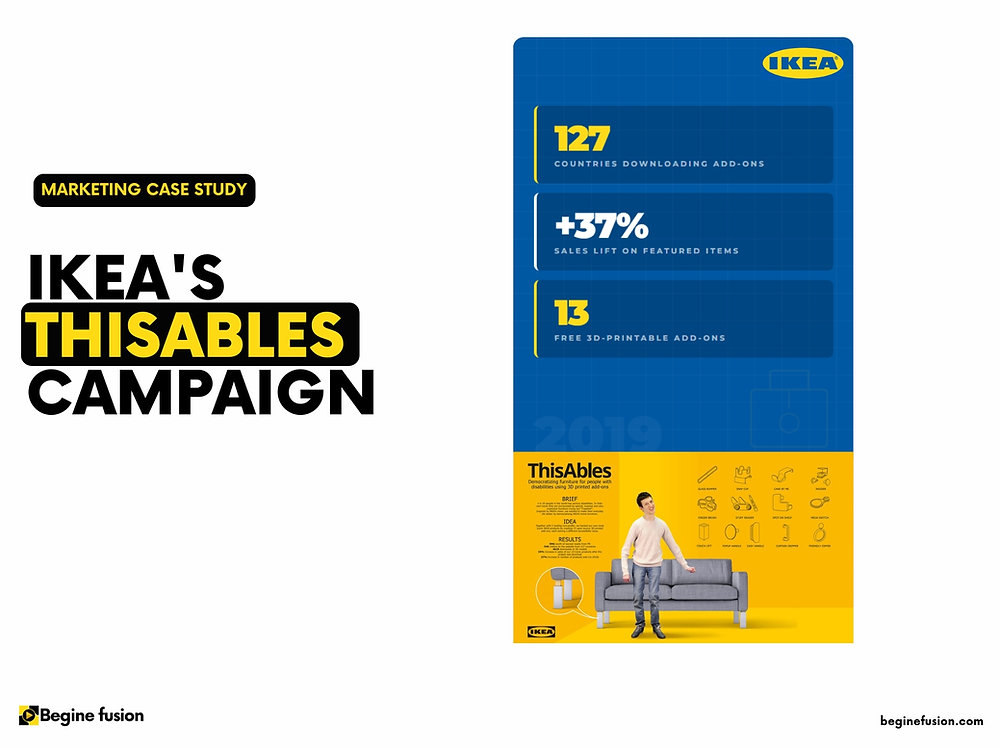
In 2019, IKEA Israel launched a collection of 13 free, 3D-printable furniture add-ons that made their products accessible to people with disabilities generating downloads in 127 countries, a 37% sales lift on adapted products, and a Cannes Grand Prix.
Table of Content
- Summary
- Background
- Problem Identification
- Objectives
- Strategy
- Technology Integration
- Implementation
- User Experience
- Results
- Challenges and Solutions
- Key Takeaways
Summary
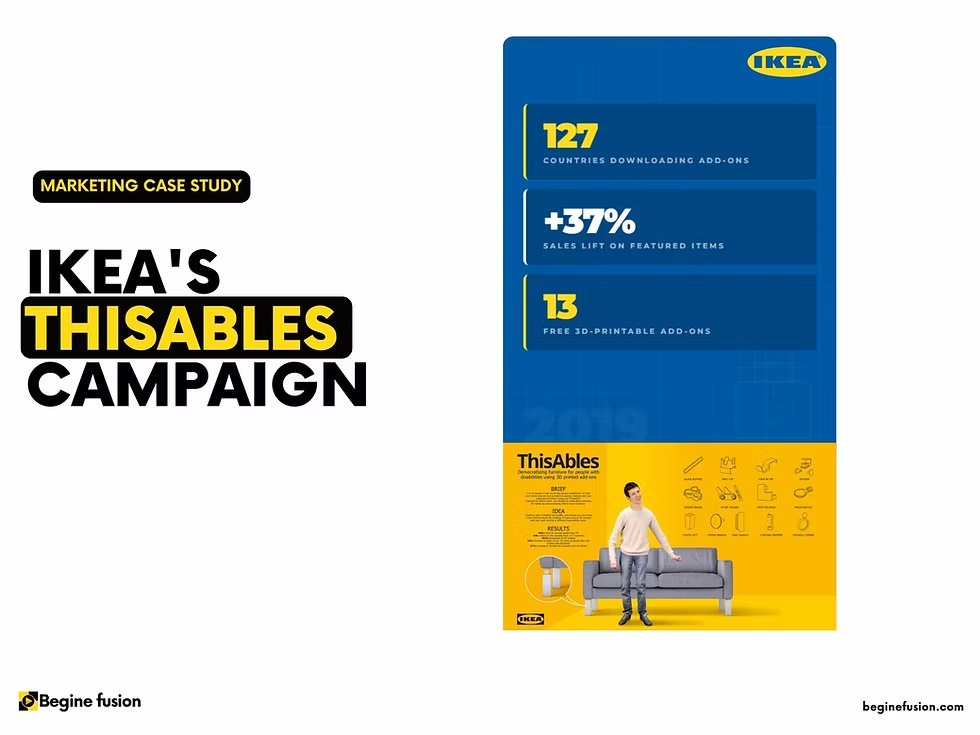
In March 2019, IKEA Israel launched “ThisAbles” a collection of 13 free, downloadable 3D-printable add-ons designed to make IKEA furniture more accessible to people with disabilities. Developed in partnership with accessibility organizations Milbat and Access Israel, the add-ons included easy-grip handles for wardrobes, oversized light switch extensions, walking stick holders for beds, and more. The files were distributed as free STL downloads, available to anyone with access to a 3D printer worldwide. The campaign won the Cannes Lions Grand Prix for Health and Wellness, generated downloads in 127 countries, and increased sales of adapted products by 37% proving that inclusive design can be both morally right and commercially powerful.
Background
IKEA’s mission to create a better everyday life for the many people had a significant blind spot. Despite being the world’s largest furniture retailer, IKEA’s products were designed for a generalized “average” user, leaving millions of people with disabilities unable to use standard furniture without modifications. Simple tasks like opening a wardrobe, turning on a lamp, or getting into bed required adaptations that were expensive, custom-made, or unavailable. The gap between IKEA’s democratic design philosophy and the reality of accessibility presented both a moral obligation and a business opportunity.
Problem Identification
- IKEA’s mass-market furniture was inaccessible to people with various disabilities mobility impairments, limited grip strength, visual impairments, and more
- Custom accessibility modifications were expensive and often required professional assistance
- No major furniture retailer was addressing accessibility through their existing product lines
- The disability community represented a large, underserved market segment with significant spending power
Objectives
- Make IKEA furniture more accessible without requiring expensive product redesigns or new SKUs
- Demonstrate that inclusive design could drive commercial results, not just goodwill
- Build the campaign on an open-source model that empowered communities rather than creating dependency
- Generate global awareness of accessibility gaps in everyday products
Strategy
McCann Tel Aviv developed a strategy built on open design and community empowerment:
- Co-Creation with Disability Organizations: Partnered with Milbat (custom technology for people with disabilities) and Access Israel (national accessibility advocacy) to identify the most impactful modifications
- 3D-Printable Open-Source Model: Designed all add-ons as free downloadable STL files, removing cost barriers and enabling global distribution without manufacturing infrastructure
- Targeted Product Modifications: Rather than redesigning entire product lines, created small, attachable add-ons that modified existing IKEA products a capital-efficient approach
- Hackathon-Style Development: Brought together designers, engineers, and people with disabilities to co-create solutions that addressed real-world needs
- Global PR Strategy: Launched with a coordinated media push that positioned IKEA as a leader in inclusive design
Technology Integration
- 3D Printing and CAD Design: Created 13 initial designs as STL files optimized for consumer-grade 3D printers, ensuring broad accessibility
- Open File Distribution: Hosted files on a dedicated download platform with no licensing restrictions, enabling anyone worldwide to print the add-ons
- In-Store Support: IKEA Israel stores featured accessible testing sections where customers could try add-ons before downloading and printing
- Community Submission Platform: Invited the global community to suggest new designs and submit ideas, creating an expandable design library
Implementation
The campaign rolled out through a structured sequence:
- Research and Co-Design: Worked with Milbat, Access Israel, and people with disabilities to identify the highest-impact furniture modifications needed
- Hackathon Development: Brought together industrial designers, engineers, and the disability community to develop functional prototypes
- Design Optimization: Refined 13 designs for 3D-printable production, ensuring they could be printed on standard consumer printers with common materials
- Pilot Testing (IKEA Israel): Launched at Tel Aviv store with in-store accessibility sections and staff training
- Global File Release: Published free STL downloads on dedicated website, accessible from anywhere in the world
- PR Campaign: Coordinated global media outreach positioning the campaign as a breakthrough in inclusive design
- Community Expansion: Opened the platform for community-submitted design ideas to expand the library beyond the initial 13 products
User Experience
- Users visited the ThisAbles website and browsed available add-on designs matched to specific IKEA products
- Each design included clear instructions, compatible IKEA product names, and printing specifications
- Users downloaded free STL files and printed them at home, at local makerspaces, or through online 3D printing services
- Printed add-ons attached to existing IKEA furniture using simple snap-on or adhesive methods
- IKEA Israel stores provided physical demonstrations, allowing customers to test add-ons before printing
Results
The ThisAbles campaign delivered meaningful impact across commercial and social dimensions:
- Global Reach: Downloads from 127 countries far exceeding IKEA’s retail footprint
- Sales Impact: 37% increase in units sold for products with available add-ons versus the prior year
- Revenue Growth: 33% revenue increase on adapted product lines at IKEA Israel
- Product Range: 13 initial designs covering living room, bedroom, bathroom, and study furniture
- Award Recognition: Cannes Lions Grand Prix for Health and Wellness (2019); Gold at The One Show; D&AD Awards recognition
- Media Coverage: Extensive global media attention positioning IKEA as an inclusive design leader
- Community Growth: Open-source model attracted designers and accessibility advocates worldwide who contributed ideas for new designs
Challenges and Solutions
- Narrative Sensitivity: Telling stories about disability required careful attention to language, representation, and credit. The campaign centered the voices and expertise of people with disabilities and partner organizations rather than speaking for them
- 3D Printer Access: Not everyone had access to a 3D printer. IKEA addressed this by providing in-store printing support and partnering with local makerspaces and libraries that offered 3D printing services
- Design Scalability: With only 13 initial designs, the library couldn’t cover all needs. The open-source community submission model was designed to expand the collection organically over time
- Attribution and Credit: Ensuring that the disabled creators, designers, and partner organizations received proper credit alongside IKEA’s brand was essential for authenticity
Key Takeaways
- Open design can unlock new market segments: By making modifications free and open-source, IKEA didn’t just serve an underserved community they drove 37% more sales on adapted products because accessibility became a feature, not a limitation
- Modify, don’t redesign: Rather than overhauling entire product lines (expensive and slow), ThisAbles showed that small, attachable modifications can transform accessibility at a fraction of the cost
- Co-create with the communities you serve: Designing for people with disabilities without involving them would have produced inferior solutions and lacked authenticity. The partnership model was both ethically correct and practically superior
- Any product with mod-friendly design can follow this model: The concept of 3D-printable add-ons isn’t limited to furniture. Any product with standardized dimensions and attachment points electronics, vehicles, tools, clothing could adopt a similar open-source accessibility approach
- Purpose campaigns work best when they’re also good business: ThisAbles wasn’t charity it drove measurable commercial results. That commercial viability ensures sustainability and organizational buy-in for inclusive design initiatives
Sources
- Ad Age IKEA’s ThisAbles Wins Cannes Lions Grand Prix in Health and Wellness
- 3D Printing Industry IKEA Israel Launches Free 3D Printable ThisAbles
- Contagious IKEA ThisAbles Campaign Analysis
- Design Museum Q&A IKEA ThisAbles