
Case Study: Mattel & Warner Bros.' Barbie Marketing Blitz
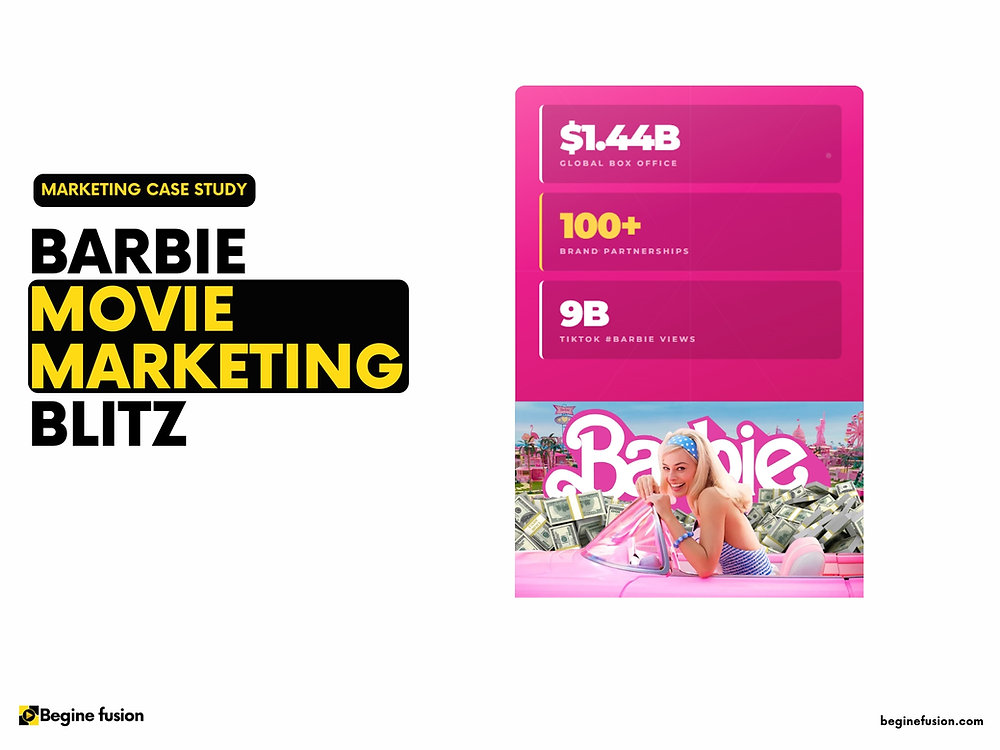
In 2023, the Barbie movie didn’t just launch it colonized pop culture with 100+ brand partnerships, $150 million in marketing spend, and a $1.44 billion global box office that made it the highest-grossing Warner Bros. film of all time.
Table of Content
- Summary
- Background
- Problem Identification
- Objectives
- Strategy
- Technology Integration
- Implementation
- User Experience
- Results
- Challenges and Solutions
- Key Takeaways
Summary
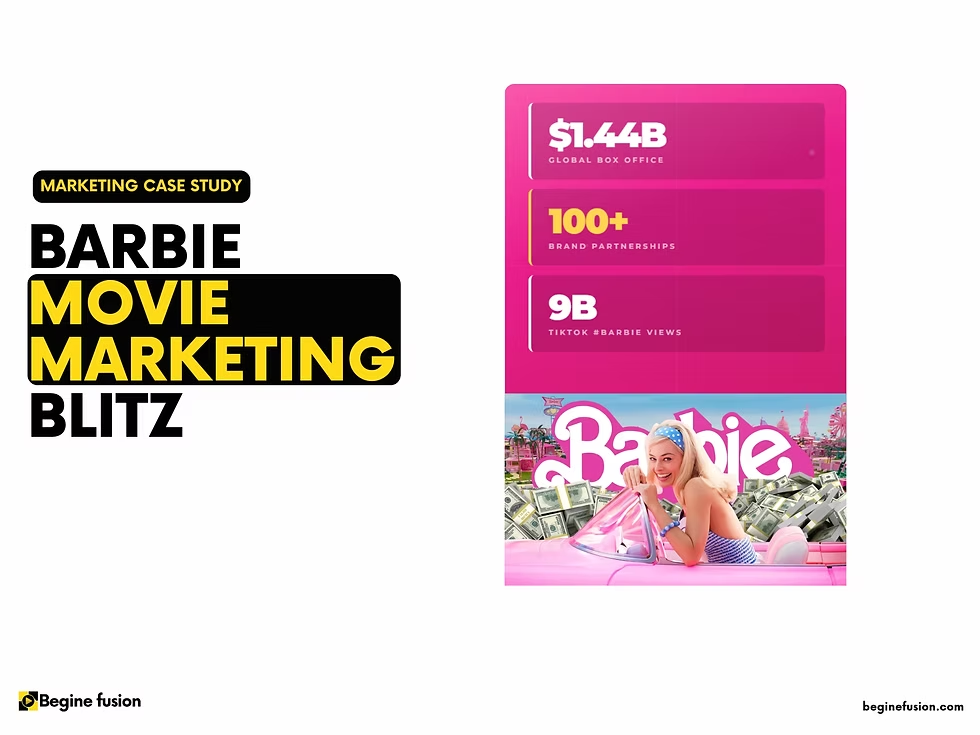
Mattel and Warner Bros. orchestrated one of the most ambitious marketing campaigns in film history for the 2023 Barbie movie. With a marketing budget of $150 million exceeding the $145 million production budget the campaign spanned 100+ brand collaborations across fashion, food, beauty, lifestyle, and tech. The strategy turned “Barbie Pink” into a cultural phenomenon, generated 9 billion TikTok views under #Barbie, and propelled the film to $1.44 billion at the global box office. The campaign demonstrated that when marketing is treated as a product in itself, it can generate returns that dwarf traditional advertising approaches.
Background
Mattel had been working for years to revitalize the Barbie brand under CEO Ynon Kreiz’s IP-driven strategy. Despite introducing more diverse body types and skin tones, the brand still struggled with relevance among Gen Z and young adult audiences who associated Barbie with outdated beauty standards. The film, directed by Greta Gerwig and starring Margot Robbie, presented an opportunity to completely redefine how a new generation perceived the brand but only if the marketing matched the ambition.
Problem Identification
- Significant relevance gap with Gen Z and young adult audiences who viewed Barbie as a relic
- Decades of criticism around unrealistic body image and beauty standards associated with the brand
- Competition for attention in an oversaturated summer movie market
- Need to appeal simultaneously to nostalgic older audiences and younger demographics unfamiliar with the brand’s cultural significance
Objectives
- Generate massive global awareness that transcended traditional movie marketing
- Drive box office performance to justify the $295 million total investment (production + marketing)
- Reposition the Barbie brand as culturally relevant, self-aware, and inclusive
- Create a marketing ecosystem so pervasive that engaging with the campaign became unavoidable
Strategy
The marketing team deployed an omnipresent, multi-channel strategy designed to make Barbie inescapable:
- Partnership Saturation: Secured 100+ brand collaborations across every consumer category fashion (Gap, Zara, Crocs), food (Burger King, Cold Stone), beauty (NYX, OPI), lifestyle (Airbnb’s Malibu Dreamhouse), and more
- Meme-Friendly Visual Identity: Designed everything around the signature Barbie Pink (#FF1493), creating instantly shareable, recognizable content
- Experiential Marketing: Built real-world activations including life-size Dreamhouse experiences, pop-up salons, and pink-themed retail installations
- User-Generated Content Engine: Released a custom poster generator (via PhotoRoom) that attracted 13+ million users, turning fans into marketers
- Strategic Teaser Placement: Debuted the trailer before Avatar: The Way of Water screenings with a 2001: A Space Odyssey music homage, generating immediate buzz
- Cross-Demographic Appeal: Balanced nostalgic elements for millennials with fresh, meme-worthy content for Gen Z
Technology Integration
- AI-Enhanced Targeting: Data-driven precision marketing to reach specific demographic segments across digital channels
- Custom Poster Generator: Partnership with PhotoRoom to create a selfie tool where users could place themselves in Barbie packaging generating 13+ million uses and massive organic reach
- Social Listening Infrastructure: Real-time monitoring of #Barbie conversations across platforms to capitalize on trending moments and adjust messaging
- Cross-Platform Analytics: Coordinated measurement across traditional media, digital, social, and experiential channels to optimize spend in real-time
Implementation
The campaign was rolled out through a carefully orchestrated timeline:
- Early Buzz (Late 2022): Released first-look images and teaser content designed for social media sharing
- Trailer Strategy (Q1 2023): Premiered trailer in high-profile theatrical settings, immediately generating meme culture
- Partnership Rollout (Q2-Q3 2023): Staggered 100+ brand collaboration announcements over months, creating continuous news cycles
- Experiential Activations (Summer 2023): Launched pop-up experiences, themed retail spaces, and the Airbnb Dreamhouse
- UGC Tools (June 2023): Released the poster generator, turning organic sharing into the campaign’s primary growth engine
- Opening Weekend (July 21, 2023): Coordinated all channels for maximum impact on release weekend, capitalizing on the “Barbenheimer” cultural moment
User Experience
- Consumers encountered Barbie-branded products across virtually every retail category during their daily lives
- The poster generator provided an interactive, shareable experience that made participation effortless
- Pink-themed retail activations created photo-worthy in-store moments that fueled social media content
- The “Barbenheimer” phenomenon the coinciding release with Oppenheimer turned moviegoing into a cultural event, with audiences dressing up and attending double features
- Brand collaborations offered accessible entry points at every price level, from Crocs to high-end fashion
Results
The Barbie marketing blitz delivered extraordinary returns across every metric:
- Box Office: $1.44 billion worldwide ($637 million domestic, $810 million international) highest-grossing film of 2023 and highest-grossing Warner Bros. film ever
- Net Profit: Approximately $421 million
- Social Media Impact: 9 billion TikTok views under #Barbie; 145% increase in #Barbie hashtag usage across TikTok, YouTube, and Instagram Reels in H1 2023
- UGC Engagement: 13+ million users created custom posters via the PhotoRoom generator
- Awards: Oscar win for Best Original Song (Billie Eilish); 8 total Oscar nominations; 6 Critics’ Choice Awards; Golden Globe for Cinematic and Box Office Achievement
- Brand Repositioning: Successfully shifted Barbie’s image from nostalgia brand to cultural force among younger audiences
Challenges and Solutions
- Body Image Criticism: Despite the brand’s evolution, critics argued the film didn’t fully address decades of body image concerns. The marketing team leaned into the film’s self-aware, feminist messaging to acknowledge the brand’s complicated history honestly
- Partnership Saturation Risk: With 100+ collaborations, there was real danger of brand dilution and consumer fatigue. The team staggered announcements over months and ensured each partnership offered something unique
- Capitalism Contradiction: The film’s anti-consumerist themes clashed with the massive merchandise push. Marketing embraced the irony rather than hiding from it
- Award Season Controversies: Director Greta Gerwig and star Margot Robbie were notably absent from key Oscar nominations, generating industry backlash. The team used the controversy to extend the cultural conversation
Key Takeaways
- Treat marketing as a product: The Barbie marketing campaign wasn’t supporting the film it was its own cultural product that people wanted to engage with independently
- Design for remixing: Every element of the campaign the pink aesthetic, the poster generator, the brand collaborations was designed to be shared, remixed, and personalized
- Saturate strategically: Omnipresence works when each touchpoint offers something different. Repetition without variation creates fatigue; repetition with variety creates cultural dominance
- Lean into contradictions: Rather than avoiding the tension between Barbie’s commercial nature and the film’s feminist messaging, the campaign embraced the complexity and audiences responded
- Cultural timing is a multiplier: The unplanned “Barbenheimer” moment showed that campaigns that tap into cultural energy get exponentially more return than those that fight for attention alone
Sources
- Variety Barbie Marketing Campaign Explained
- Box Office Mojo Barbie (2023)
- Marketing Brew Counting the Many Barbie Collabs
- Deadline Barbie Movie Profits