
The Future of AI Datacenters Is in Orbit
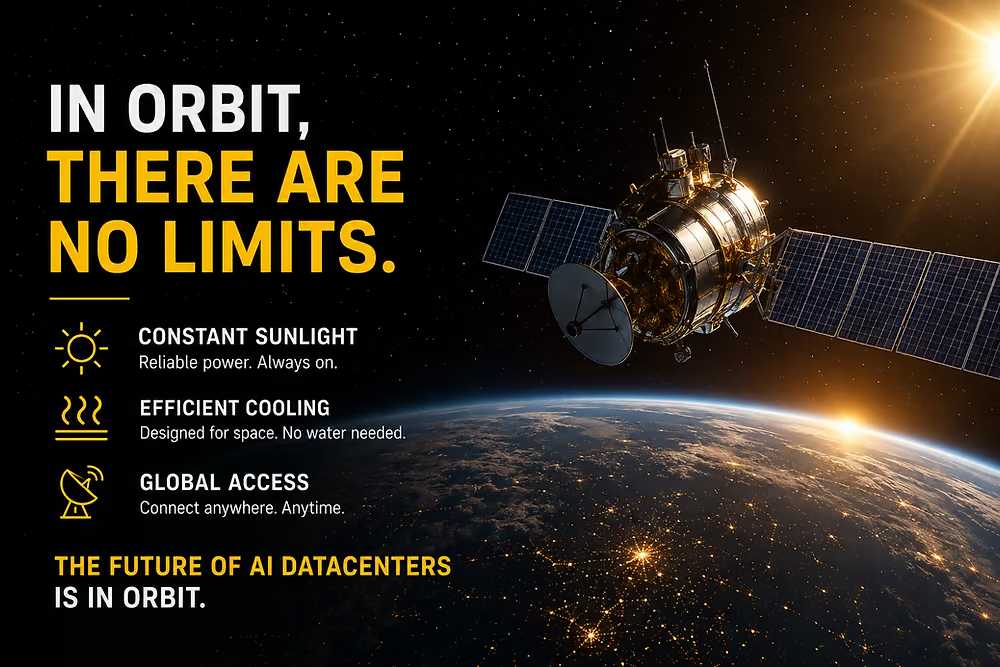
That sentence reads like science fiction until you look at what already launched. In November 2025, Starcloud sent Starcloud-1 into orbit aboard a SpaceX Falcon 9. The satellite carried an NVIDIA H100 GPU, the first deployment of datacenter-class GPU compute outside the atmosphere. Starcloud later ran a version of Google’s Gemma model in orbit and trained nanoGPT on the satellite. The company has stated Starcloud-2 will use multiple H100 GPUs alongside NVIDIA Blackwell B200 chips. Starcloud-3 is being designed for SpaceX Starship-class deployment.
Treat this as the first signal. The category exists now. The remaining questions are which workloads move first, who controls the infrastructure, and how fast the economics improve.
Why AI Infrastructure Is Hitting a Wall on the Ground
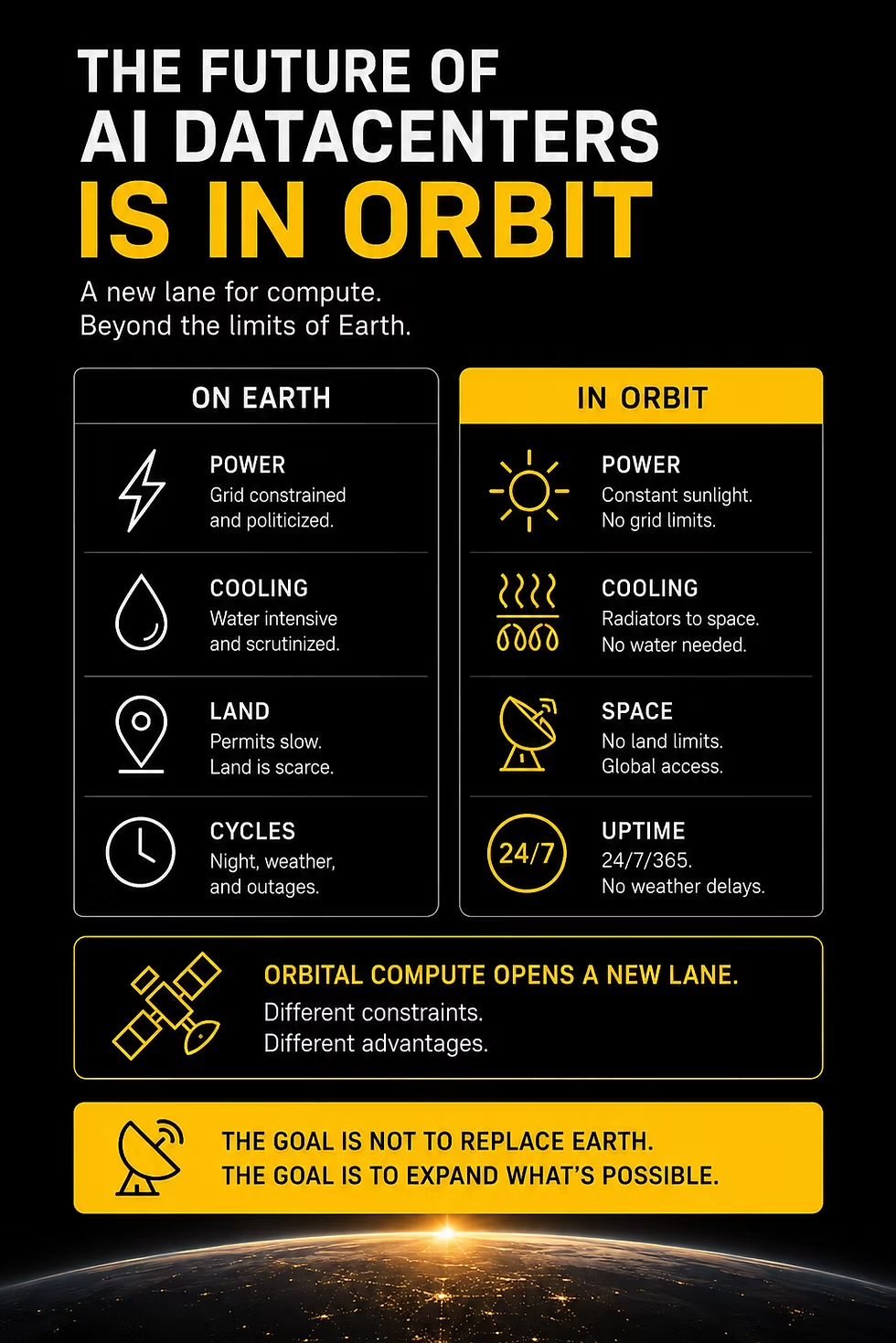
AI training and inference need three things at scale: power, cooling, and physical land near grid capacity. All three are getting harder to source on Earth.
Hyperscalers are competing for energy contracts. Several U.S. utilities have signalled that new datacenter capacity is constrained by transmission capacity, not only generation. Water use from cooling is drawing political scrutiny in regions like Arizona, Virginia, and parts of Ireland. Permitting timelines for greenfield datacenter sites are extending. Real estate near substations is being repriced as a strategic asset.
Earth-based datacenters will keep scaling. The question is whether every workload should compete for that same constrained supply.
What Orbital Datacenters Actually Offer
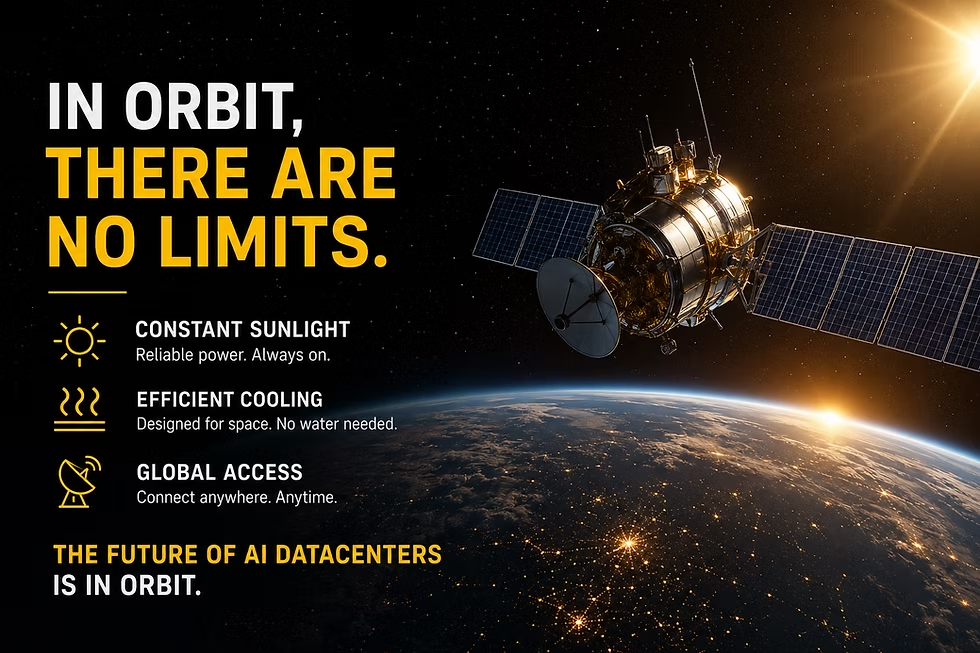
A satellite in the right orbit sits in constant sunlight. Solar input is uninterrupted by weather, night cycles, or grid politics. That changes the energy equation for compute that can tolerate the operating constraints of space.
Heat is rejected through radiators directly to space rather than chilled by mechanical cooling. The thermal model is different and in some ways simpler, though it brings its own engineering challenges.
Orbital compute opens a new lane alongside ground-based compute. It changes the cost stack by removing local water draw, grid dependence, and land competition. The tradeoffs are different. The category is different.
A satellite in the right orbit sits in constant sunlight. Solar input is uninterrupted by weather, night cycles, or grid politics. That changes the energy equation for compute that can tolerate the operating constraints of space.
What Starcloud Actually Proved
Three things matter from the Starcloud-1 mission.
- A datacenter-class GPU survived launch and operated in orbit. A modern language model ran inference in space. A training run completed in space.
- Those are small workloads. The H100 in orbit is one chip, not a cluster. Gemma is a small model. NanoGPT is a teaching-scale architecture. The demonstrated operational envelope is what matters here. The next missions can scale from there.
- Treat Starcloud-1 as the same kind of moment that the first commercial cloud workloads represented two decades ago. The infrastructure existed before it scaled. The scale came once the unit economics moved.
Where Orbital AI Compute Starts
Orbital compute begins with specialized workloads. The economics do not yet support mainstream AI training there. The entry workloads share one trait: they tolerate the operating constraints of space or benefit from being there.
Space-based data processing. Earth observation satellites generate enormous data volumes. Downlinking everything to ground stations creates bandwidth bottlenecks and delays. Processing imagery in orbit and sending only the results back changes the bandwidth profile.
Defense and intelligence workloads. Sovereign compute in orbit is attractive to defense agencies that already operate space assets. Latency to ground stations is acceptable for many of these workloads.
Research compute. Universities and national labs running latency-tolerant simulations may find orbital capacity useful as it becomes available.
Latency-tolerant AI jobs. Batch inference, model fine-tuning on archived data, and long-running training jobs do not need millisecond round trips to a user.
These are the entry workloads. They are narrow, specialized, and tied to use cases where orbital constraints are acceptable or advantageous.
The Hard Problems
Mainstream AI training in orbit faces problems that remain open.
Launch cost. SpaceX Falcon 9 and the maturing Starship program have driven cost per kilogram down. Moving hundreds of tonnes of compute hardware to orbit is still expensive compared to building a datacenter in Iowa.
**Maintenance.**Hardware failures in low Earth orbit must be designed around with redundancy and remote management. There is no field technician rebooting a rack at 3 a.m.
Radiation hardening. Consumer-grade silicon experiences single-event upsets from cosmic rays. Datacenter GPUs were built for clean rooms, not orbital radiation. Shielding adds mass. Software-level error correction adds overhead.
Thermal design. Radiative cooling works at small scale. High-density GPU clusters generate heat loads that have not been demonstrated in orbit.
Bandwidth and latency. Optical inter-satellite links and ground-to-orbit bandwidth are improving. They are not yet at the level required for large-scale data movement.
Cybersecurity. A satellite is a hard-to-patch endpoint with a long mission life. The attack surface is real.
Orbital debris. More satellites mean more collision risk. The Kessler problem is a regulatory and operational constraint, not a marketing one.
Regulation. Frequency allocation, orbital slots, export controls on advanced chips, and cross-border data sovereignty all apply.
Capital intensity. Building and launching orbital compute is more capital-intensive per unit of compute than building a ground-based facility, at least for now.
Anyone selling this category as solved is selling something else.
Who Is Connected to This Shift
This is an infrastructure stack story. Several sectors are positioned for direct participation.
Launch providers.
- SpaceX is the dominant player. Rocket Lab, Blue Origin, and Relativity Space are positioning to capture share. Cost per kilogram is the gating variable.
Satellite manufacturers.
- Companies designing larger satellites capable of hosting compute clusters become infrastructure providers, not only communications vendors.
AI chip companies.
- NVIDIA is already in orbit through Starcloud. AMD, custom silicon vendors, and radiation-hardened chip suppliers will compete for the next generation of designs.
Cloud providers.
- AWS, Microsoft, and Google have all signalled interest in space-adjacent compute. None has flown a GPU datacenter yet. That gap is the strategic opening.
Edge computing firms.
- Orbital compute is, in one framing, the most remote edge node ever deployed. The architecture patterns overlap.
Cybersecurity companies.
- Securing distributed, hard-to-reach compute nodes is a category that will need to mature alongside the hardware.
Space infrastructure firms.
- Companies building in-orbit servicing, refueling, and assembly capabilities become enablers of larger orbital compute clusters.
The Investor and Strategy Angle
The AI infrastructure story has been told mostly through chips and models. The next chapter is about where compute lives, how it is powered, and who controls the location.
Energy access is becoming a competitive asset. Grid capacity in specific geographies is becoming a competitive asset. Orbital position may become a competitive asset within a decade.
For investors, the questions worth asking:
Which launch providers will own the cost curve?
Which satellite manufacturers can host datacenter-class payloads?
Which chip designs survive the radiation and thermal environment?
Which cloud providers acquire or partner with orbital compute startups first?
Which sovereign customers anchor early commercial demand?
For technology strategists, the question is which workloads in the portfolio will be cheaper or more strategic to run in orbit five to ten years from now, and what that implies for vendor selection today.
A Realistic Timeline
2025 to 2027: Prototype missions and specialized workloads. Single-chip and small-cluster demonstrations. Earth observation processing, defense pilots, and research workloads. Starcloud-2 and Starcloud-3 fall in this window if schedules hold.
**2028 to 2032:**Early commercial orbital compute services become possible if launch costs continue to fall, thermal management scales, and bandwidth improves. Specialized providers may begin offering compute-as-a-service for narrow use cases.
**2035 and beyond:**Larger orbital compute clusters may become part of the global AI infrastructure stack, sitting alongside ground-based hyperscale datacenters. Mainstream training running in orbit at scale is a projection, not a forecast.
These are scenarios. Each band depends on several variables that are still in motion.
The Strategic Takeaway
AI infrastructure is moving beyond traditional datacenters. Starcloud’s orbital H100 mission proves the shift has already begun. The question is which workloads move first, who controls the infrastructure, and how fast the economics improve.
Treat orbital compute the way early hyperscale cloud was treated in 2007: a real category, narrow, and growing. The companies that build position in the launch, satellite, chip, and edge layers now will be the ones offering products in 2030. The companies waiting for the category to become obvious will buy capacity from them.
The infrastructure stack is getting taller.