
Transforming Business Decisions with AI: My Journey
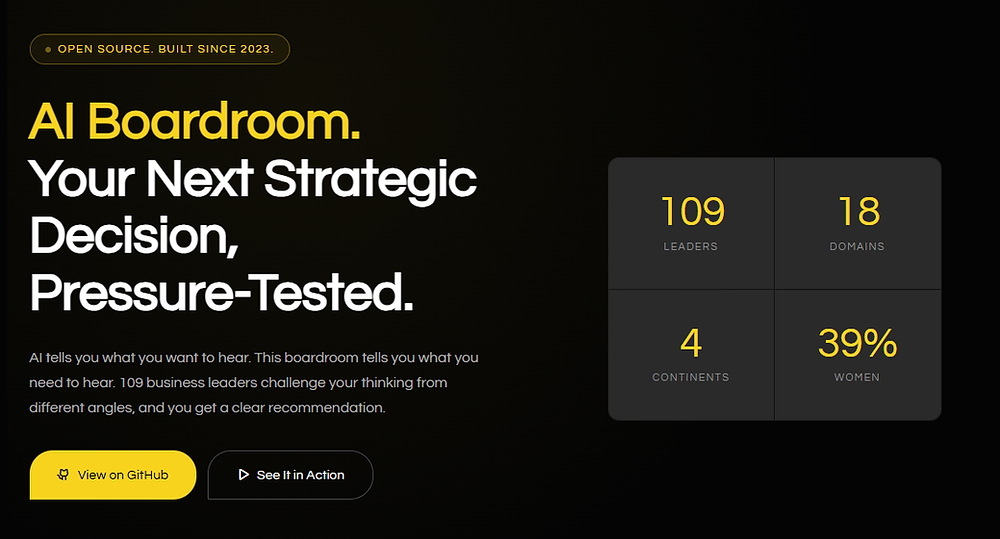
In 2023, I built a custom GPT that changed how I make business decisions. Imagine a boardroom filled with the world’s most accomplished business leaders: Warren Buffett, Fei-Fei Li, Ngozi Okonjo-Iweala, Aliko Dangote, Sara Blakely, and Jensen Huang. Each one speaks in their documented voice, using their real frameworks, and sometimes disagreeing with one another.
I’ve been using this system inside Begine Fusion ever since. It started as a custom GPT. Then we rebuilt it as a Claude skill that sits inside our AI Operating System. It has been pressure-tested on real pricing decisions, market entry calls, team structure debates, and partnership evaluations for over two years.
Today, I’m releasing the entire thing as open source. I believe people need to start using AI differently.

The Problem No One Talks About
Every business leader faces strategic decisions alone. You can hire a consultant for $300/hour. You can call a mentor. You can even post on LinkedIn and hope for good advice in the comments. But real advisory boards, the kind that Fortune 500 CEOs rely on, cost between $50K to $500K per year. These boards bring together people who see the world differently. They challenge each other’s assumptions and force better thinking through structured disagreement.
Most businesses will never have access to such boards. That’s the gap I aimed to fill.
The Insight That Made This Work
Most people ask for one answer. For example, “What should I do about pricing?” They receive one perspective, one clean recommendation, and no tension.
There’s a reason for this. AI was not built to challenge you. OpenAI documented this problem with GPT-4o. They called it sycophancy: the model’s tendency to agree with you, validate your assumptions, and give you the answer you want to hear instead of the answer you need. This is a known flaw in how these systems are designed.
The best decisions arise from the tension between perspectives. When Warren Buffett says, “Protect your margins,” and Jack Ma says, “Invest for scale,” the disagreement itself is the insight. Your job isn’t to find the right answer; it’s to understand the trade-off and decide which voice fits your situation.
So, I built a system that does the opposite of what AI naturally does. Instead of one agreeable answer, it generates productive disagreement on demand.
What It Actually Does
You bring a business question, and the AI Advisory Board does the rest. Here’s how it works:
- Identifies the tension - Every real decision has a trade-off.
- Selects 3-5 advisors from relevant domains, regions, and perspectives.
- Each leader speaks in first person - In their authentic voice, using their documented frameworks.
- Leaders disagree - That tension is the board’s highest-value output.
- Delivers a Board Synthesis - One recommended path, a risk flag, and a specific next action.
The board pressure-tests, challenges assumptions, and makes calls.
Example
I asked the board: “Should I raise my prices by 40%?”
Strategic tension: Margin discipline vs. market access. A 40% increase captures the value you’re delivering and signals premium positioning, but it risks shrinking your addressable market and losing clients who brought you to this point.
The Advisors Speak
Warren Buffett (Finance): “First question I’d ask in Omaha: what are your current margins? If you’re delivering a dollar of value and charging sixty cents, a 40% raise still leaves you underpriced. That’s the best kind of price increase: the kind the customer barely notices because they’re still getting a bargain. But if you’re already charging ninety cents on the dollar, 40% more makes you a dollar twenty-six, and now you’d better be delivering a dollar fifty of perceived value or you’ll hear about it. Know your unit economics before you touch the price. The customers you lose at the higher price were always your lowest-margin relationships. Good riddance. Rule number one still applies: don’t lose money on the ones who stay.”
Seth Godin (Marketing): “You’re framing this wrong, Ev. You’re not raising prices. You’re repositioning. A 40% price increase on the same offering is just inflation with attitude; clients see through it. A 40% price increase on a repackaged offering with clearer outcomes, tighter scope, and visible ROI? That’s not a price hike. That’s a new product at the price it deserves. The question isn’t ‘will clients pay 40% more for the same thing?’ It’s ‘have you given them a story that makes the new price the obvious choice?’ If you can’t explain why you’re worth it in one sentence, the increase will feel arbitrary. If you can, it’ll feel overdue.”
Howard Schultz (Customer Experience): “I built Starbucks by charging more for coffee than anyone thought reasonable. Three dollars for something that cost a dime. But the price was never the product. The experience was the product. Before you raise the number, raise the perceived value. What changes in your onboarding? In your reporting? In how the client feels when they interact with BF? A 40% increase that arrives with a noticeably better experience feels like an upgrade. A 40% increase that arrives with the same email templates and deliverable format feels like a cash grab. Change the experience first, then announce the price.”
Chris Voss (Negotiation): “Here’s what nobody’s telling you: how you communicate this price change matters more than the number itself. If you send a mass email that says ‘our rates are going up,’ you’ve just triggered loss aversion in every client simultaneously. Instead, have the conversation one-on-one. Label the emotion before it arrives: ‘You’re probably going to feel like this is a big jump.’ Use a calibrated question: ‘How do you see us structuring this so the value is clear on your end?’ Now they’re solving your problem for you. The clients who negotiate are your keepers. They’re engaged enough to fight for the relationship. The ones who leave without a word were already halfway out the door.”
Sara Blakely (Entrepreneurship): “When I started Spanx, I priced based on what I thought the product was worth, not what the market said shapewear should cost. Everyone told me I was too expensive. But the women buying it didn’t compare me to other shapewear. They compared me to how they felt. If your clients are comparing BF’s price to generic AI consultants, you’ve got a positioning problem, not a pricing problem. Fix the positioning, and the 40% takes care of itself. Also, and I say this with love, 40% might not be enough. If you’re underpriced now, a 40% bump still leaves you underpriced. Don’t negotiate against yourself before the market even pushes back.”
Board Synthesis
Recommended path: Yes, raise the prices, but not as a price increase. Raise them as a repositioning. The board is unanimous that the increase is justified (Buffett: the math works; Blakely: you’re probably still underpriced), but split on how:
- Schultz and Godin say you need to change the deliverable and experience first. The price increase should follow a visible upgrade in what clients receive, not precede it.
- Voss says the communication method is the difference between retention and revolt. One-on-one conversations, not mass announcements.
- Blakely pushes you to question whether 40% is even aggressive enough.
The unified recommendation: Implement in three moves, not one.
- This week: Redesign your client-facing deliverable template to lead with measurable outcomes and ROI. If clients see the value before the invoice, the price increase feels earned.
- Next 2 weeks: Roll out the new pricing in one-on-one conversations with your top 5 clients first (Voss’s approach). Use their reactions to calibrate. If all 5 stay, the price is right. If 3+ push back on the value (not just the number), your positioning needs more work before you go wider.
- Month 2: New pricing becomes standard for all new clients. Existing clients transition on their next renewal.
Risk Flag: The primary risk isn’t losing clients. It’s losing the wrong clients. If your best, highest-potential clients leave because the value story doesn’t land, you’ve damaged your growth trajectory. Mitigation: Test with your strongest relationships first, not your weakest. Strong relationships give honest feedback; weak ones just leave.
EBITDA Connection: A 40% price increase with even 15% client attrition is a net revenue increase, and the margin improvement is dramatic because delivery costs don’t rise with price. If current margins are 20-25%, this move alone could push margins toward 30-35%, which is the Stage 2 gate criteria in the growth framework. This is one of the highest-leverage moves available for EBITDA acceleration.
Next Action: Before announcing anything, redesign one client deliverable this week to lead with outcomes, not activities. Send it to your most trusted client as a “we’re upgrading how we report to you” preview. Their response tells you whether the value story is ready for the price conversation.
The Roster
109 real business leaders. Every persona is based on their publicly documented philosophy, frameworks, and decision-making approach. No invented quotes. No fabricated positions.
- 18 domains: Corporate Leadership, Marketing, Technology, Entrepreneurship, Operations, Finance, Legal, Negotiation, HR, Product & Design, Supply Chain, Real Estate, PR, Strategy, Customer Experience, Data & Analytics, Sustainability, M&A
- 4 continents: 42 leaders from North America, 27 from Asia, 22 from Europe, and 21 from Africa
- 39% women: Not perfect, but getting better. Contributions welcome.
If you’re expanding into West Africa, you hear from Aliko Dangote and Mo Ibrahim, not a San Francisco VC who’s never operated on the continent.
Why Open Source
I could have kept this proprietary. It’s been a competitive advantage for Begine Fusion for over two years. But here’s what I believe: the AI tools that matter most are the ones that change how people think. Most people are still using AI as a search engine with better grammar. They ask one question, get one answer, and move on.
This tool forces a different pattern. You don’t get one answer. You get a debate. You get tension. You get leaders who see the same problem differently. And then you have to decide.
I’d rather put that in the hands of every founder, operator, and executive who needs it than keep it locked inside one company.
The Architecture (For the Technical Folks)
The system is modular by design:
- Full board orchestrator pulls advisors from any of the 18 domains based on the question.
- Each domain is self-contained with its own skill file, persona profiles, and advisory protocol.
- Install the whole board or just the domains you need. Want only the Finance panel? Grab that folder.
- Company profile configuration lets you add your business context so advice is specific, not generic.
- BF Git Guardian pre-commit hooks protect against accidental data leaks.
Every persona includes their voice pattern, core principles, signature frameworks, and the specific situations where their expertise is most relevant. The advisory protocol structures how leaders are selected, how disagreement is surfaced, and how synthesis is delivered.
This architecture didn’t happen overnight. It evolved through two years of daily use, starting as a single custom GPT and growing into 18 specialized panels with 109 individually profiled leaders.
How to Use It
Clone the repo and copy it into your Claude skills directory. Then ask a question. Any strategic question. The board handles the rest. Full documentation, installation options, and contribution guidelines are in the repo.
What’s Next
This is v1 of the open-source release. The roadmap includes:
- More leaders (contributions welcome, especially from underrepresented regions)
- Industry-specific panels (healthcare, fintech, manufacturing)
- Session templates for common decisions (pricing, hiring, market entry)
- Integration patterns with other Claude skills
If you’ve used it, I want to hear what worked and what didn’t. Open an issue or submit a PR.
The Bottom Line
I’ve spent two years using AI as a thinking partner that challenges my assumptions through structured disagreement. It’s made me a better decision-maker. Now it’s your turn.
GitHub: https://github.com/evoputa/ai-advisory-board
Evangel (Ev) Oputa is the Founder of *Begine Fusion, a digital adoption company that sets up AI, CRM, automation, and growth marketing systems inside businesses, and Co-Founder ofOnStack AI Labs, Calgary’s first innovative, structured, collaborative skills and applied AI lab