
The AI Reality Curve: Where Your Organization Stands
Between 2023 and mid-2025, organizations invested an estimated $30-40 billion into enterprise AI. According to MIT, 95% of those pilots delivered zero measurable return. The technology wasn’t the problem. The approach was.
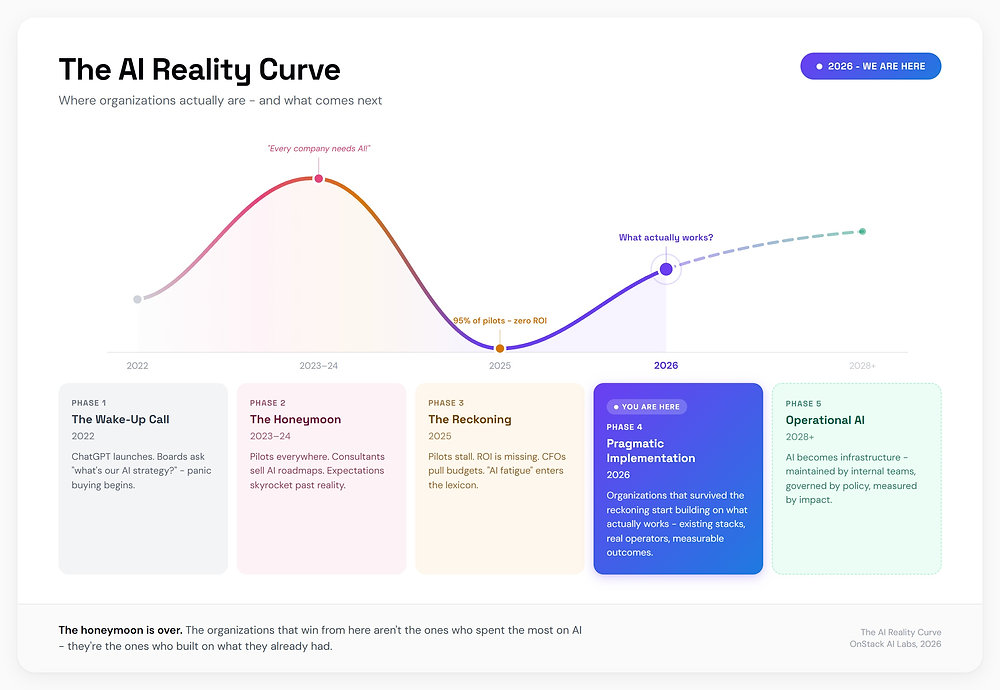
The AI Reality Curve is a framework developed by OnStack AI Labs to map what organizations actually experienced across five phases of AI adoption, where most organizations are stuck today, and what separates the companies that will succeed from here from the ones that won’t.

What Is the AI Reality Curve?
The AI Reality Curve tracks organizational experience with AI across five distinct phases: The Wake-Up Call (2022), The Honeymoon (2023-24), The Reckoning (2025), Pragmatic Implementation (2026), and Operational AI (2028+).
Unlike the Gartner Hype Cycle, which tracks market perception of a technology’s maturity, the AI Reality Curve focuses on what happens inside the organization. It answers a different question: not “where is AI as a technology?” but “where is my company in its relationship with AI, and what should we do next?”
Gartner placed generative AI into the “Trough of Disillusionment” in their 2025 Hype Cycle for AI, confirming the broader market pattern. But “trough of disillusionment” doesn’t give an operations leader a playbook. The AI Reality Curve does.
Here’s what each phase looks like, why it happened, and what it means.
Phase 1: The Wake-Up Call (2022)
In November 2022, ChatGPT launched. Within two months it reached 100 million users, making it the fastest-growing consumer application in history at that point.
Overnight, every board, executive team, and operations meeting included the same question: what’s our AI strategy?
Most organizations didn’t have one. AI had been a niche concern for data science teams and R&D departments. Now it was front-page news and leadership wanted answers.
What defined Phase 1:
This wasn’t about implementation. It was about awareness. The technology arrived in a form that non-technical people could understand, and the pressure to respond was immediate. Organizations started attending webinars, hiring consultants, and asking their IT teams to “look into it.”
The Phase 1 mistake: Treating urgency as a strategy. Awareness is necessary, but the organizations that moved fastest from “we should do something” to “we’re buying something” often made the worst investments, because they skipped the step of understanding what problem AI was supposed to solve for their specific operation.
Phase 2: The Honeymoon (2023-24)
With urgency came spending. AI consulting firms (many newly rebranded from general digital transformation shops) sold roadmaps, strategies, and pilot programs to organizations desperate not to fall behind.
The market exploded. Every software vendor added “AI-powered” to their product description. Conferences sold out. The demos were impressive.
Three dynamics set up the failure that followed:
Expectations decoupled from reality. Leadership teams watched ChatGPT write an essay in 10 seconds and extrapolated that to “AI will transform our operations in 90 days.” The gap between what AI can do in a demo and what AI can do inside a regulated enterprise workflow is enormous, and almost nobody was talking about that gap during the Honeymoon.
Pilots multiplied without success criteria. Organizations launched AI pilots because they felt they had to, not because they’d identified specific operational problems. MIT’s research found that large enterprises took an average of nine months to move any pilot to scale. Mid-market firms moved faster, averaging 90 days, because they had less bureaucracy and tighter scopes.
Budgets targeted the wrong areas. According to the MIT NANDA study, more than half of enterprise AI budgets went to sales and marketing tools. The biggest returns, however, came from back-office automation: document review, procurement workflows, and reducing external agency spend. Organizations invested in what was visible to the board, not in what moved the needle operationally.
The Honeymoon felt productive. Pilots were launching, vendors were pitching, teams were excited. But beneath the surface, the foundations for failure were already set.
Phase 3: The Reckoning (2025)
Then came the correction.
By mid-2025, CFOs started asking the question that should have been asked in 2023: where’s the ROI?
The MIT NANDA study, published in July 2025, put a number to what many had already suspected. Based on 300+ AI deployments, 52 organizational interviews, and 153 senior leader surveys, the study found that 95% of enterprise AI pilots delivered zero measurable impact on the bottom line.
Context matters here. The study defined success narrowly: deployment beyond pilot phase with measurable P&L impact within six months. Critics, including researchers at UC Berkeley, argued this timeframe is too short and the definition too rigid. Some AI investments create value through cost avoidance, team capability building, or process understanding that surfaces over a longer horizon.
Both things can be true. The stat may overstate failure, and the broader pattern is still real. S&P Global’s 2025 survey of over 1,000 enterprises found that 42% of companies abandoned most of their AI initiatives that year, up from 17% in 2024. RAND Corporation’s analysis placed the overall AI project failure rate at over 80%, roughly twice the failure rate of non-AI IT projects.
The shadow AI economy emerged. Perhaps the most telling finding from the MIT study: while only 40% of companies had official enterprise AI subscriptions, over 90% of employees reported using personal AI tools like ChatGPT for work tasks daily. The enterprise AI strategy was failing, but AI itself was working fine for individuals who found their own use cases.
What the Reckoning taught:
The organizations that paid attention during Phase 3 learned the critical lesson: the failure was never the technology. It was the approach. Generic tools bolted onto complex workflows without integration, governance, or operator training will fail regardless of how capable the underlying model is.
The real cause of failure, across every major study, comes down to three things: poor workflow integration, misaligned investment priorities, and no clear success criteria tied to business outcomes.
Phase 4: Pragmatic Implementation (2026) - Where We Are Now
This is where we are today. And this phase is fundamentally different from everything that came before.
The organizations entering Phase 4 aren’t the ones that spent the most on AI during the Honeymoon. They’re the ones that learned the most during the Reckoning. They stopped chasing AI for its own sake and started asking a different question: what actually works?
In 2023, Gartner projected that over 80% of enterprises would have AI in production by 2026. By 2025, Gartner’s updated outlook projected that 95% of enterprises would be using generative AI APIs or deployed applications by 2028, a timeline that reflects how much longer the path to production has taken than initially expected.
Three patterns define Phase 4 organizations:
Pattern 1: Start with the operation, not the technology
Instead of “where can we use AI?”, Phase 4 organizations ask “what operational problem costs us the most time, money, or risk?” Then they evaluate whether AI is the right tool, or whether simpler automation, a process change, or a system integration would solve it faster.
This means some AI projects never get built, because the problem didn’t require AI. That’s a feature, not a bug.
Pattern 2: Build on existing infrastructure
The MIT study found that AI tools built by specialized external vendors succeeded about 67% of the time, while internal builds succeeded roughly 33%. The tools that succeeded were designed to fit into existing workflows, not replace them.
Phase 4 organizations aren’t ripping out their ERP, CRM, or document management systems. They’re layering capability onto what they already have. They’re asking: what data do we already collect? What systems are in place? What integrates without a rebuild?
At OnStack AI Labs, we call this the stack-first approach: your existing technology stack isn’t a limitation, it’s the foundation. AI implementations that respect existing infrastructure and operator capabilities consistently outperform projects that require organizations to adopt entirely new platforms.
Pattern 3: Design for the operator, not the executive
The Honeymoon was defined by AI projects that looked great in board presentations but failed in daily operations. Phase 4 reverses that priority. The question isn’t “will this impress leadership?” It’s “can the person who uses this every day actually operate, maintain, and explain it?”
This means governance from day one. Training the team who’ll run the system, not just the team who approved the budget. Building AI that operators can maintain independently, without creating permanent vendor dependency.
Phase 5: Operational AI (2028+)
Phase 5 is where the curve eventually leads, though most organizations aren’t there yet. In this phase, AI stops being a special initiative and becomes infrastructure, like cloud computing or email.
In Phase 5 organizations, AI is maintained by internal teams with the skills to manage it. It’s governed by policy frameworks tested and refined during earlier phases. And it’s measured by operational impact, not by the novelty of the technology.
Deloitte’s 2026 State of AI report found that only 34% of organizations are using AI to deeply transform their operations, while another third are still using it at a surface level with little process change. The decisions made in Phase 4 determine whether an organization ever reaches Phase 5.
Where Does Your Organization Stand?
Be honest. Which of these sounds like your situation?
Still in Phase 2 (The Honeymoon): You’re running AI pilots without clear success metrics. Your AI vendor promises transformation but hasn’t delivered measurable results. Your team is excited about demos, but nobody has asked who operates this system after go-live.
Still in Phase 3 (The Reckoning): You tried AI and it underperformed. Budget’s been pulled back. There’s skepticism across leadership. Employees are quietly using ChatGPT on their personal accounts. Nobody wants to propose another AI initiative.
Entering Phase 4 (Pragmatic Implementation): You’ve identified specific operational problems. You’re evaluating AI alongside other solutions, not assuming AI is the answer. You’re asking about integration with existing systems, operator training, and governance.
If you’re stuck in Phase 3, the worst move is to stay there. AI isn’t going away. Your competitors, your customers, and your industry are all moving toward Phase 4 whether you participate or not. The Reckoning taught real lessons. The question is whether you apply them.
If you’re entering Phase 4, the biggest risk is repeating the Honeymoon playbook with slightly more caution. The approach needs to fundamentally change: start with operations, build on your stack, design for operators, and govern from day one.
The Data Behind the AI Reality Curve
| Source | Finding | Year |
|---|---|---|
| MIT NANDA Study | 95% of enterprise AI pilots delivered zero measurable P&L impact | 2025 |
| S&P Global | 42% of companies abandoned most AI initiatives (up from 17% in 2024) | 2025 |
| RAND Corporation | Over 80% of AI projects fail, 2x the rate of non-AI IT projects | 2025 |
| Gartner | GenAI entered “Trough of Disillusionment” in 2025 Hype Cycle | 2025 |
| Gartner | Predicts 60% of AI projects unsupported by AI-ready data will be abandoned through 2026 | 2025 |
| MIT NANDA | Vendor-built AI tools succeed ~67% of the time vs. ~33% for internal builds | 2025 |
| MIT NANDA | Back-office automation delivers highest ROI, despite majority of budgets going to sales/marketing | 2025 |
| Deloitte | Only 34% of organizations using AI for deep operational transformation | 2026 |
Frequently Asked Questions
What is the AI Reality Curve? The AI Reality Curve is a five-phase framework developed by OnStack AI Labs that maps the actual organizational experience with AI adoption from 2022 to 2028+. Unlike the Gartner Hype Cycle, which tracks market perception, the AI Reality Curve focuses on what happens inside the organization and provides actionable guidance for each phase.
Why do most enterprise AI projects fail? According to research from MIT, RAND Corporation, and S&P Global, the primary causes of AI project failure are poor workflow integration, misaligned investment priorities (spending on high-visibility projects rather than high-ROI operations), and a lack of clear success criteria tied to business outcomes. The failure is in the approach, not the technology.
What phase of AI adoption are most organizations in during 2026? Most organizations are transitioning between Phase 3 (The Reckoning) and Phase 4 (Pragmatic Implementation). They’ve experienced the disappointment of failed pilots and are now evaluating how to approach AI differently, with tighter scopes, clearer metrics, and builds that integrate with existing infrastructure.
What is the stack-first approach to AI implementation? The stack-first approach means building AI capabilities on top of an organization’s existing technology infrastructure rather than requiring platform replacements or major overhauls. It assesses what systems, data, and team capabilities already exist, then identifies where AI integrates cleanly to deliver measurable value. Organizations using this approach consistently see higher adoption rates and faster time to production.
How does the AI Reality Curve differ from the Gartner Hype Cycle? The Gartner Hype Cycle tracks market perception and expectation of a technology across its maturity lifecycle. The AI Reality Curve tracks the internal organizational experience: what teams actually went through, where budgets went, what failed, and what’s working now. It’s designed for operations leaders making implementation decisions, not analysts tracking technology markets.
Is it too late to start AI implementation in 2026? No. Phase 4 (Pragmatic Implementation) is the most favorable time to begin, because the lessons from earlier phases are well-documented, vendor tools have matured, and the approach has shifted from hype-driven experimentation to operations-first implementation. Organizations starting now can avoid the costly mistakes of the Honeymoon and Reckoning phases entirely.
What Comes Next
The AI Reality Curve isn’t a prediction. It’s a map of what actually happened, what’s happening now, and what the data says comes next.
The organizations that will define Phase 4 aren’t the ones with the biggest AI budgets. They’re the ones with the clearest understanding of their own operations, the discipline to build on what they already have, and the honesty to deploy AI only where it creates measurable value.
Not more AI. Better AI. Built on real infrastructure, operated by real teams, measured by real outcomes.
The honeymoon is over. The work starts now.
OnStack AI Labs is Calgary’s applied AI research lab. We help mid-market organizations implement AI on their existing infrastructure through structuredassessment,strategy,implementation, andongoing support.
Ready to find out where your organization sits on the AI Reality Curve?
Attend an Awareness Session - 60 minutes, no pitch, just an honest assessment of whether AI makes sense for your operation.
Book a Readiness Workshop - A half-day structured workshop that maps your tech stack, assesses your AI maturity, and delivers a 90-day implementation roadmap.
Talk to Our Team - Have a specific question? We are happy to talk.
OnStack AI Labs - A QA Enterprises & Begine Fusion venture.