
AI for Client Onboarding: Sort the Gates by What You Can Undo
Onboarding is the part of professional services work that everybody agrees is too slow and nobody wants to touch, because the slow parts are the ones that protect the firm.
TL;DR
- Onboarding is six gates: conflicts, identity and background, scope, engagement terms, data collection, system setup.
- Sort them by reversibility. A wrong folder is fixed in a minute. Acting on a conflicted matter cannot be undone by correcting a record.
- Search is not the decision. AI can surface every possible conflict and still leave the judgement about whether it is one to a person.
- Most of the delay is not in the risky gates. It is in chasing documents, rekeying the same information and waiting for a template.
- Collect once. Clients notice being asked for the same thing three times more than they notice the total elapsed days.
- Assist the preparation, hold the decision. That line is what keeps a faster process from becoming a riskier one.
Six gates, and one you cannot undo
Onboarding gets described as a single process with a start and an end, which hides the thing that matters. It is a sequence of gates, each answering a different question, and they carry very different consequences when they go wrong.
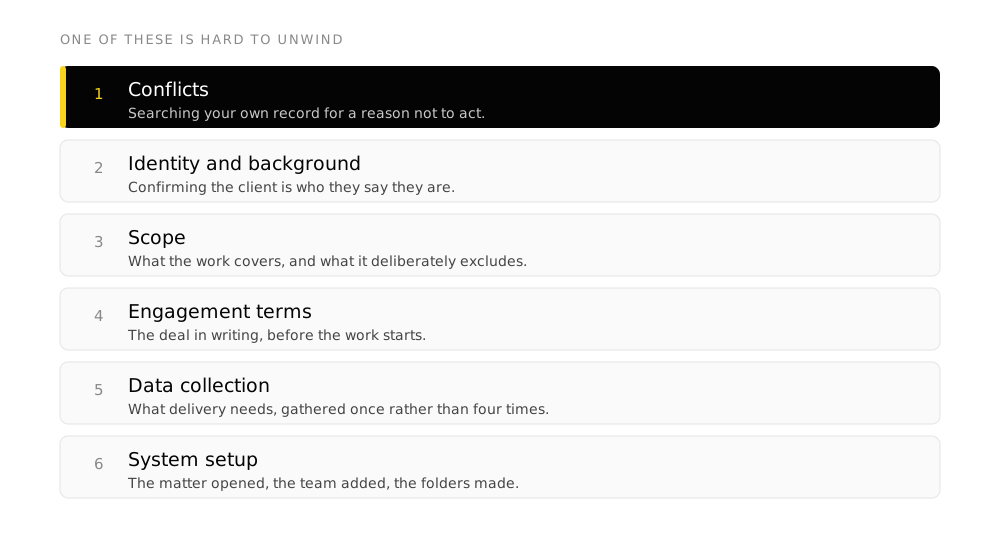
Run the reversibility test across them and the picture changes. If system setup is wrong, somebody fixes a folder. If data collection is incomplete, somebody sends another email. If scope is loose, there is an awkward conversation in month two and possibly a variation.
If the conflicts gate is wrong, the firm has acted against an interest it was obliged to protect. That is not corrected by updating a record, and depending on the profession it can end the engagement, require withdrawal, and expose the firm to a complaint. The same asymmetry applies to client identity in the professions where verification is a legal obligation rather than a preference.
That is the sorting principle. Not how complicated a gate is, and not how long it takes. What happens when it is wrong and nobody notices for three months.
Where AI belongs inside a gate
The useful distinction is not between gates that may use AI and gates that may not. It is between the preparation inside a gate and the decision at the end of it.
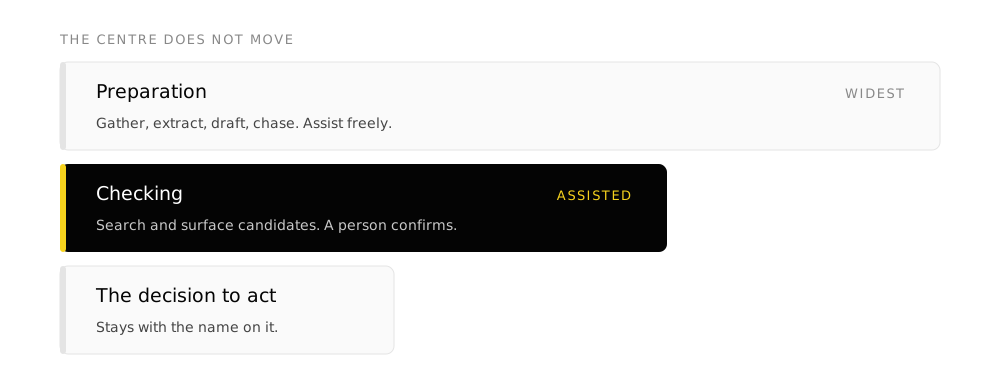
Take conflicts. The search is a genuinely hard information problem: the same company appears under four spellings, a subsidiary relationship is not recorded anywhere, a former client’s directors now sit on the board of the prospect. Searching across the firm’s whole history with tolerance for those variations is exactly what a machine is better at than a person working through a name list.
The judgement that follows is a different act. Whether a surfaced match is a conflict depends on the nature of the past work, what the firm learned, what the client would reasonably expect, and the rule that governs your profession. That is a professional decision, and it stays with the professional.
So AI raises the number of candidates a firm sees and does not reduce the number of decisions it makes. Firms that expect the opposite are usually disappointed, and the ones that get it right treat a longer candidate list as the benefit rather than the cost.
Worth keeping
- Assist preparation freely, confirm checking with a person, and never move the decision itself.
- A better search produces more candidates to clear. Resource the clearing, or the gate gets slower.
- Record what was searched and what was decided. The record is the point of the gate, not a by-product.
Where the delay actually is
Firms assume onboarding is slow because of the risky gates. It is usually slow somewhere much more ordinary.
The single largest source of elapsed time in most firms. A request goes out, nothing comes back, somebody remembers a week later. Automated follow-up with a clear list of what remains outstanding addresses this without touching any professional judgement.
Client details arrive in an email, get typed into an intake form, typed again into the engagement letter, and typed a third time into the practice system. Extracting once and reusing removes both the delay and the transcription errors nobody finds until later.
The engagement letter has to be adapted, so it sits in a queue behind other work. Drafting from the agreed scope produces something for review immediately, which changes the wait from days to the length of one review.
Different people request overlapping information because no one holds the whole list. A single record of what has been asked and answered fixes the client's experience even when the total time is unchanged.
The team starting the work asks the client things onboarding already collected. Structuring what was gathered so delivery can use it is unglamorous and is what makes the client feel the firm is organised.
None of that is a professional judgement. All of it is administrative, and it is where a firm can move quickly without changing its risk position at all.
A client does not experience your onboarding as a number of days. They experience it as how many times they were asked for something they had already sent.
A sequence that works
-
Map your gates and mark the irreversible ones
Write down the gates as your firm actually runs them, then mark each one with what happens if it is wrong and goes unnoticed. The marks matter more than the map, and they tend to disagree with where the effort currently goes.
-
Fix collection before anything else
One list of what is needed, one request, one place the client sends it, automated follow-up on what is outstanding. This removes the largest block of elapsed time and touches none of the professional decisions.
-
Extract once, reuse everywhere
Pull the details out of what the client sent and populate the intake record, the engagement letter draft and the system setup from that one extraction. Have a person verify the extraction once rather than retyping it three times.
-
Improve the conflicts search, keep the conflicts decision
Widen what gets searched and how tolerant the matching is, then present candidates with the context needed to clear them. Expect more candidates and plan for the clearing time. Record the search and the reasoning behind each decision.
-
Hand over structured, not raw
Give the delivery team what was collected in a form they can use, so the first client conversation is about the work. This is the step most often skipped and the one clients notice.
Steps two, three and five carry no professional risk and account for most of the delay. That is the case for doing them first, ahead of the gate everyone wants to talk about.
Common mistakes
- Automating the conflicts decision because the search got good. Why it fails: the search finds candidates, and whether a candidate is a conflict depends on professional rules and firm context that are not in the data. Better: automate the search, present the context, keep the decision with a named professional.
- Treating client identity verification as a document-reading task. Why it fails: where verification is a legal obligation, the obligation is on the firm and is not discharged by a system reading a passport image. Better: check what your profession and jurisdiction actually require before changing this gate at all.
- Speeding up intake without resourcing the clearing. Why it fails: a wider search surfaces more candidates, and if nobody is assigned to clear them the queue becomes the new delay. Better: plan the clearing capacity as part of the change.
- Generating engagement terms without a review. Why it fails: engagement terms define scope, liability and fees, and a plausible draft that omits a limitation is worse than a slow one. Better: draft automatically, review deliberately, and keep a named approver.
- Collecting more because collection got easier. Why it fails: every extra field is data the firm now holds, protects and may have to justify. Better: collect what delivery needs and stop.
- Leaving no record of what was checked. Why it fails: the gate exists to be evidenced later, and a fast process with no audit trail has removed the thing it was for. Better: record what was searched, what was found and who decided, as part of the workflow rather than afterwards.
What this article does not claim
It does not claim any figure for onboarding time reduction. The numbers that circulate come from vendor material, so none is published here.
It does not state what any professional-conduct rule requires. Conflicts, client identity and engagement terms are governed by rules that differ by profession, regulator and province, and this article says only that those duties exist and are yours to check.
It does not claim any tool satisfies an obligation. The obligation attaches to the firm and the professional, and software does not carry it.
- Onboarding
- Everything between deciding to act for a client and being able to start the work, including the checks that decide whether the firm may act at all.
- Conflicts check
- A search of the firm's own history for relationships or past work that would prevent it acting, or that require consent before it can.
- Client identity verification
- Confirming a client is who they claim to be, which in several professions is a legal obligation with prescribed steps rather than a matter of firm policy.
- Engagement terms
- The written record of what the firm will do, on what basis, at what price, with what limitations.
- Scope
- What the work covers and, more usefully, what it deliberately excludes.
- Matter or engagement opening
- Creating the record the work will be delivered and billed against, once the gates have been cleared.
- Reversibility
- Whether a mistake can be corrected after it is discovered, which is the property that should decide how much human control a step keeps.
- Extraction
- Pulling structured details out of documents a client has already sent, so the same information is not requested or retyped again.
Questions firms ask
Can AI run our conflicts check?
It can run the search, and searching is the part it is genuinely good at, including name variations and relationships a manual check would miss. Deciding whether a match is a conflict is a professional judgement governed by your own rules, and it stays with a person.
What is the fastest safe improvement?
Collection. One list, one request, one destination, automated follow-up on what is outstanding. It removes the largest block of elapsed time and changes none of the professional decisions.
Is it safe to draft engagement letters automatically?
Drafting is fine and reviewing is not optional. These documents set scope and liability, and a fluent draft with a missing limitation is a real exposure. Keep a named approver on every one.
How does this connect to financial services onboarding?
The gate structure is the same, and regulated firms have additional obligations around client information gathering that are set by their regulator. If you are a registered firm, read AI use cases in investment management for where those lines sit.
Will faster onboarding increase our risk?
Only if speed comes from the irreversible gates. Taking days out of chasing and rekeying leaves the risk position unchanged. That is the reason to sort by reversibility before choosing what to change.
What should we record?
What was searched, what was found, who decided and on what basis. The record is what the gate is for, and it needs to be produced by the process rather than reconstructed later.
Where does the firm archive come into it?
Conflicts searching and engagement drafting both read the firm's own history, so they inherit whatever signal that history carries. See AI for knowledge management for what has to be true of the archive first.