
AI for Proposal Development: Hand Over the Assembly, Keep the Argument
Every proposal starts the same way. Somebody asks whether there is a similar one from last year, finds three, picks the one that looks closest, and begins deleting another client’s name from it.
TL;DR
- Proposal effort splits into assembly and argument. Assembly is finding, adapting and reformatting. Argument is what actually gets read.
- Assembly consumes most of the hours and decides almost none of the outcome.
- Four parts reuse very differently. Credentials reuse safely, methodology reuses as a skeleton, pricing does not reuse, and the client's problem never does.
- The part most often copied is the one that cannot be. A recycled understanding of the client is the most visible failure in a proposal.
- Generation without a current archive produces confident, stale claims, including credentials that are no longer true.
- The gain is time moved, not time saved. Hours come out of assembly and go into the argument, and that is what changes results.
Two kinds of proposal work
Watch where the hours go on a competitive proposal and they divide cleanly.
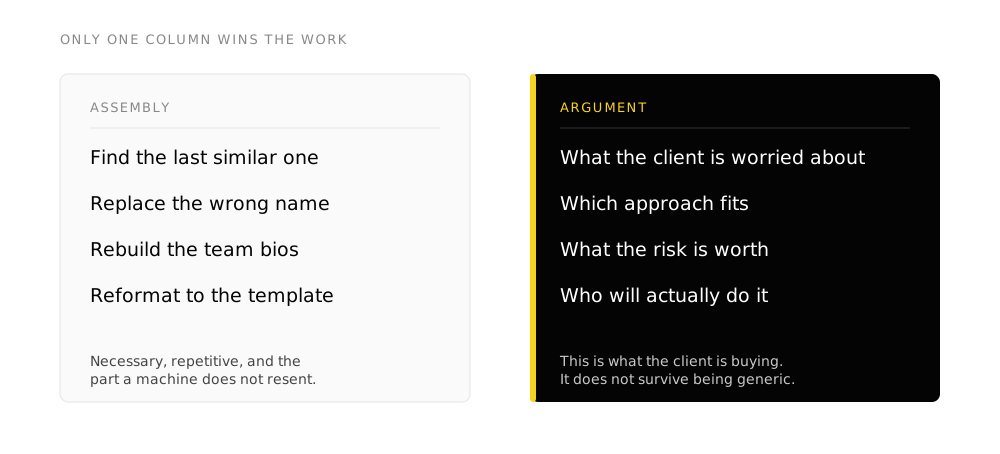
The uncomfortable pattern is the order. Assembly happens first because it is concrete and somebody can start it immediately. The argument happens last, after the document exists, usually the evening before submission, by the senior person with the least time. The part that decides the outcome gets whatever is left.
That is the case for handing assembly over. Assembly matters, and doing it first, by hand, every time, systematically starves the thinking.
What reuses and what does not
Firms treat reuse as a single idea, which is why proposals drift toward generic. The parts behave differently.
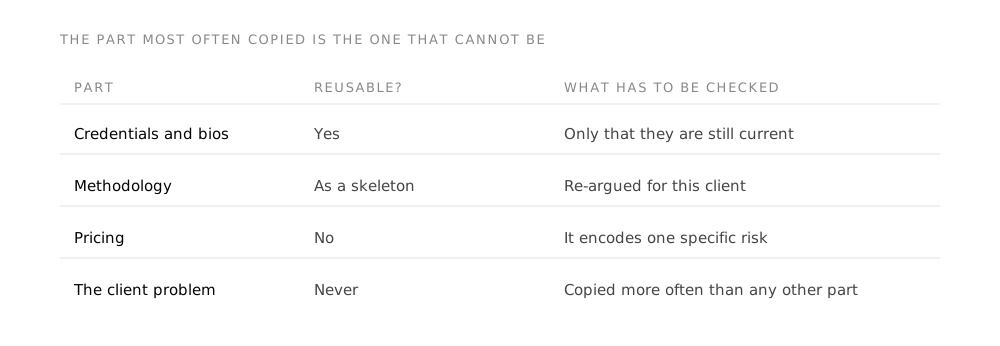
Credentials and biographies reuse safely and still need a currency check. The relevant risk is quiet: a project description that predates a change in what the team can claim, or a biography for somebody who left. Both read fine and both are wrong.
Methodology reuses as a skeleton. The stages of how your firm approaches this kind of work are stable. Why those stages fit this client’s situation is not, and a methodology section that could be sent to any client tells the reader you have not thought about theirs.
Pricing does not reuse. A price encodes an assumption about a specific risk, a specific scope and a specific client’s behaviour. Copying a number from a similar engagement copies assumptions nobody restated.
The client’s problem never reuses, and it is copied more often than anything else, because it is the hardest section to write and the easiest to fill with something adjacent. A client reading their own situation described in someone else’s terms notices immediately, and everything after that paragraph gets read with suspicion.
Worth keeping
- Decide the reuse rule per section, not per document. A single rule produces generic proposals.
- Currency checking is the cheapest control in the whole process and the one most often missing.
- If a section could go to any client in your sector unchanged, it is not doing work in your proposal.
Where AI helps
Locating the genuinely comparable proposal rather than the one somebody happens to remember. This is retrieval, and it depends entirely on whether the archive can say which version is current.
Pulling credentials, biographies and the methodology skeleton into a draft in the current template, with the fields that need updating marked rather than silently carried over.
Reading the request document and confirming that every stated requirement has a response somewhere. Firms lose on completeness more often than they expect, and this check is mechanical.
Finding the previous client's name, a stale date, a role that no longer exists or a currency that does not match. These are the errors that cost credibility out of proportion to their size.
The short version, the summary for a procurement portal, the presentation for the meeting. This is real effort that adds no argument, and it is well suited to being generated from an approved document.
Every one of those is assembly. That is the point. The list is not a limitation on what AI can do, it is a description of where the value is, because the argument is the part the client is paying to receive.
What the client is actually buying
A proposal is a claim that you understand a specific situation and can be trusted with it. That claim is made in a few places: how you describe the problem, which approach you chose and why, what you priced the risk at, and who is going to do the work.
A proposal that reads as though it could have been sent to anybody has answered a question the client did not ask.
None of those four is retrievable, because none of them exists before somebody thinks about this client. Generation can produce something that occupies the space and reads well, which is exactly why the failure is dangerous. A blank section gets noticed internally. A fluent, generic section gets submitted.
So the control worth building is not a review of grammar or formatting. It is a named person confirming that the problem statement and the approach are specific to this client, before the document goes out.
A sequence that works
-
Fix the reusable library, not the whole archive
Credentials, biographies, methodology skeletons, standard terms. A small set, each with an owner and a review date. This is the same work as any knowledge base, scoped to what proposals consume.
-
Generate the assembly draft early
Produce the structural document at the start rather than the end, with the argument sections empty and clearly marked as such. The empty sections are the feature, because they make visible how much thinking is still owed.
-
Spend the reclaimed time on the argument
The hours removed from assembly have to go somewhere deliberate. If they are absorbed by taking on more proposals, the win rate will not move and the process will feel busier.
-
Run two checks before submission
A mechanical check for completeness, stale details and leftover names. Then a human check that the problem statement and the approach could not be sent to another client. The second check is the one that matters and it takes ten minutes.
Step three is where firms lose the benefit. Assembly time is easy to measure and easy to reclaim. If nobody decides where it goes, it goes into volume, and the firm produces more generic proposals slightly faster.
Common mistakes
- Generating the whole proposal. Why it fails: the sections that decide the outcome are the ones no system can produce, and a fluent version of them is harder to catch than a blank one. Better: generate assembly, leave argument sections empty and marked.
- Reusing pricing from a similar engagement. Why it fails: a price carries assumptions about scope and risk that nobody restated when it was copied. Better: price the risk in front of you, using past engagements as evidence rather than as an answer.
- Skipping the currency check on credentials. Why it fails: outdated project claims and biographies for departed staff read perfectly and are wrong, and they are exactly what a client verifies. Better: give the credential library an owner and an annual review.
- Letting reclaimed hours turn into more proposals. Why it fails: volume without better argument lowers the average quality of what you submit. Better: decide in advance that the time goes into the argument, and check that it did.
- Treating the request document as a formality. Why it fails: firms lose on unanswered requirements more often than on weak arguments, and the check is mechanical. Better: automate the completeness check and run it before the final review, not after.
- Building on an archive nobody trusts. Why it fails: retrieval surfaces whichever version looks closest, and if the archive cannot mark the current one, the draft starts from a superseded document. Better: fix the small reusable library first.
What this article does not claim
It does not claim a win-rate improvement, a turnaround reduction or an hours-saved figure. Those numbers circulate widely in this subject and trace back to vendor material, so none is published here.
It claims the effort should move from assembly to argument. The length of the document is a separate question and this article leaves it alone.
It does not name a tool. The split between assembly and argument is a property of the work, and it holds regardless of what produces the document.
- Proposal
- A document offering to do specific work for a specific client, usually in competition, and usually read by people who did not write the request.
- Assembly
- Finding, adapting, formatting and checking the parts of a proposal that already exist somewhere in the firm.
- Argument
- The reasoning specific to this client: what their problem is, which approach fits, what the risk is worth and who will do the work.
- Credential
- A description of relevant past work used as evidence of capability, which needs a currency check because its truth changes over time.
- Methodology skeleton
- The stable sequence of how a firm approaches a type of work, reusable as structure and requiring a fresh explanation of fit.
- Boilerplate
- Standard language reused across proposals, safe where it is administrative and damaging where it stands in for thinking.
- Completeness check
- Confirming every stated requirement in the request has a corresponding response, a mechanical step that decides more outcomes than firms expect.
- Win rate
- The share of submitted proposals that convert, which moves with the quality of the argument rather than the speed of the assembly.
Questions firms ask
Can AI write our proposals?
It can produce the assembly, which is most of the pages and little of the value. The problem statement, the choice of approach, the pricing and the team are specific to a client and to a judgement your firm is making, and generating them produces something plausible rather than something true.
What is the single highest-value check?
A person confirming that the problem statement and the approach could not be sent to a different client unchanged. It takes minutes and it catches the failure that costs the most.
Why do our proposals drift generic when we reuse more?
Because one reuse rule is being applied to four different kinds of content. Credentials reuse safely, methodology reuses as structure, pricing does not reuse, and the client's problem never does. Set the rule per section.
Should we tell clients AI was involved?
Check any disclosure duty in your profession and in the request document itself, since some procurement processes ask directly. Regardless of that, a named person is putting their firm behind the claims, and that is what the client is relying on.
Where do we start if our archive is a mess?
With the small library proposals actually consume: credentials, biographies, methodology skeletons, standard terms. That is a week of work. See AI for knowledge management for how to mark the current version.
How do we know it is working?
The argument sections get written earlier and by the right people. If the only change is that documents appear faster, the time has gone into volume rather than into thinking.
Does this apply to renewals and internal proposals?
The split holds, and the balance shifts. With an existing client, more of the credentials work is already done and the argument is about what changed, which is still not reusable from anywhere.