
How Nonprofits Can Use AI to Amplify Mission on Any Budget
How Can I Use AI in Nonprofit ?
Nonprofits operate under a constraint that most businesses do not face: every dollar spent on operations is a dollar not spent on mission. That tension between administrative necessity and mission delivery defines every resource allocation decision in the sector. When a development director spends 20 hours writing a grant application, that is 20 hours not spent building donor relationships. When a program manager manually compiles impact reports, that is time not spent improving programs.
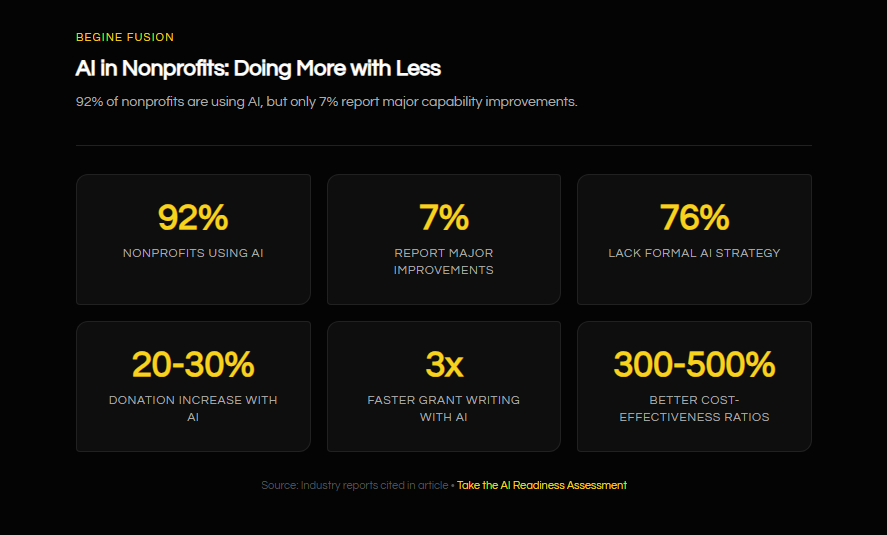
AI changes this equation in ways that are particularly relevant to resource-constrained organizations. Virtuous and Fundraising.AI surveyed 346 nonprofits in late 2025 and found 92% using AI in some capacity. Fast Forward’s 2025 AI for Humanity Report puts internal operations use at 82%. The impact gap is the more useful number: only 7% of the Virtuous respondents report major improvements in their ability to achieve their mission, and TechSoup and Tapp Network found that only 24% of nonprofits have a formal AI strategy across more than 1,300 respondents. Most nonprofits are experimenting with AI without a clear plan for how it connects to their mission objectives.
This guide covers the specific AI applications that deliver measurable results for nonprofit organizations, the real numbers behind each one, and a practical framework for prioritizing AI investments when every dollar has to justify itself against mission impact.
Fundraising and Donor Engagement
Fundraising is where AI delivers the most immediate financial return for nonprofits, and it is where the data is clearest. More than 30% of nonprofits reported increased fundraising revenue in the past year after adopting AI tools. Organizations using AI for fundraising see 20-30% increases in donations through predictive analytics, personalized outreach, and automated engagement strategies.
The technology works across the entire donor lifecycle. At the prospecting stage, AI analyzes publicly available data, giving patterns, and wealth indicators to identify individuals most likely to give and most likely to give at specific levels. Currently, 13% of nonprofits use predictive AI software for donor prospecting, which means 87% are still relying on manual research and gut instinct to identify potential major donors.
For existing donors, AI personalizes communication at a scale that manual processes cannot achieve. Instead of sending the same appeal to every donor, AI segments your donor base by giving history, engagement patterns, communication preferences, and affinity indicators to generate messages that resonate with each segment. The difference between a generic appeal and a personalized one is measurable in response rates: personalized fundraising communications consistently outperform generic ones by 15-25% in both open rates and gift conversion.
Donor retention is where AI’s predictive capability matters most. AI models analyze donor behavior signals (declining engagement, reduced giving frequency, changes in communication response patterns) to identify donors at risk of lapsing before they actually lapse. Intervening with a personalized re-engagement strategy before a donor is lost is dramatically cheaper and more effective than trying to reacquire lapsed donors.
From the donor perspective, acceptance is high: 67% of online donors agree that nonprofits should use AI to assist in marketing, fundraising, and administrative tasks. Donors are not opposed to AI; they are opposed to impersonal, irrelevant communications, which is exactly what AI helps eliminate.
For organizations evaluating where to start, the fundraising application has the most straightforward ROI calculation. Compare your current donor acquisition cost, retention rate, and average gift size against the cost of AI fundraising tools (typically $200-2,000 per month depending on organization size and tool sophistication). Most organizations see positive ROI within the first quarter.
Grant Writing and Proposal Development
Grant writing consumes an enormous amount of staff time in most nonprofits. A single federal grant application can require 40-80 hours of staff time. Foundation proposals, while shorter, still require 8-20 hours each when you account for research, writing, budget preparation, and review cycles. Multiply that by the 20-50 grant applications a mid-size nonprofit submits annually, and grant writing becomes one of the largest time investments in the organization.
AI grant writing tools have matured significantly. TechSoup and Tapp Network found that 24.6% of nonprofits use AI for grant writing. The saving comes from where the tool sits in the process: identifying grant opportunities that match your programs, extracting requirements from RFP documents, drafting narrative sections based on your program data and outcomes, generating budget justifications, and compiling supporting documentation. Your grant writer starts from a populated draft rather than a blank page, and the research and formatting work that normally front-loads a proposal is already done.
The quality question is important. AI-generated grant narratives require human review and editing. The AI produces a strong first draft that captures program details, aligns with funder priorities, and follows the required format. The human grant writer then refines the narrative voice, adds detailed programmatic details, and ensures the proposal tells a compelling story. This workflow is dramatically faster than writing from scratch while maintaining the quality that competitive grants require.
For organizations that cannot afford dedicated grant writing staff, AI tools democratize access to grant funding. A program director who understands the work but is not a professional writer can use AI to produce a competitive first draft, then refine it. This reduces the barrier to pursuing grant funding that smaller organizations often face.
The broader content creation impact extends beyond grants. The same AI tools that assist with grant writing also help with donor communications, annual reports, impact stories, newsletter content, and social media posts. Fast Forward found grant writing and content creation to be the top internal use of AI at 77%, ahead of data analysis at 59% and donor engagement at 58%.
Administrative Operations and Efficiency
Administrative overhead is the metric that nonprofit boards, donors, and watchdog organizations scrutinize most closely. AI’s most important contribution to nonprofits may be its ability to reduce administrative costs while improving the quality of administrative functions.
The time savings are substantial: organizations typically see 15-20 hours weekly saved on administrative tasks through AI implementation. For a nonprofit with five administrative staff, that is the equivalent of gaining a half-time employee without any additional salary cost. AI resolves support tickets 52% faster compared to organizations without AI tools.
Specific administrative applications include automated data entry and CRM updates (reducing the manual work of logging donor interactions, volunteer hours, and program participation), intelligent scheduling for staff and volunteers, automated financial reconciliation and reporting, and document management and retrieval.
For organizations using Salesforce Nonprofit Cloud, Bloomerang, or similar CRM platforms, AI features are increasingly built into the platforms you already use. Salesforce Einstein, for example, provides predictive lead scoring and automated data enrichment within the nonprofit CRM. These built-in AI capabilities mean you do not need a separate AI tool; you need to activate and configure the AI features in your existing systems.
Email management is another area where AI delivers disproportionate time savings. Nonprofit staff, particularly in development and communications roles, spend significant time managing email. AI email tools that draft responses, categorize incoming messages, and schedule follow-ups can recover 3-5 hours per week per staff member.
The cumulative effect of AI across administrative functions is what makes the biggest difference. No single automation saves enough time to be significant by itself. But when AI handles data entry, email management, scheduling, reporting, and routine communications simultaneously, the aggregate time savings allow staff to redirect meaningful capacity toward mission delivery.
Program Delivery and Impact Measurement
Program delivery is the reason nonprofits exist, and AI applications in this area are growing rapidly. AI-native nonprofits achieve cost-effectiveness ratios 300-500% better than traditional organizations, which means they deliver more impact per dollar invested.
AI enhances program delivery in several ways. Needs assessment uses AI to analyze community data, demographic trends, and service utilization patterns to identify where programs are needed most and how to target resources effectively. Program matching connects beneficiaries with the most appropriate services based on their specific needs, eligibility criteria, and historical outcomes data. Outcome prediction models estimate which interventions are most likely to succeed for specific populations, allowing organizations to optimize their program design.
Impact measurement is where AI addresses one of the nonprofit sector’s persistent challenges: demonstrating the effectiveness of programs to funders, boards, and the public. AI automates the collection, analysis, and visualization of outcome data. Instead of manually compiling spreadsheets at the end of a grant period, AI systems track outcomes continuously and generate reports that show trends, highlight successes, and identify areas for improvement in real time.
For organizations running multiple programs across multiple sites, AI provides the analytical capability to compare program effectiveness, identify what is working, and allocate resources to the highest-impact interventions. This data-driven approach to program management is increasingly expected by sophisticated funders, and organizations that can demonstrate AI-powered impact measurement have a competitive advantage in funding applications.
The practical starting point for most nonprofits is automating their existing data collection and reporting processes. If you are currently using spreadsheets to track program outcomes, AI tools can automate data collection from intake forms, session logs, and surveys, then generate reports that would take staff days to compile manually. The time savings alone justify the investment, and the improved data quality strengthens every grant report and impact assessment you produce.
Volunteer Management and Engagement
Volunteers are a critical resource for most nonprofits, and managing them effectively requires coordination that scales with the volunteer base. AI volunteer management tools automate scheduling, match volunteers with opportunities based on skills and preferences, streamline communication, and track hours and impact.
The matching function is particularly valuable. Rather than broadcasting volunteer opportunities to the entire volunteer base and hoping the right people respond, AI matches opportunities with volunteers based on their skills, availability, location, interests, and past engagement patterns. This targeted approach increases response rates and volunteer satisfaction simultaneously, because volunteers receive opportunities that are genuinely relevant to them rather than generic broadcasts they ignore.
Retention is as important for volunteers as it is for donors. AI tracks engagement signals to identify volunteers who are becoming less active and triggers personalized re-engagement communications before they disengage entirely. The cost of recruiting and onboarding a new volunteer is significant; retaining existing volunteers is always more efficient.
For organizations with large volunteer bases (100+), the scheduling coordination alone justifies AI investment. Manual scheduling for recurring volunteer shifts, event staffing, and program support requires dedicated staff time that AI handles automatically, with the added benefit of optimizing coverage based on predicted need.
Communication is the other major volunteer management function that AI improves. Automated acknowledgment messages, shift reminders, impact updates, and appreciation communications keep volunteers engaged without requiring staff to manage each touchpoint manually. The consistency of communication matters: volunteers who feel informed and appreciated return at significantly higher rates than those who only hear from the organization when they are needed.
Marketing and Communications
Nonprofit marketing operates under the same constraints as the rest of the organization: limited budgets, limited staff, and the need to justify every expenditure. AI makes nonprofit marketing dramatically more efficient by automating content creation, optimizing channel strategy, and personalizing communications at scale.
Content creation is the most widely adopted application: 33% of nonprofits use AI for content marketing. AI tools generate social media posts, newsletter content, blog articles, email campaigns, and event promotional materials. The workflow typically involves the communications team providing key messages and parameters, the AI generating multiple content variations, and the team selecting, editing, and scheduling the approved versions.
Email marketing optimization is where AI delivers the most measurable fundraising impact through marketing. AI optimizes send times based on individual recipient behavior, personalizes subject lines and content, and segments audiences for targeted campaigns. These optimizations compound: a 10% improvement in open rates combined with a 15% improvement in click-through rates and a 20% improvement in conversion rates delivers a substantial increase in overall campaign effectiveness.
Social media management AI tools schedule posts across platforms, analyze engagement patterns to identify optimal posting times and content types, and generate content variations for A/B testing. For organizations with one-person communications teams, AI effectively multiplies their capacity by handling the routine content generation and scheduling that consumes the majority of their time.
For event promotion, AI analyzes historical attendance data, engagement patterns, and community demographics to predict which promotional strategies will drive the highest attendance and which segments of your audience are most likely to attend specific event types. This allows targeted promotion that is more effective and less costly than broad-based marketing.
Financial Management and Compliance
Nonprofit financial management has unique complexities: fund accounting, restricted versus unrestricted funds, grant budget tracking, and the compliance requirements of multiple funders. AI tools designed for nonprofit finance automate reconciliation, flag potential compliance issues, and generate the funder-specific financial reports that consume significant staff time.
Grant budget tracking is a specific pain point that AI addresses effectively. When an organization manages 15-30 active grants simultaneously, each with its own budget categories, reporting requirements, and spending restrictions, tracking compliance manually is both time-consuming and error-prone. AI monitors spending against each grant budget in real time, flags expenses that may not align with grant restrictions, and generates the financial reports that funders require.
Audit preparation is another area where AI saves significant time. AI organizes financial documentation, identifies potential issues before auditors do, and generates the supporting schedules and reconciliations that auditors request. Organizations report that AI-assisted audit preparation reduces the time spent on audit support by 30-50%.
Tax compliance for nonprofits involves its own complexity. AI tools help ensure that expenditures are properly categorized across programs, management, and fundraising functions, a classification that affects both IRS Form 990 reporting and donor confidence. Automated categorization reduces the risk of errors that could trigger scrutiny or undermine public trust in the organization’s financial management.
For organizations considering financial AI tools, the starting point is usually automated reconciliation and reporting within your existing accounting system. QuickBooks, Sage, and most nonprofit-specific accounting platforms are adding AI features that handle routine categorization, reconciliation, and reporting tasks.
Where to Start: A Decision Framework
Nonprofit organizations face a particularly acute version of the “where to start” challenge because resources are limited and every investment must demonstrate mission alignment.
Start here if fundraising growth is your priority: Implement AI-powered donor analytics and personalized communications. The 20-30% increase in donations that organizations report makes this the highest-ROI starting point. Expected impact: measurable increase in donor response rates within 60 days.
Start here if grant funding is your primary revenue source: Deploy AI grant writing assistance. Opportunity research, requirement extraction, and first-draft narrative move off your grant writer’s desk, which frees time for relationship building with funders. Expected impact: record your hours per proposal before you start, then measure again after three submissions.
Start here if administrative costs are your biggest concern: Focus on AI-powered CRM automation and email management. The 15-20 hours per week in time savings translate directly to reduced overhead or redirected capacity. Expected impact: measurable time savings within 30 days.
Start here if program impact measurement is your weakness: Implement automated data collection and reporting. Better data strengthens every grant application and donor communication. Expected impact: continuous outcome tracking replacing manual quarterly reports within 90 days.
Start here if you are a small organization with limited staff: Start with AI content creation tools for marketing, grant writing, and donor communications. These have the lowest implementation cost and the most immediate time savings. Expected impact: 60-80% reduction in content creation time from day one.
The principle across all starting points: pick one area, measure the baseline, implement, evaluate after 90 days, and expand. Nonprofits that try to implement AI across multiple functions simultaneously risk overwhelming already-stretched staff.
What Nonprofit AI Cannot Do (Yet)
AI cannot build the personal relationships that drive major gift fundraising. It cannot replace the empathy and judgment that program staff bring to beneficiary interactions. It cannot navigate the political dynamics of community partnerships and coalition building. And it cannot make strategic decisions about mission direction, program priorities, or organizational values.
AI tools reflect the data they are trained on. If your donor database has gaps, your AI recommendations will have gaps. If your program outcome data is incomplete, AI-generated reports will be incomplete. Data quality is a prerequisite for effective AI, not something AI fixes on its own.
The ethical dimensions are important for mission-driven organizations. AI in fundraising must respect donor privacy and preferences. AI in program delivery must avoid perpetuating biases in service delivery. AI in communications must maintain the authentic voice that your supporters connect with. These are not hypothetical concerns; they require active attention during implementation and ongoing monitoring.
The three quarters of nonprofits without a formal AI strategy are at risk of spending money on tools that do not connect to their mission priorities. AI investment without strategic alignment is a cost, not an investment. Before deploying any AI tool, the question should be: how does this help us deliver more mission impact per dollar?
Moving Forward
The nonprofit sector is at an inflection point with AI. The organizations that implement AI strategically are reducing administrative costs, increasing fundraising revenue, improving program effectiveness, and demonstrating impact more convincingly to funders and supporters. The organizations that do not are working harder for the same or worse results.
The resource constraints that define nonprofit operations make AI particularly valuable. When you cannot solve problems by hiring more staff, you solve them by making existing staff more effective. AI does exactly that across fundraising, grant writing, administration, program delivery, and communications.
The cost of nonprofit AI tools has decreased substantially. Many tools offer nonprofit pricing or free tiers for small organizations. Google provides $10,000 per month in free Google Ads credits to qualifying nonprofits, and many AI vendors offer 50% or more discounts for 501(c)(3) organizations. The implementation complexity has decreased as well, with most tools designed for non-technical users and available as integrations with platforms nonprofits already use.
The organizations seeing the best results share a common approach: they start with their biggest operational bottleneck, measure the time and cost before AI, deploy a focused solution, measure again after 90 days, and use those results to build the case for expanding AI to additional functions. This disciplined, evidence-based approach mirrors the program evaluation methodology that most nonprofits already know well.
If you want to identify which AI applications would deliver the highest mission impact for your specific organization, start with a structured assessment of where your staff spends time on tasks that AI could handle. That assessment reveals both the efficiency opportunities and the strategic priorities for your AI investment.
Take the Systems Readiness Assessment
Sources
Read 8 August 2026.
- 92% using AI in some capacity and 7% reporting major improvements: Virtuous and Fundraising.AI, 2026 Nonprofit AI Adoption Report, 346 nonprofits surveyed in late 2025, virtuous.org/blog/2026-nonprofit-ai-adoption-report
- 82% using AI for internal operations, 77% for grant writing and content creation, 59% for data analysis, 58% for donor engagement: Fast Forward, 2025 AI for Humanity Report, ffwd.org/2025-ai-for-humanity-report
- 24% with a formal AI strategy, 24.6% using AI for grant writing, 33% using AI for content marketing: TechSoup and Tapp Network, The State of AI in Nonprofits 2025, more than 1,300 nonprofit professionals, blog.tappnetwork.com/tapp-and-techsoup-release-2025-ai-benchmark-report
- 200% increase in award nominations: Begine Fusion client work with S2SA, our-work/zoho-casestudy-s2sa