
How AI Transforms Education: A Practical Guide for 2026
How Can I Use AI in Education?
Education institutions operate under a unique set of pressures that AI is particularly well suited to address. Class sizes are growing while budgets are not. Teachers spend more time on administrative tasks than on the instruction and mentoring that actually improve student outcomes. Students arrive with widely different skill levels, learning speeds, and support needs, and the traditional one-size-fits-all model cannot serve them all effectively. Administrators manage enrollment, compliance, scheduling, and communication workflows that consume hours of staff time every week.
AI changes the equation by handling the volume, personalization, and data processing that human staff cannot do at scale. Not by replacing teachers or administrators, but by automating the repetitive work that keeps them from doing what they were trained to do.
The numbers tell the story of an industry in rapid transformation.
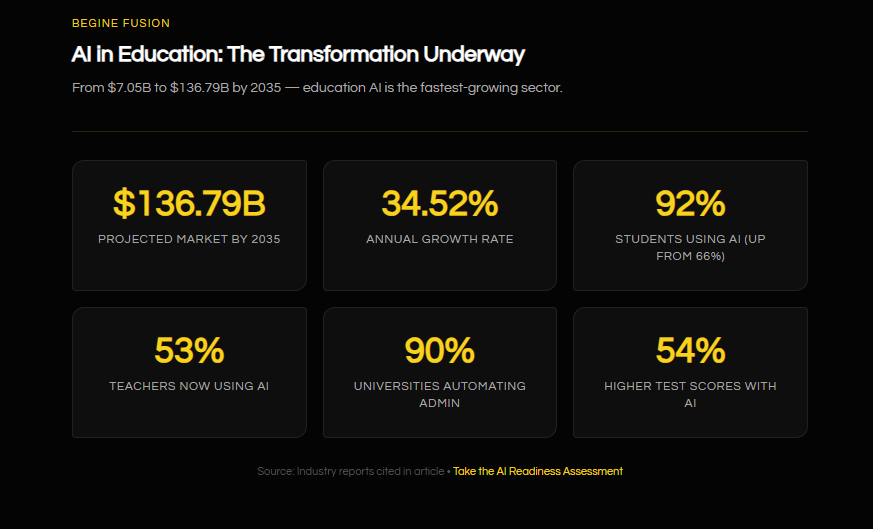
The global AI in education market was valued at $7.05 billion in 2025 and is projected to reach $136.79 billion by 2035, growing at a compound annual growth rate of 34.52%. Student AI usage jumped from 66% in 2024 to 92% in 2025.
Teacher adoption doubled from 25% to 53% between the 2023-24 and 2024-25 school years. Nearly two in three K-12 teachers now say they or their school district have incorporated generative AI into their teaching process. And 90% of universities now use AI to automate administrative tasks like enrollment, scheduling, or plagiarism detection.
AI is not coming to education. It is already there. The question is whether your institution is using it strategically or watching others pull ahead.
This guide covers the specific AI applications that deliver measurable results for education organizations, the real performance data behind each one, and a framework for deciding where to start based on your institution type.
Personalized Learning at Scale
Personalized learning is the single highest-impact application of AI in education because it addresses the fundamental limitation of traditional instruction: one teacher cannot simultaneously deliver 30 different lessons to 30 students with 30 different needs.
AI-powered adaptive learning platforms adjust content difficulty, pacing, sequencing, and format based on each student’s performance in real time. When a student struggles with a concept, the system provides additional practice, alternative explanations, or prerequisite review before moving forward. When a student demonstrates mastery quickly, the system advances them without forcing them to sit through material they already understand.
The results are significant. Students in AI-powered learning environments achieve 54% higher test scores, show 30% better learning outcomes, and experience 10 times more engagement compared to traditional methods. A 2025 randomized controlled trial published in Scientific Reports found AI tutoring outperformed in-class active learning with an effect size between 0.73 and 1.3 standard deviations. To put that in context, an effect size of 0.5 is generally considered medium and 0.8 is considered large. AI tutoring is producing large to very large improvements in learning outcomes.
For K-12 schools, adaptive learning platforms like DreamBox, Khan Academy’s AI-powered features, and IXL adjust math and reading instruction to each student’s level. Teachers receive dashboards showing which students are progressing, which are stuck, and which specific concepts are causing difficulty. This transforms the teacher’s role from delivering uniform instruction to providing targeted intervention where it matters most.
For higher education, AI personalization extends to course recommendations, study path optimization, and prerequisite gap identification. AI systems analyze a student’s academic history, learning patterns, and career goals to recommend courses and study strategies that maximize their probability of success. Institutions using these systems report measurable improvements in retention and graduation rates because students are less likely to enroll in courses they are not prepared for or to miss prerequisite knowledge that causes them to fail.
The cost advantage of AI-powered personalization is also substantial. Traditional one-on-one tutoring costs $25 to $80 per hour. AI tutoring platforms typically cost $15 to $30 per month for unlimited access, representing up to 90% cost savings while maintaining educational effectiveness. For schools and districts that cannot afford tutoring programs for every student who needs one, AI makes personalized support economically viable at scale.
Intelligent Tutoring and Student Support
Intelligent tutoring systems represent one of the most researched and validated applications of AI in education, with decades of development now accelerated by generative AI capabilities.
These systems go beyond simple question-and-answer interactions. They maintain models of each student’s knowledge state, identify misconceptions, provide scaffolded hints rather than direct answers, and adapt their teaching strategy based on how the student responds. The goal is to replicate the effectiveness of one-on-one human tutoring, which research has consistently shown produces dramatically better learning outcomes than classroom instruction alone.
The latest generation of AI tutors powered by large language models can engage in natural language conversations about course material, explain concepts in multiple ways, work through problems step by step, and answer follow-up questions. Students can ask questions at 2 AM that they would never ask in front of 30 classmates, and receive immediate, patient, non-judgmental responses.
For K-12 applications, AI tutoring systems provide homework help, test preparation, and concept reinforcement outside of school hours. Districts that have deployed these systems report that students who use AI tutoring regularly show measurable improvement in standardized test scores and course grades. The 24/7 availability is particularly valuable for students who lack access to tutoring support at home.
For higher education, AI tutoring supports large introductory courses where the student-to-instructor ratio makes individual attention impractical. An introductory chemistry class with 300 students and two teaching assistants cannot provide meaningful one-on-one support during office hours. An AI tutor can simultaneously support all 300 students with personalized explanations and practice problems.
The operational efficiency extends to institutional cost structures. Corporate training deployments of AI tutoring have shown support ticket volume dropping by 42%, course completion increasing from 58% to 83%, and trainers saving over 15 hours weekly on repetitive queries. Education institutions are seeing parallel results: reduced demand for remedial courses, fewer repeat enrollments, and higher first-attempt pass rates.
Automated Grading and Assessment
Grading is one of the largest time consumers in education, and AI is producing measurable time savings that directly translate to more instructional capacity.
K-12 educators report a 44% time savings in grading due to AI-based assessment tools. Across higher education, average grading time for instructors decreased by 37% due to automation in assessment tasks. For a teacher who spends 10 hours per week grading, that represents 4 to 5 hours recovered weekly for instruction, student interaction, lesson planning, or professional development.
AI grading has evolved well beyond simple multiple-choice scanning. Current systems can evaluate short-answer responses, essays, lab reports, and mathematical problem-solving with increasingly sophisticated rubric application. The AI identifies not just whether an answer is correct, but what type of error the student made, which allows for targeted feedback rather than a simple score.
For essay and writing assessment, AI tools analyze structure, argumentation, evidence use, grammar, and style against rubric criteria. They provide detailed feedback comments that students can use for revision. The AI does not replace the teacher’s final judgment on writing quality, but it produces a first-pass evaluation that the teacher can review and adjust in a fraction of the time it would take to grade from scratch.
For STEM subjects, AI grading handles mathematical proofs, coding assignments, and scientific calculations with high accuracy. Automated code grading systems can evaluate not just whether a program produces the correct output, but whether the code follows best practices, handles edge cases, and demonstrates understanding of the underlying concepts.
The consistency benefit is significant. Human graders experience fatigue, unconscious bias, and drift over the course of grading a large stack of assignments. AI applies the same criteria to the first submission and the hundredth submission identically. This does not mean AI grading is perfect, but it provides a consistent baseline that human review can refine.
For formative assessment, AI enables frequent low-stakes checks for understanding that would be impractical to grade manually. A teacher can assign a brief writing response every class and use AI to provide immediate feedback without adding hours of grading work. More frequent formative assessment leads to earlier identification of learning gaps and better instructional adjustment.
Administrative Automation
Education institutions run on administrative processes that consume enormous staff hours: enrollment management, scheduling, attendance tracking, compliance reporting, parent and student communication, budget management, and records maintenance. AI automates and optimizes many of these processes.
81% of teachers say AI saves them time when completing administrative work. 80% report time savings when preparing to teach. The most common time-saving applications include lesson planning, grading support, generating classroom materials, and drafting communications to parents. These are not trivial time savings. For a teacher spending 15 to 20 hours per week on non-instructional tasks, recovering even a third of that time fundamentally changes their capacity to focus on students.
Enrollment management is one of the highest-impact administrative applications. AI systems handle prospective student inquiries about application deadlines, financial aid, program requirements, and campus information 24 hours a day. Institutions using AI-powered enrollment chatbots report that they can respond to thousands of inquiries simultaneously with consistent, accurate information, freeing admissions staff for personalized outreach and strategic enrollment planning.
Scheduling optimization is another area where AI produces measurable results. Building class schedules that accommodate room capacity, instructor availability, student course requirements, and prerequisite sequencing is a complex optimization problem. AI scheduling systems produce optimized schedules faster and with fewer conflicts than manual scheduling, reducing the administrative hours spent on schedule revisions and student complaints.
For compliance and reporting, AI automates the data collection, formatting, and submission processes that education institutions must complete for accreditation bodies, state education departments, and federal agencies. The reporting burden on schools and universities has increased steadily, and AI reduces the staff time required to meet these obligations.
Financial aid processing benefits from AI automation as well. AI systems can pre-screen financial aid applications, identify missing documentation, calculate preliminary award packages, and flag applications that require human review. This reduces processing time and gets financial aid information to students faster, which directly affects enrollment decisions.
Early Warning Systems and Student Retention
Identifying students who are at risk of failing or dropping out is one of the most valuable applications of AI in education because early intervention dramatically improves outcomes, and AI can detect risk signals that humans miss.
AI early warning systems analyze multiple data streams: attendance patterns, assignment completion rates, grade trajectories, learning management system engagement, library usage, and financial aid status. By identifying the combination of factors that historically predict poor outcomes, these systems flag at-risk students weeks or months before a human advisor would notice the same pattern.
For K-12 schools, early warning systems identify students who are showing signs of disengagement: declining attendance, missing assignments, dropping grades, and reduced participation. Teachers and counselors receive alerts that allow them to intervene with targeted support before the student falls too far behind to recover. Schools using these systems report measurable reductions in chronic absenteeism and course failure rates.
For higher education, retention is directly tied to revenue. Every student who drops out represents lost tuition revenue and a failure of the institution’s educational mission. AI retention systems at universities analyze student behavior patterns to predict which students are most likely to leave and what type of intervention is most likely to be effective. Some students need academic support. Others need financial counseling. Others need social connection. AI helps institutions match the right intervention to the right student at the right time.
The predictive accuracy of these systems has improved substantially with larger datasets and better models. Institutions that have implemented AI-driven retention programs report retention rate improvements that translate directly to both better student outcomes and stronger institutional finances.
Content Creation and Curriculum Development
AI is transforming how educators create instructional materials, develop curricula, and adapt content for diverse learners.
For lesson planning, 42% of higher education instructors now use AI to assist in lesson planning, an increase of 18 percentage points from 2023. AI generates lesson plan drafts, discussion questions, in-class activities, and homework assignments aligned to learning objectives and standards. The teacher reviews and customizes the output rather than creating everything from scratch. For a new teacher building their first year of lesson plans, this can save hundreds of hours while producing higher-quality materials that incorporate established best practices.
Content adaptation for different learning needs is where AI delivers particular value. A teacher with students reading at grade level, two years below grade level, and two years above grade level traditionally needs to create three different versions of the same material. AI generates differentiated versions of instructional content adjusted for reading level, complexity, and scaffolding. It can also translate materials into multiple languages for English language learners, adapting not just the language but the cultural references and examples.
For curriculum development at the institutional level, AI analyzes learning outcomes data across courses and programs to identify where students consistently struggle, where curriculum gaps exist, and where content is redundant across courses. This data-driven approach to curriculum design replaces the anecdotal and political processes that often drive curriculum decisions.
Assessment item generation is another high-value application. Creating high-quality test questions that are valid, reliable, and aligned to specific learning objectives is time-intensive skilled work. AI generates assessment items that teachers can review and curate rather than write from scratch. For large question banks needed for adaptive testing or randomized exams, AI makes it feasible to create the volume of items required.
For higher education, AI assists with course design by analyzing enrollment patterns, job market data, and student outcome data to recommend program modifications. If graduates of a particular program consistently lack a skill that employers require, AI can identify that gap and suggest curriculum additions.
Academic Integrity
The relationship between AI and academic integrity is complex. AI creates new cheating risks while simultaneously providing tools to address them.
AI-powered plagiarism and AI-content detection systems have become standard in education. 90% of universities use AI for plagiarism detection. These systems have evolved to detect not just copied text but paraphrased content, translated plagiarism, and AI-generated submissions. The detection technology is in an ongoing competition with generation technology, and no detection system is perfectly accurate. But the combination of detection tools and pedagogical redesign provides a reasonable approach to maintaining academic standards.
The more effective response to AI-generated academic work is assessment redesign. Institutions that are handling this well are shifting toward assessments that AI cannot easily complete: in-class demonstrations, oral examinations, portfolio-based assessment, project-based learning with documented process, and assessments that require personal reflection and experience-based analysis. These assessment methods not only resist AI circumvention but often measure deeper learning than traditional written exams.
For institutions that want to allow and encourage AI use, the challenge becomes teaching students to use AI as a tool rather than a crutch. This means designing assignments where AI is explicitly permitted for specific steps (research, outlining, drafting) while requiring students to demonstrate their own analysis, judgment, and original thinking in the final product. The goal is to prepare students for a workforce where AI proficiency is expected, not to pretend AI does not exist.
Data Analytics and Institutional Intelligence
Education institutions generate enormous volumes of data that historically went unanalyzed. AI makes it possible to extract actionable intelligence from this data at every level of the organization.
At the classroom level, AI analytics provide teachers with real-time insight into student understanding. Learning management system data, assessment results, and engagement metrics combine to give teachers a continuously updated picture of which students understand the material, which are struggling, and which specific concepts are causing difficulty. This replaces the traditional approach of waiting for a test to discover that half the class did not understand a topic covered three weeks ago.
At the department level, AI analytics identify patterns in course success rates, instructor effectiveness, and curriculum performance. If students who take Course A before Course B consistently outperform those who take them in reverse order, AI surfaces that pattern so the department can adjust prerequisites or sequencing.
At the institutional level, AI provides administrators with predictive models for enrollment, budget planning, facility utilization, and workforce needs. Enrollment forecasting models that incorporate demographic trends, economic indicators, competitor activity, and historical patterns produce more accurate projections than traditional methods, allowing institutions to plan staffing and budgets with greater confidence.
For school districts, AI analytics aggregate data across schools to identify system-wide patterns: which programs are producing the best outcomes, where resource allocation is and is not aligned with student needs, and which interventions are working. This evidence-based approach to district management is more effective than the politics-driven decision-making that often characterizes public education administration.
The data privacy dimension is critical and non-negotiable. Education data, particularly for K-12 students, is protected by federal regulations including FERPA, COPPA, and state-level student privacy laws. Any AI implementation must comply with these regulations, which means evaluating vendors for data handling practices, ensuring student data is not used to train commercial AI models, and maintaining transparency with parents and students about how their data is used.
Accessibility and Inclusion
AI is making education more accessible to students with disabilities and diverse learning needs in ways that were not economically feasible before.
Real-time captioning and transcription powered by AI makes classroom lectures and discussions accessible to deaf and hard-of-hearing students without requiring a human captioner for every class session. The quality of AI captioning has improved to the point where it is viable for classroom use, though it still requires human review for accuracy in technical or specialized content.
Text-to-speech and speech-to-text systems assist students with visual impairments, dyslexia, and other reading difficulties. AI-powered reading assistants can adjust reading speed, highlight text as it is read, provide definitions and context for unfamiliar words, and translate content into simplified language. For students with dyslexia, AI tools that convert text to audio or adjust formatting for readability can be the difference between struggling through every assignment and engaging with content comfortably.
Language translation and interpretation assist multilingual students and families. AI translation makes it possible to communicate with parents in their preferred language for school communications, conferences, and emergency notifications. For English language learners, AI-powered language support provides scaffolded content that helps students access grade-level material while they develop English proficiency.
Content adaptation for students with cognitive disabilities is another area where AI adds value. AI generates simplified versions of grade-level content, creates visual supports, and adapts assessment formats for students with IEPs (Individualized Education Programs). Creating these adaptations manually for each student is extremely time-intensive for special education teachers. AI dramatically reduces the production time while allowing teachers to focus on the instructional and relational aspects of supporting these students.
Where to Start: A Decision Framework
Education is diverse, and the right starting point depends on your institution type and most pressing challenge.
Start here if you are a K-12 school or district: Adaptive learning platforms and AI grading tools. The 44% grading time savings and 54% improvement in test scores from personalized learning represent the most immediate impact. Expected impact: measurable reduction in teacher administrative burden and improvement in differentiated instruction within 60 days.
Start here if you are a college or university focused on retention: AI early warning and retention systems. Identifying at-risk students before they drop out directly affects both student outcomes and institutional revenue. Expected impact: measurable improvement in retention rates within one academic term.
Start here if you are a large university with high enrollment volume: Administrative automation for enrollment, financial aid, and student services. AI chatbots and process automation handle the inquiry volume that overwhelms staff during peak periods. Expected impact: significant reduction in response times and staff workload within 90 days.
Start here if you are a training or continuing education provider: AI tutoring and adaptive content delivery. The cost advantage of AI tutoring over human instruction makes personalized training economically viable at scale. Expected impact: improved completion rates and learner satisfaction from day one.
Start here if you are a small school with limited resources: AI lesson planning and content creation tools. These have the lowest implementation cost and the most immediate time savings per teacher. Expected impact: 30-50% reduction in lesson preparation time within 30 days.
The principle across all institution types: start with the activity that consumes the most educator or staff time relative to the judgment it requires, automate that work first, and measure the impact before expanding.
What Education AI Cannot Do (Yet)
AI cannot build the mentoring relationships that shape students’ lives. It cannot model intellectual curiosity, ethical reasoning, or the social skills that students develop through interaction with caring adults. It cannot manage a classroom of 8-year-olds, coach a debate team, or recognize when a student needs emotional support rather than academic help.
AI tools are only as good as the data they are trained on and the context they receive. An AI tutoring system trained primarily on content from one cultural perspective may not serve students from diverse backgrounds equitably. Algorithmic bias in education AI is a documented concern, and institutions must evaluate AI tools for fairness across demographic groups before deploying them.
The data privacy requirements in education are strict and getting stricter. FERPA, COPPA, and state student privacy laws impose specific obligations on how student data can be collected, used, and shared. AI vendors that do not meet these requirements are not viable partners for education institutions, regardless of how impressive their technology appears.
The OECD’s 2026 Digital Education Outlook recommends that education institutions move beyond general-purpose AI tools toward purpose-built educational AI designed to produce durable learning gains, not just better task outputs. The distinction matters. A general-purpose AI chatbot can help a student write an essay. A purpose-built educational AI system helps a student learn to write better essays. The difference is the difference between a tool that does work for students and a tool that helps students learn.
The institutions achieving the best results with AI share common characteristics: they chose applications with clear educational objectives, invested in training their faculty and staff to work effectively with AI, maintained assessment practices that ensure AI augments learning rather than replacing it, and kept student data privacy as a non-negotiable requirement.
Moving Forward
Education is at a point where the gap between AI-adopting institutions and non-adopting institutions is becoming visible in outcomes. Students in AI-powered learning environments are achieving measurably better results. Teachers using AI tools are spending more time on instruction and less on administration. Institutions with AI-driven retention systems are keeping more students enrolled and on track to graduation.
The economic argument is direct. AI-powered personalized learning produces 54% higher test scores. AI grading saves teachers 37 to 44% of their grading time. AI tutoring provides 90% cost savings compared to traditional one-on-one tutoring. And AI administrative automation frees staff hours that can be redirected to student-facing work.
The adoption data makes the trajectory clear. 92% of students are already using AI. 53% of K-12 teachers are using AI in their classrooms. 90% of universities are using AI for administrative tasks. The technology is not waiting for institutional permission. Students and faculty are adopting it whether or not their institutions have a strategy for it.
The institutions that will benefit most are those that develop intentional AI strategies rather than reacting to ad hoc adoption. That means identifying which AI applications align with institutional goals, establishing policies for responsible use, investing in faculty training, and measuring outcomes to inform expansion decisions.
If you want to identify which AI applications would deliver the highest impact for your specific education organization, start with a structured assessment of where your faculty and staff spend time on work that AI could handle. That assessment reveals both the efficiency opportunities and the strategic priorities for your AI investment.