
How E-Commerce Businesses Use AI to Scale Revenue
How Can I Use AI in My E-Commerce Business?
E-commerce is where AI stopped being theoretical years ago. Every time you see a “recommended for you” section, a price that shifts between morning and evening, or a chatbot that actually resolves your return without a phone call, you are looking at AI doing real work in a real store.
The difference in 2026 is scale and accessibility. What used to require a data science team and a seven-figure budget is now available through platforms that a two-person Shopify store can set up in a weekend.
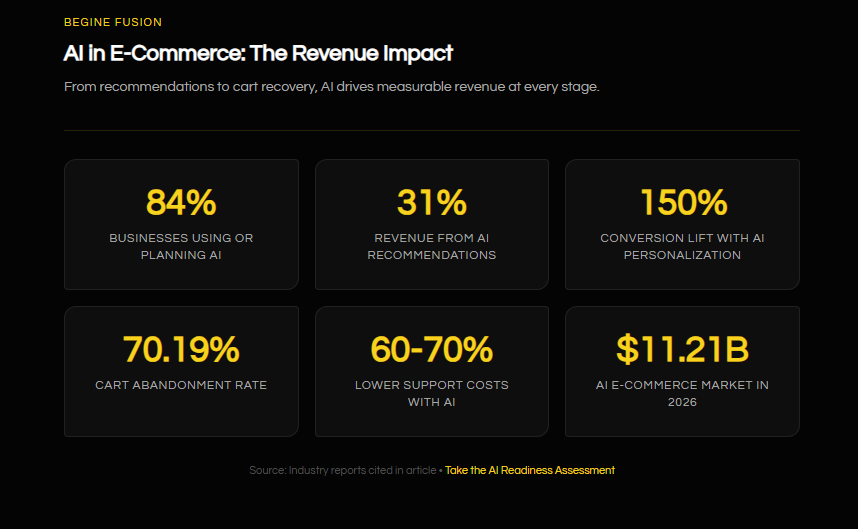
The AI in e-commerce market hit $9.01 billion in 2025 and is projected to reach $11.21 billion in 2026, growing at a compound annual rate of 23.59%. That growth is not driven by enterprise giants alone. It is driven by small and mid-size retailers who realized that competing without AI means competing with one hand tied behind their back.
This guide covers the specific AI applications that matter for e-commerce businesses of every size, the real numbers behind each one, and where to start if you have never deployed an AI tool in your store.
The Current State of AI in E-Commerce
Before we get into specific applications, the adoption numbers tell an important story. Around 84% of e-commerce businesses are either actively using AI or have it on their implementation roadmap. Among e-commerce professionals specifically, 77% reported using AI tools daily in 2025, up from 69% the year before. And 97% of retailers plan to increase their AI budgets going forward.
These are not aspirational survey responses. They reflect the competitive reality that stores without AI capabilities are losing ground on personalization, pricing speed, inventory accuracy, and customer response times simultaneously.
The businesses seeing the best results share a common trait: they did not try to deploy AI everywhere at once. They picked one high-impact area, measured for 90 days, optimized, and expanded. That disciplined approach is what separates the 5% that get measurable ROI from the 95% of AI pilots that fail to deliver results due to implementation complexity.
Personalized Product Recommendations
Product recommendations are the most mature AI application in e-commerce and still the one with the highest dollar-for-dollar return. AI recommendation engines analyze browsing history, purchase patterns, time on page, cart contents, and hundreds of other signals to surface products each individual shopper is most likely to buy.
The numbers are hard to argue with. AI-powered recommendations drive up to 31% of total e-commerce revenue. Companies using sophisticated recommendation engines report conversion rate increases of up to 150% and average order value growth of 50%. During the 2025 holiday season, Adobe Analytics found that visitors arriving from generative AI sources converted at rates 31% higher than traffic from traditional channels.
The practical difference between basic and AI-powered recommendations is significant. Basic systems show “customers also bought” based on simple purchase correlation. AI recommendation engines factor in real-time behavior, seasonal patterns, inventory levels, margin targets, and individual customer lifecycle stage to generate suggestions that are genuinely relevant rather than statistically probable.
For smaller stores, recommendation engines are available as plugins for every major platform. Shopify, WooCommerce, BigCommerce, and Magento all have AI recommendation apps that can be configured in hours, not weeks. The entry cost ranges from $50 to $500 per month depending on catalog size and traffic volume, making this the most accessible AI investment for any e-commerce business.
What matters is measurement. Track your recommendation click-through rate, the conversion rate of recommended products versus non-recommended products, and the average order value lift. If those numbers are not moving within 60 days, your recommendation configuration needs adjustment, not more time.
AI-Powered Customer Service
Customer service is where most e-commerce businesses first encounter AI, and it is also where the gap between good and bad implementation is widest. A poorly configured chatbot that loops customers through irrelevant menus will damage your brand faster than no chatbot at all. A well-configured AI support agent that resolves issues on the first interaction will fundamentally change your cost structure and customer satisfaction scores.
Modern AI customer service agents handle 70-85% of routine inquiries without human intervention. That includes order status checks, return initiation, shipping questions, product availability, account management, and basic troubleshooting. The cost reduction is dramatic: businesses report 60-70% lower support costs while improving customer satisfaction scores by 30%.
The key metric that matters is resolution rate, not deflection rate. Deflection means the chatbot prevented a customer from reaching a human. Resolution means the chatbot actually solved the problem. Many businesses celebrate high deflection rates without realizing they are just making it harder for frustrated customers to get help.
Vodafone provides a useful benchmark: their AI customer service implementation achieved a 70% reduction in cost-per-chat while maintaining quality standards. Alibaba’s chatbot system saves roughly $150 million annually. These are enterprise examples, but the proportional savings apply at every scale.
For a mid-size e-commerce store doing $1-5 million in annual revenue, a well-implemented AI support system typically costs $500-2,000 per month and replaces the equivalent of 2-3 full-time support agents. The math works within the first month for most businesses.
Implementation priorities should follow this order: order tracking and status (highest volume, lowest complexity), returns and exchanges (high volume, moderate complexity), product questions (moderate volume, requires good product data), and then account and billing issues (lower volume, higher stakes). Deploy in that sequence and you will build confidence in the system before putting it on high-stakes interactions.
Dynamic Pricing and Competitive Intelligence
Static pricing in e-commerce is a liability. Your competitors adjust prices multiple times per day based on demand signals, inventory levels, competitor moves, and margin targets. If you are updating prices weekly or monthly, you are leaving money on the table every day.
AI dynamic pricing agents monitor competitor prices, demand patterns, inventory positions, and historical sales data to recommend or automatically implement optimal prices. The results are consistent: businesses using AI pricing report 5-10% margin improvements while maintaining or increasing sales volume. That margin improvement drops directly to the bottom line.
The reason dynamic pricing works is not because AI finds some magical price point humans would miss. It works because AI can process thousands of pricing decisions per day across thousands of SKUs, responding to market conditions faster than any human team could. A pricing analyst might review 50-100 products daily. An AI pricing agent reviews your entire catalog continuously.
For smaller catalogs (under 1,000 SKUs), competitive monitoring tools with AI pricing suggestions start at around $200 per month. For larger catalogs, full dynamic pricing platforms range from $1,000 to $10,000 monthly depending on catalog size and integration complexity.
One important caveat: dynamic pricing requires guardrails. Set minimum and maximum price boundaries for every product. Define rules about how frequently prices can change and by how much. Monitor for situations where the AI creates pricing that damages brand perception or violates MAP (Minimum Advertised Price) agreements with manufacturers. The AI optimizes within the boundaries you set, so set them thoughtfully.
Inventory Management and Demand Forecasting
Inventory is where AI delivers some of its quietest but most impactful results in e-commerce. Carrying too much inventory ties up cash and leads to markdowns. Carrying too little means stockouts that send customers to competitors and may never come back.
AI inventory management systems reduce stock levels by 20% while simultaneously improving service levels by 65%. They achieve this by analyzing historical sales patterns, seasonal trends, marketing calendar impacts, external data (weather, economic indicators, social media trends), and supplier lead times to forecast demand at the SKU level with far greater accuracy than spreadsheet-based planning.
Forecasting accuracy improvements are the foundation. AI-driven demand forecasting reduces prediction errors by 20-50% compared to traditional methods. That translates to logistics costs dropping by up to 15% and inventory turnover improving by 25-30%. For an e-commerce business carrying $500,000 in inventory, a 20% reduction in stock levels frees up $100,000 in working capital while actually improving fill rates.
The practical implementation path depends on your platform. Shopify, BigCommerce, and most modern e-commerce platforms have native or plugin-based AI inventory tools. For businesses using ERP systems, AI inventory modules integrate with SAP, NetSuite, and similar platforms.
Where AI inventory management gets particularly valuable is in multi-channel operations. If you sell through your website, Amazon, Walmart Marketplace, and wholesale channels simultaneously, AI can optimize inventory allocation across channels based on demand signals, margin differences, and fulfillment costs that would be nearly impossible to manage manually at scale.
Start by measuring your current stockout rate, overstock rate, and inventory turnover ratio. Those three numbers give you your baseline. After 90 days with AI inventory management, measure them again. Businesses that do this consistently see improvements within the first quarter.
Cart Abandonment Recovery
The average e-commerce cart abandonment rate sits at 70.19%. That means seven out of ten shoppers who put items in their cart leave without buying. For a store doing $1 million in completed sales, there is potentially $2.3 million in abandoned cart value sitting on the table.
Traditional cart recovery uses timed email sequences: abandon cart, wait one hour, send email with a reminder, wait 24 hours, send email with a discount. This approach recovers 3-5% of abandoned carts.
AI cart recovery agents take a fundamentally different approach. They analyze why each individual shopper likely abandoned (price sensitivity, shipping cost surprise, comparison shopping, distraction, payment friction) and tailor the recovery attempt accordingly. AI-driven cart recovery systems recover 8-12% of abandoned carts, roughly doubling or tripling the rate of traditional email sequences.
The intelligence layer matters. If a customer abandoned because of shipping costs, the AI sends a free shipping offer. If they abandoned while comparison shopping, the AI sends a price match or value comparison. If they abandoned at the payment page, the AI might trigger an alternative payment option. This segmented approach converts at significantly higher rates than one-size-fits-all discount emails.
For a store with $1 million in completed sales and a 70% abandonment rate, moving from 4% recovery to 10% recovery means an additional $140,000 in annual revenue from the same traffic. That is new revenue with zero additional acquisition cost.
Most major e-commerce platforms have AI-powered cart recovery apps available. Klaviyo, Omnisend, and similar platforms offer AI-driven abandoned cart flows that segment by abandonment reason and personalize the recovery message. Setup takes hours, not weeks, and results are measurable within 30 days.
Visual Search and Product Discovery
How customers find products is changing faster than most e-commerce businesses realize. The traditional path of typing keywords into a search bar is being supplemented and sometimes replaced by visual search, conversational search, and AI-assisted discovery.
Visual search lets customers take a photo of something they like (a piece of furniture they saw at a friend’s house, a pair of shoes someone was wearing, a product they saw on social media) and find identical or similar products in your catalog. The data shows that visual search users spend 2.3 times more than traditional text search users, making this a high-value channel even at lower traffic volumes.
Conversational search is the bigger shift. Instead of typing “men’s blue running shoes size 11 under $150,” shoppers increasingly interact with AI assistants that ask clarifying questions, understand preferences, and guide them to the right product.
AI-assisted shopping sessions show conversion rates of 12.3% compared to 3.1% for non-assisted sessions, a four-fold difference that represents the most significant conversion rate gap in e-commerce today. Also, 37% of product discovery now starts with AI agents like ChatGPT and Perplexity rather than traditional search engines.
This means your product data, descriptions, and structured information need to be optimized not just for Google but for AI systems that will recommend (or not recommend) your products to potential buyers.
Practical implementation: ensure your product data is complete and structured. Include detailed specifications, multiple high-quality images from different angles, complete attribute data (material, dimensions, color variations, use cases), and natural language descriptions that AI systems can parse effectively. This is the foundation that every AI-powered search and discovery tool depends on.
Fraud Detection and Prevention
E-commerce fraud costs retailers billions annually, and the sophistication of fraud attempts scales with the sophistication of the businesses trying to prevent it. Traditional rule-based fraud detection (flag any order over $500, flag any new customer shipping to a different address) catches obvious fraud but also blocks a significant percentage of legitimate orders, costing you real revenue.
AI fraud detection systems analyze hundreds of signals per transaction in real time: device fingerprint, behavioral patterns, shipping and billing address relationships, purchase velocity, time-of-day patterns, and comparison against known fraud patterns. The results are measurable: AI fraud detection reduces chargebacks by 50-70% while improving approval rates for legitimate customers by 10-15%.
That second number is the one most businesses underestimate. Every legitimate order you block due to a false positive fraud flag is a customer you may lose permanently. AI fraud systems dramatically reduce false positives while catching more actual fraud, improving both your loss prevention and your customer experience simultaneously.
For most e-commerce businesses, fraud detection AI is consumed as a service rather than built internally. Platforms like Stripe, Signifyd, Riskified, and similar providers offer AI fraud scoring that integrates with your checkout flow. Pricing typically runs 0.5-1.5% of transaction value for guaranteed fraud protection, which is almost always cheaper than the fraud losses and chargeback fees you are currently absorbing.
The implementation is straightforward: integrate the fraud scoring API into your checkout flow, set your risk tolerance thresholds, and monitor the results. Most businesses see the impact within the first billing cycle.
Content Generation at Scale
Product descriptions, email campaigns, social media posts, blog content, ad copy, and category page content all require writing. For a store with 500 SKUs, writing unique, optimized product descriptions alone requires hundreds of hours. For a store with 10,000 SKUs, it is essentially impossible without AI.
AI content generation for e-commerce has matured past the “sounds robotic” phase. Modern tools produce product descriptions, email sequences, and ad copy that match your brand voice and convert at rates comparable to human-written content. The efficiency gain is staggering: generating 100 product descriptions takes 25-33 hours manually versus 5-15 minutes with AI tools, an 88% time savings.
One real-world benchmark: a retailer used AI to generate 300 product descriptions in 2 hours and saw a 47% increase in product page traffic afterward because the AI-generated descriptions were more consistently optimized for search and more complete in their feature coverage than the previous human-written versions.
The practical applications extend beyond product descriptions. AI content tools generate email subject lines with higher open rates by testing and optimizing across segments. They create ad copy variations for A/B testing at volumes that would be impractical manually.
They draft blog content that targets long-tail search queries for products in your catalog.
The quality control step is non-negotiable. AI-generated content should be reviewed for accuracy, brand voice consistency, and factual claims about products. The workflow is: AI generates first draft, human reviews and edits, approved content publishes. This workflow is dramatically faster than humans writing from scratch while maintaining quality standards.
Supply Chain Optimization
Supply chain management in e-commerce has moved from a back-office function to a competitive differentiator. Customers expect two-day or same-day delivery, transparent tracking, and hassle-free returns. Meeting those expectations profitably requires supply chain intelligence that humans alone cannot provide at scale.
AI supply chain optimization reduces inventory costs by 20-30% while increasing sales by 15-25% through better product availability. It achieves this through three connected capabilities: supplier performance monitoring (which suppliers deliver on time and at quality), route optimization (which shipping paths minimize cost and transit time), and demand-aware fulfillment (which warehouse should ship each order based on inventory position and proximity).
For multi-warehouse operations, AI fulfillment routing alone can reduce shipping costs by 10-20% by ensuring each order ships from the optimal location. For businesses relying on third-party logistics (3PL), AI tools provide visibility into 3PL performance that enables data-driven decisions about carrier and fulfillment partner selection.
The implementation complexity here is higher than other AI applications discussed in this post. Supply chain AI typically requires integration with your order management system, warehouse management system, and carrier APIs. For businesses doing under $5 million in annual revenue, the best approach is usually a platform that bundles these capabilities (ShipBob, Flexport, or similar) rather than building custom integrations.
For businesses at scale ($10 million and above), dedicated supply chain AI platforms like Blue Yonder, Coupa, or similar enterprise tools provide the depth of optimization that justifies their implementation cost and complexity.
Where to Start: A Practical Framework
If you are reading this and wondering where to begin, here is the decision framework based on what delivers the fastest measurable impact for most e-commerce businesses.
Start here if your biggest problem is conversion rate: Implement AI product recommendations. The plugins are available for every major platform, setup takes hours, and you will have measurable data within 30 days. Expected impact: 15-20% increase in conversion rate from recommended products.
Start here if your biggest problem is support costs: Deploy an AI customer service agent focused on order tracking and returns first. Expected impact: 40-60% reduction in support ticket volume within 60 days.
Start here if your biggest problem is margin: Implement AI dynamic pricing or cart recovery. Pricing optimization delivers 5-10% margin improvement. Cart recovery delivers new revenue from existing traffic. Both show results within 30-60 days.
Start here if your biggest problem is inventory: Deploy AI demand forecasting. Expected impact: 20-50% reduction in forecast errors, leading to better stock levels and fewer stockouts within one quarter.
Start here if your biggest problem is content: Use AI content generation for product descriptions and email campaigns. The time savings are immediate and measurable from day one.
The common thread: pick one area, define your baseline metrics before implementation, deploy, measure for 90 days, optimize, and then expand to the next area. Businesses that follow this sequence consistently outperform those that try to deploy AI across multiple areas simultaneously.
What E-Commerce AI Cannot Do (Yet)
AI in e-commerce is not a magic button that fixes a broken business model. If your product-market fit is weak, AI will help you discover that faster, not fix it. If your fulfillment operations are fundamentally broken, AI will optimize a broken system rather than replace it with a working one.
AI still struggles with novel situations it has not been trained on. A sudden viral TikTok moment that drives 10x normal traffic to a specific product will confuse demand forecasting models trained on historical patterns. New product launches have no historical data for AI to learn from. Emerging fraud vectors may not match patterns the AI has seen before.
Human judgment remains essential for brand decisions, supplier relationships, product selection, and strategic direction. AI is an execution layer that makes your existing strategy dramatically more efficient. It does not replace the strategy itself.
The businesses getting the most from AI in e-commerce are the ones that treat it as what it is: a tool that handles scale, speed, and pattern recognition better than humans, freeing human operators to focus on creativity, relationships, and strategic decisions that AI cannot replicate.
Moving Forward
The gap between e-commerce businesses using AI and those that are not is widening every quarter. Shoppers who experience AI-powered personalization, instant support resolution, and optimized pricing at one store carry those expectations to every other store they visit. Meeting those expectations is no longer optional for competitive e-commerce operations.
The good news is that the entry barriers have never been lower. You do not need a data science team. You do not need a six-figure budget. You need clarity about which problem to solve first, a willingness to measure results honestly, and the discipline to optimize before expanding.
If you want to identify which AI applications would deliver the highest impact for your specific e-commerce operation, start with a structured assessment of your current capabilities and gaps. That clarity makes the difference between AI that delivers measurable ROI and AI that becomes another line item on your expense report.