
How AI Is Transforming Manufacturing: Where to Start in 2026
How Can I Use AI in My Manufacturing Business?
Manufacturing is a data-rich environment where small improvements compound into significant financial outcomes. A 2% reduction in scrap rate across a production line running 24/7 translates to hundreds of thousands of dollars annually. A 10% improvement in equipment uptime means more output from the same capital investment. A 15-minute reduction in changeover time, multiplied across thousands of changeovers per year, recovers weeks of production capacity.
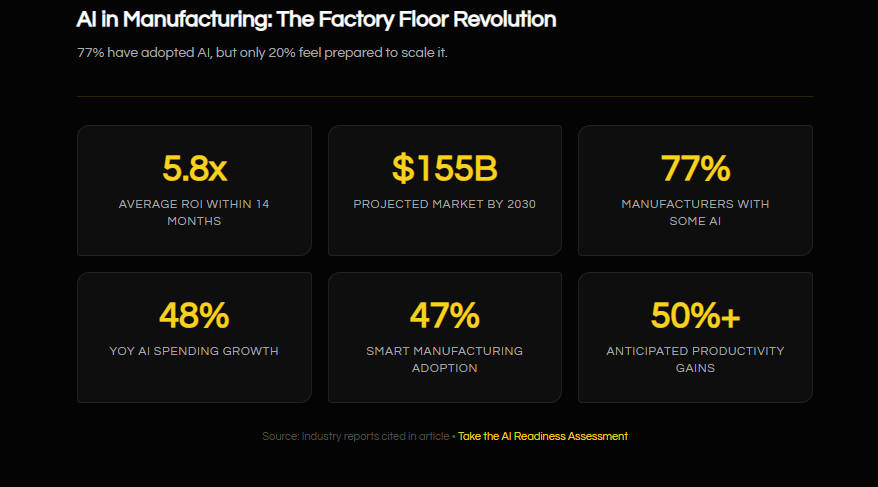
AI is delivering these improvements at scale across the manufacturing sector. The adoption numbers reflect how fast the shift is happening: 77% of manufacturers have implemented AI to some extent, 98% are exploring or actively considering AI-driven automation, and global smart manufacturing adoption reached 47% in early 2026. The AI in manufacturing market hit $34.18 billion in 2025 and is growing at 35.3% annually, projected to reach $155 billion by 2030. Manufacturing AI spending grew 48% year-over-year, concentrated in predictive maintenance and quality control.
The ROI data is equally clear. Manufacturers report an average 5.8x return on AI investment within 14 months of production deployment. Organizations typically see positive ROI within 8 to 11 months. Many manufacturing leaders anticipate AI-driven productivity gains of 50% or more as workflows are redesigned around automation and intelligence.
But the gap between exploration and execution is wide. Only 20% of manufacturers say they feel fully prepared to use AI at scale. This guide covers the specific AI applications that deliver measurable results in manufacturing, the real performance data behind each one, and a practical framework for deciding where to start.
Predictive Maintenance
Predictive maintenance is the most mature and highest-ROI application of AI in manufacturing. It is also the application where the financial case is easiest to quantify, because unplanned downtime has a precise cost: between $36,000 per hour in consumer goods manufacturing and $2.3 million per hour in automotive production.
Traditional maintenance operates on one of two models. Reactive maintenance fixes equipment after it breaks, which means unplanned downtime, emergency repair costs, and cascading production delays. Preventive maintenance follows a fixed schedule regardless of actual equipment condition, which means you replace components that still have useful life while occasionally missing failures that occur between scheduled intervals. Both approaches waste money.
AI predictive maintenance changes the equation by analyzing sensor data from equipment in real time, including vibration patterns, temperature readings, power consumption, acoustic signatures, and operating parameters, to predict failures before they occur. The system identifies patterns that indicate developing problems days or weeks before a breakdown, giving maintenance teams time to schedule repairs during planned downtime.
The performance improvements are substantial and well-documented. AI-driven predictive maintenance reduces equipment downtime by 45-50% and lowers maintenance costs by 25-40%. Over 50% of industrial companies have adopted AI-driven predictive maintenance as of 2025, making it the most widely deployed AI application in the sector.
Through a partnership with Palantir, Metso has transformed how it supports customer uptime. See how they moved from reacting to equipment failures to predicting them in advance, keeping operations running and the right parts always within reach.
The technology has advanced significantly in the past two years. The integration of generative AI into predictive maintenance systems represents a major step beyond traditional machine learning approaches. Instead of simply flagging anomalies, modern systems explain what is failing, why it is failing, and what the optimal repair strategy should be. The convergence of edge AI and 5G connectivity enables real-time responsiveness, making tasks like rerouting work or shutting down equipment to prevent damage feasible in milliseconds rather than minutes.
For manufacturers evaluating where to start with AI, predictive maintenance offers the most straightforward business case. Identify your most expensive equipment, calculate your current unplanned downtime costs, and compare that against the cost of sensors and AI monitoring. The math consistently favors adoption. Most implementations start with critical equipment (compressors, CNC machines, conveyor systems, packaging lines) and expand as the system learns and proves its value.
The implementation path typically follows three stages. First, deploy sensors on critical equipment and begin collecting baseline data. Second, train AI models on your specific equipment behavior patterns and failure modes. Third, integrate predictive alerts into your maintenance management system so that work orders are automatically generated when the AI identifies developing issues. Each stage delivers independent value, and the system improves continuously as it accumulates more data about your specific equipment.
Quality Control and Defect Detection
Quality control is where AI delivers results that human inspection physically cannot match. Human inspectors miss 20-30% of defects during standard inspection tasks. They fatigue over shifts, their attention varies, and they cannot maintain consistent accuracy at production speeds. AI visual inspection systems detect defects with 95-99% accuracy, operate continuously without fatigue, and analyze each image in under 100 milliseconds.
The financial impact of quality failures makes this application particularly compelling. Costs from poor quality can account for 5% to 35% of revenue in manufacturing. For a $50 million manufacturer, that represents potential losses of $2.5 million to $17.5 million annually. Every defect that escapes detection costs more the further it travels through the production process and supply chain. Catching a defect on the line costs cents; catching it at final assembly costs dollars; catching it after it reaches the customer costs orders of magnitude more.
AI quality inspection uses computer vision and machine learning to analyze products at every stage of production. Camera systems capture high-resolution images of parts, assemblies, and finished products. AI models trained on thousands of examples of both acceptable and defective parts classify each item in real time. When the system detects a defect, it can trigger automatic rejection, alert operators, and log the defect type and location for root cause analysis.
The speed advantage matters as much as the accuracy advantage. AI visual inspection systems can detect assembly or soldering defects in under 200 milliseconds, enabling real-time corrections that minimize error propagation down the production line. When defects are caught immediately, you can trace them back to the specific process step, machine setting, or material lot that caused them, which means you fix the root cause rather than continuing to produce defective parts.
Intel saves $2 million annually with their AI vision inspection system. That is a single company applying the technology to a specific set of inspection tasks. Across an entire manufacturing operation with multiple inspection points, the savings compound significantly.
The technology has expanded beyond simple pass-fail inspection. Modern AI quality systems perform dimensional measurement, surface finish analysis, assembly verification, label and packaging inspection, and color matching.
They can detect defects that are invisible to the naked eye, including micro-cracks, subsurface voids, and material contamination that would only be caught by destructive testing under traditional methods.
For manufacturers with high-volume production lines, the ROI calculation is straightforward: compare your current defect escape rate, warranty costs, and inspection labor costs against the cost of AI vision systems. For manufacturers with lower volumes but high-value products, the calculation focuses on preventing the catastrophic cost of a defective part reaching the customer.
Implementation typically starts with the inspection point where defect escape rates are highest or where the financial impact of escapes is greatest. Deploy cameras and AI models at that single point, validate accuracy against your existing inspection process, and expand to additional inspection points as confidence builds.
Supply Chain Optimization
Manufacturing supply chains generate enormous volumes of data: purchase orders, shipping records, inventory levels, supplier lead times, demand signals, quality metrics, and logistics data. AI processes this data to make supply chain decisions that are faster, more accurate, and more responsive to changing conditions than manual planning.
The most immediate application is demand forecasting. Traditional demand planning relies on historical averages, seasonal adjustments, and manual input from sales teams. AI demand forecasting analyzes historical patterns alongside external signals including economic indicators, weather data, social media sentiment, competitor pricing, and leading indicators specific to your industry. The result is demand forecasts that are 20-50% more accurate than traditional methods, which directly reduces both overstock costs and stockout losses.
Inventory optimization is where accurate demand forecasting translates into financial results. AI determines the optimal inventory level for every SKU at every location based on demand variability, lead times, carrying costs, and service level targets. Manufacturers using AI inventory optimization typically reduce inventory carrying costs by 20-30% while simultaneously improving fill rates. That is not a tradeoff; it is AI finding the optimal balance point that manual planning consistently misses.
Supplier management is another area where AI delivers measurable value. AI systems monitor supplier performance across delivery reliability, quality metrics, price trends, and risk indicators. They identify suppliers at risk of delivery failures based on early warning signals and recommend alternative sourcing strategies before disruptions occur. For manufacturers managing dozens or hundreds of suppliers, this proactive approach prevents the production disruptions that reactive supplier management cannot avoid.
Logistics optimization uses AI to determine the most cost-effective shipping routes, consolidation opportunities, and carrier selections. For manufacturers with complex distribution networks, AI logistics optimization typically reduces transportation costs by 10-15% while improving delivery reliability.
The 2026 manufacturing landscape has made supply chain AI more urgent. The smart factory is being driven by a 425,000-worker labor gap, surging energy costs, and sluggish industrial growth. Organizations that cannot optimize their supply chains through intelligence are absorbing costs that their AI-equipped competitors are eliminating.
For manufacturers evaluating supply chain AI, the starting point depends on your biggest cost driver. If excess inventory is consuming working capital, start with demand forecasting and inventory optimization. If supply disruptions are your primary risk, start with supplier monitoring and risk assessment. If logistics costs are disproportionate, start with transportation optimization. Each application delivers independent ROI and feeds data into the others as you expand.
Production Scheduling and Optimization
Production scheduling in manufacturing involves balancing competing constraints: machine capacity, material availability, labor schedules, customer delivery dates, changeover times, energy costs, and quality requirements. The combinatorial complexity of optimizing across all these variables simultaneously exceeds what manual scheduling or simple heuristic-based systems can handle effectively.
AI production scheduling systems analyze all constraints simultaneously and generate optimized schedules that maximize throughput while meeting delivery commitments. Over 40% of manufacturers with production scheduling systems are upgrading to AI-driven capabilities in 2026 to enable more autonomous processes.
The improvements are measurable across multiple dimensions. AI scheduling reduces changeover times by identifying optimal production sequences that minimize the setup changes between runs. It improves machine utilization by eliminating the scheduling gaps that occur when human planners cannot process all constraints simultaneously. It reduces work-in-progress inventory by synchronizing production flows across work centers. And it improves on-time delivery by identifying scheduling conflicts and capacity bottlenecks before they cause delays.
For job shops and make-to-order manufacturers, AI scheduling is particularly valuable because the scheduling complexity scales exponentially with the number of unique orders, machines, and routing options. A job shop with 50 machines and 200 active orders has millions of possible scheduling combinations. AI evaluates these combinations and identifies schedules that human planners would never find through manual methods.
Real-time rescheduling is where AI scheduling delivers its greatest advantage over traditional approaches. When a machine breaks down, a material shipment is late, or a rush order arrives, AI instantly recalculates the optimal schedule across the entire operation. Manual rescheduling in response to disruptions typically takes hours and produces suboptimal results because the planner cannot evaluate all downstream impacts simultaneously.
Energy cost optimization is an increasingly important dimension of production scheduling. AI schedules energy-intensive operations during off-peak rate periods, balances load across the facility to avoid demand charges, and coordinates with on-site generation or storage where available. For manufacturers where energy represents a significant portion of operating costs, AI-optimized energy scheduling alone can justify the investment in scheduling AI.
Digital Twins and Simulation
Digital twins create virtual replicas of physical manufacturing systems, from individual machines to entire production lines to complete factory operations. When connected to real-time sensor data, these digital replicas mirror the current state of the physical system and enable simulation of changes before they are implemented on the production floor.
The digital twin market is growing rapidly, valued at $18.9 billion in 2025 and projected to reach $155 billion by 2030, with manufacturing leading adoption. Over 4,200 facilities reported successful digital twin deployments in 2025 alone. Companies using digital twins report an average 22% ROI.
The practical applications span the full manufacturing lifecycle. In process optimization, digital twins simulate changes to machine parameters, line configurations, and material flows to identify improvements without disrupting production. In new product introduction, digital twins validate manufacturing processes virtually, reducing the physical trial-and-error cycles that consume time and materials. Error rates during startup have dropped by 67% at facilities using digital twins for new product introduction.
In capacity planning, digital twins model production scenarios across different demand levels, product mixes, and resource configurations to support investment decisions. Instead of estimating whether a new machine or line will deliver the expected throughput, manufacturers can simulate the exact impact before committing capital.
Energy and emissions optimization is a growing application for digital twins in manufacturing. Mature AI-driven digital twins are delivering average emission reductions of 15-20%, with leading implementations reaching nearly 30%. The systems identify energy waste, optimize process parameters for efficiency, and simulate the impact of equipment upgrades before purchase.
For manufacturers considering digital twin implementation, the starting point is typically a critical production line or bottleneck process. Deploy sensors to capture the real-time data that feeds the digital twin, build the virtual model, validate it against physical performance, and then use it to test optimization scenarios. The insights from a single production line digital twin often justify expanding to the full factory.
Warehouse and Logistics Automation
Manufacturing warehouses and material handling operations involve repetitive, physically demanding tasks that are increasingly difficult to staff. AI-powered automation addresses both the labor challenge and the efficiency opportunity simultaneously.
AI warehouse systems optimize inventory placement, picking routes, and material flow based on demand patterns, production schedules, and space utilization. The intelligence layer determines where to store materials for fastest access, which picking sequences minimize travel time, and how to stage materials for production in the most efficient order.
Collaborative robots (cobots) are the fastest-growing category of manufacturing automation. The collaborative robot market reached $11.3 billion with 28% annual growth, and manufacturers shipped more than 210,000 cobot units over the last four quarters. Cobots work alongside human workers on tasks including machine tending, assembly, packaging, palletizing, and material handling. The AI controlling these robots adapts to changing conditions, learns optimal movement patterns, and coordinates with other automated systems.
Autonomous mobile robots (AMRs) handle material transport within manufacturing facilities, moving raw materials from receiving to storage, work-in-progress between operations, and finished goods to shipping. AI navigation allows these robots to operate in dynamic environments without fixed infrastructure like rails or magnetic strips, making them deployable in existing facilities without major modifications.
For manufacturers with high-volume material handling requirements, the ROI on warehouse automation is driven by labor cost reduction, throughput improvement, and error reduction. For manufacturers with labor availability challenges, automation addresses a constraint that no amount of compensation can solve when the workers simply are not available.
The integration of warehouse automation with production scheduling AI creates a synchronized material flow from receiving through production to shipping. When the scheduling AI changes the production sequence, the warehouse AI automatically adjusts material staging and delivery priorities. This coordination eliminates the delays and errors that occur when warehouse operations react to production changes rather than anticipating them.
Workforce Augmentation and Knowledge Management
The manufacturing sector faces a structural workforce challenge. A 425,000-worker labor gap is driving the urgency behind smart factory adoption. The challenge is not only the number of workers but the knowledge those workers carry. When experienced operators, technicians, and engineers retire, they take decades of accumulated knowledge about equipment behavior, process optimization, and troubleshooting with them.
AI addresses both dimensions of the workforce challenge. On the knowledge retention side, AI systems capture and codify the expertise of experienced workers. When a veteran technician knows that a specific machine vibrates differently before a bearing failure, AI codifies that pattern into a predictive model that works for every technician, not just the one with 30 years of experience. Technician knowledge retention is the top LLM deployment driver in manufacturing at 35%.
AI-powered training and assistance tools accelerate the development of new workers. Instead of requiring months of shadowing experienced operators, new workers can access AI systems that provide step-by-step guidance, answer questions about equipment and procedures, and flag potential errors in real time. This does not replace hands-on training, but it compresses the learning curve significantly.
Multilingual standard operating procedure (SOP) generation is another practical application, cited by 22% of manufacturers as an LLM deployment priority. For manufacturers with diverse workforces, AI-generated SOPs in multiple languages ensure that every worker has clear, accurate instructions regardless of their primary language.
Regulatory compliance is another area where AI assists the manufacturing workforce. Compliance acceleration is the second most cited LLM deployment driver at 28%. AI monitors regulatory changes, identifies which operations and procedures are affected, and generates updated documentation. For manufacturers in heavily regulated industries (pharmaceutical, medical device, aerospace, food and beverage), this automated compliance tracking reduces the risk of violations while freeing quality and compliance staff for higher-value work.
Cross-plant best practice diffusion rounds out the knowledge management applications. For manufacturers operating multiple facilities, AI identifies which plants are achieving superior performance on specific metrics and extracts the practices and parameters that drive those results. This systematic approach to sharing best practices replaces the ad hoc knowledge transfer that most multi-plant operations rely on.
Where to Start: A Decision Framework
Manufacturing operations vary enormously in complexity, product type, volume, and capital intensity. The right AI starting point depends on your specific operational profile and biggest constraint.
Start here if unplanned downtime is your biggest cost: Implement predictive maintenance on your most critical equipment. The ROI is the most straightforward to calculate and the fastest to realize. Expected impact: 45-50% reduction in unplanned downtime within 6 months.
Start here if quality costs are your biggest concern: Deploy AI visual inspection at your highest-defect or highest-cost inspection point. Expected impact: 95-99% defect detection accuracy, replacing manual inspection that catches only 70-80%.
Start here if inventory and supply chain costs are excessive: Implement AI demand forecasting and inventory optimization. Expected impact: 20-30% reduction in inventory carrying costs with improved fill rates within 90 days.
Start here if production scheduling is limiting throughput: Deploy AI scheduling that optimizes across all constraints simultaneously. Expected impact: measurable improvement in machine utilization and on-time delivery within 60 days.
Start here if the labor shortage is your primary constraint: Focus on warehouse automation and workforce augmentation tools. Expected impact: reduced dependency on manual labor for repetitive tasks with faster onboarding for new workers.
The principle across all starting points: pick one application, establish baseline metrics, deploy, measure for 90 days, optimize, and then expand. The 98% of manufacturers exploring AI and the 20% who feel prepared represent a massive gap that is closed through disciplined execution, not through trying to automate everything at once.
What Manufacturing AI Cannot Do (Yet)
AI in manufacturing has real limitations that deserve direct acknowledgment rather than optimistic hand-waving. AI cannot replace the judgment of experienced process engineers who understand why a machine behaves differently on humid days or why a specific material lot requires adjusted parameters. It cannot navigate the relationship dynamics with suppliers that determine who gets priority allocation during shortages. It cannot make strategic decisions about which products to manufacture, which markets to enter, or which capital investments to prioritize.
The data quality challenge is particularly acute in manufacturing. Many factories run equipment that is decades old, with limited or no sensor infrastructure. AI models require consistent, high-quality data to deliver reliable predictions. If your equipment lacks sensors, your first investment is instrumentation, not AI software. The AI is only as good as the data feeding it, and manufacturing environments are notoriously inconsistent in data quality.
The integration challenge is real. Legacy system interoperability gaps are cited by 39% of manufacturers as a top barrier to AI scaling. Manufacturing IT environments typically include a mix of OT (operational technology) and IT systems that were never designed to communicate with each other. Connecting these systems to feed data into AI platforms requires integration work that is often more complex and expensive than the AI software itself.
Cybersecurity is the top concern, with 44% of manufacturers citing cybersecurity integration complexity as their primary barrier. Connecting production systems to AI platforms creates new attack surfaces. A compromised AI system that controls production scheduling or equipment parameters could cause physical damage and safety risks. Manufacturing AI implementations require cybersecurity architectures that most IT teams have not deployed before.
The 80% of manufacturers who do not feel fully prepared are not wrong to be cautious. The technology works, but the implementation requires infrastructure, integration, data quality, and security work that goes well beyond installing software. The organizations getting the best results treat AI as an engineering project, not a software purchase.
Moving Forward
Manufacturing is in the middle of a structural transformation driven by the convergence of AI, robotics, and economic necessity. The organizations deploying AI effectively are not making incremental improvements. They are building fundamentally different operations: factories that predict and prevent failures instead of reacting to them, production lines that inspect every part instead of sampling, supply chains that anticipate disruptions instead of absorbing them, and scheduling systems that optimize across all constraints instead of satisficing across a few.
The competitive implications are straightforward. When one manufacturer can predict equipment failures weeks in advance and another is still running to failure, the first manufacturer has lower costs and higher uptime. When one manufacturer catches 99% of defects on the line and another catches 75%, the first manufacturer has lower warranty costs and higher customer satisfaction. When one manufacturer optimizes production scheduling across every constraint simultaneously and another relies on manual planning, the first manufacturer gets more output from the same capital.
The barriers to entry have decreased. AI tools for manufacturing are available as cloud services, platform integrations, and managed solutions that do not require in-house data science teams. The collaborative robot market has matured to the point where cobots are deployed by small and mid-size manufacturers, not just large enterprises. Sensor costs have dropped to the point where instrumenting equipment for predictive maintenance is affordable for most operations.
The cost of inaction is increasing. The 425,000-worker labor gap is not closing. Energy costs are not decreasing. Customer expectations for quality, delivery, and customization are not relaxing. The manufacturers that invest in AI now are building structural advantages in cost, quality, and responsiveness that compound over time.
If you want to identify which AI applications would deliver the highest impact for your specific manufacturing operation, start with a structured assessment of your current costs, downtime, quality metrics, and operational bottlenecks. That assessment gives you the data foundation for an investment decision based on your specific situation rather than industry averages.