
How Healthcare Admin Teams Use AI to Reclaim 70% of Their Time
How Can I Use AI in Healthcare Administration?
Healthcare administration runs on paperwork. Prior authorizations, claim submissions, coding reviews, appointment scheduling, patient intake forms, compliance documentation, credentialing, and billing reconciliation consume the majority of working hours in most healthcare organizations. The clinical side gets the headlines, but the administrative side is where most of the money and most of the frustration lives.
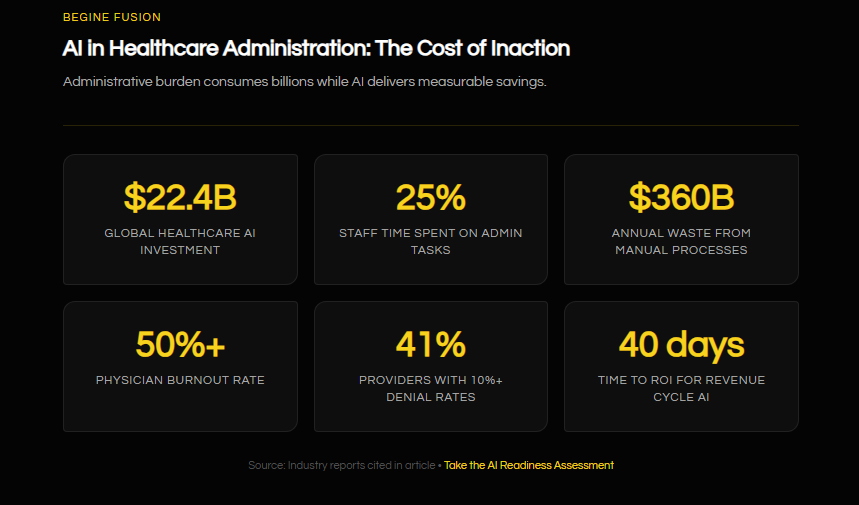
AI is changing that equation faster than most healthcare administrators realize. Not through futuristic diagnostic tools or robotic surgery, but through practical automation of the repetitive, rule-based tasks that consume 25% or more of every healthcare worker’s day. Global healthcare AI investment reached $22.4 billion in 2025, and while clinical AI attracted the majority of venture capital, administrative AI is where organizations are seeing the fastest, most measurable returns.
This guide covers the specific administrative AI applications that deliver results for healthcare organizations, the real numbers behind each one, and a practical framework for deciding where to start.
The Administrative Burden Problem
Before examining solutions, the problem deserves precise quantification. Healthcare professionals spend approximately 25% of their working hours on administrative duties rather than patient care. Nurses spend 25% of their time on regulatory and administrative activities. Physicians report that administrative burden is their single greatest frustration, with 57% identifying it as the biggest opportunity for AI to address.
The financial cost is staggering. The American College of Healthcare Executives estimates that implementing automation and analytics could eliminate $200 to $360 billion in annual spending across the U.S. healthcare system. That is not a typo. Hundreds of billions of dollars are consumed by manual processes that could be automated.
The human cost is equally significant. Physician burnout rates hover above 50% in many specialties, and administrative burden is consistently identified as the primary driver. When a physician spends more time documenting a patient encounter than conducting it, something is fundamentally broken in the system.
The adoption numbers reflect the urgency. A 2025 AHA survey found that billing and scheduling are the two fastest-growing use cases for AI in healthcare. Administrative AI adoption has reached 50-60% in leading organizations, while 63% of healthcare organizations have already integrated AI-powered solutions into their revenue cycle. The organizations that have not started are falling behind, not ahead.
From generative AI to model backed staffing, Tampa General Hospital is using human-validated AI to evolve hospital operations. With predictive models at over 95% accuracy, hospital staff can make strategic decisions to improve patient outcomes.
Revenue Cycle Management and Medical Billing
Revenue cycle management is where AI delivers the most immediate financial impact in healthcare administration. The revenue cycle includes everything from patient registration and insurance verification through coding, claim submission, payment posting, and denial management. Every step involves data entry, rule matching, and error correction that AI handles faster and more accurately than manual processes.
The complexity of medical billing creates a system where errors are almost inevitable at scale. A single patient encounter can generate dozens of codes across diagnosis, procedure, and modifier categories. Each code must align with payer-specific rules, medical necessity requirements, and documentation standards. When a human coder processes 40 to 60 charts per day, the error rate is not a question of competence. It is a question of volume meeting complexity.
The current state of medical billing is a case study in inefficiency. Claim denial rates have been increasing, with the percentage of providers reporting denial rates above 10% surging from 30% in 2022 to 41% in 2025. Each denied claim costs between $25 and $118 to rework, and 56% of providers say patient information errors are the primary cause. These are exactly the types of errors that AI catches before submission.
AI-powered revenue cycle tools deliver measurable results across every metric that matters. Healthcare organizations report 40-60% reduction in claim processing time and 25-35% improvement in first-submission approval rates. NLP-powered coding assistance reduces coding errors by 15-25% and accelerates the entire revenue cycle. Some organizations achieve ROI in as little as 40 days.
The dollar figures are significant. One healthcare technology company reported that its AI-powered solutions delivered more than $800 million in cash benefit to client health systems in 2025. At the individual facility level, AI-assisted revenue cycle management recovers $3 million to $6 million in value per 10,000 discharges.
For organizations evaluating where to start, the revenue cycle offers the clearest ROI calculation in all of healthcare AI. Your current denial rate, rework cost per denial, and days in accounts receivable give you a precise baseline. AI reduces all three, and the financial impact is measurable within the first quarter.
Implementation typically follows this sequence: automated eligibility verification (catches coverage issues before services are rendered), AI-assisted coding (reduces coding errors and captures missed charges), automated claim scrubbing (identifies errors before submission), and intelligent denial management (prioritizes and routes denials for fastest resolution). Each step builds on the previous one, and each delivers independent ROI.
Denial management deserves specific attention because it is where most revenue cycle teams spend disproportionate time. AI denial management tools categorize denials by root cause, prioritize them by dollar value and likelihood of successful appeal, and auto-generate appeal letters with the specific clinical documentation that each payer requires. Organizations using AI-powered denial management report 15 to 20 percent improvement in appeal success rates and significantly faster turnaround times on reworked claims.
Clinical Documentation and Ambient AI
Clinical documentation consumes a disproportionate share of physician time and is the single largest contributor to burnout in healthcare. Physicians routinely spend two hours on documentation for every hour of patient care. After-hours documentation, often called “pajama time,” extends the burden into evenings and weekends.
Ambient AI documentation tools represent one of the most impactful healthcare AI applications to emerge in the past two years. These tools listen to the patient-physician conversation (with consent), generate structured clinical notes, and populate the EHR automatically. The physician reviews and approves the note rather than creating it from scratch.
The research results are consistent and significant. A study across 263 providers at 6 healthcare systems found that burnout decreased from 51.9% to 38.8% after just 30 days with ambient AI documentation. Clinicians using ambient AI spent 8.5% less total time in the EHR and had over 15% decrease in time spent composing notes. Another study found the technology reduced documentation time by 30 minutes per day per provider.
Mass General Brigham, one of the largest academic health systems in the country, made ambient documentation technology available to all its physicians by April 2025, with more than 3,000 providers now routinely using the tools. The Emory and UW Health systems published similar findings: providers reported less burnout, lower cognitive burden, less after-hours documentation, and an increased ability to stay present with patients during visits.
The administrative impact extends beyond physician satisfaction. When documentation is completed in real time during or immediately after the visit, it eliminates the documentation backlog that cascades into delayed coding, delayed billing, and delayed revenue. Faster, more complete documentation means faster, more accurate claims.
For healthcare administrators, the business case is straightforward. Calculate your average physician compensation, estimate the hours spent on documentation (typically 2-3 hours daily), and compare that against the cost of ambient AI tools (typically $200-500 per provider per month). The math consistently favors adoption, before factoring in the downstream revenue cycle improvements.
Patient Scheduling and Access
Patient scheduling is deceptively complex. It involves matching patient needs with provider availability, accounting for appointment types and durations, managing cancellations and no-shows, optimizing provider utilization, and ensuring appropriate follow-up scheduling. Most healthcare organizations handle this with manual processes that are labor-intensive and error-prone.
AI-driven scheduling systems analyze patient history, provider availability, appointment types, historical no-show patterns, and external factors to optimize scheduling decisions. The most measurable impact is on no-show rates, which AI-driven scheduling reduces by 20-30% through predictive modeling and automated, personalized reminders.
No-shows cost the average medical practice $150,000 or more annually in lost revenue. A 25% reduction in no-shows translates directly to recaptured revenue and improved access for patients who need appointments. The AI does not just send reminders; it identifies which patients are most likely to no-show based on historical patterns and adjusts the reminder strategy accordingly.
Beyond no-show reduction, AI scheduling optimizes provider utilization by matching appointment complexity with available time slots, identifying scheduling gaps that can be filled with same-day appointments, and reducing overbooking that leads to long wait times and patient dissatisfaction.
RPA (robotic process automation) in scheduling saves 700-870 hours annually per scheduler. For a practice with three scheduling staff, that is the equivalent of adding a full-time employee without increasing headcount.
Implementation is typically low-risk. Most AI scheduling tools integrate with existing EHR and practice management systems. The data required (appointment history, no-show patterns, provider schedules) already exists in your systems. Pilot programs can run on a subset of providers or locations before full deployment.
Prior Authorization Automation
Prior authorization is the most universally despised administrative process in healthcare. It requires clinical staff to submit detailed justification to insurance companies before certain treatments, procedures, or medications are approved. The process is manual, time-consuming, and frequently results in delays that affect patient care.
The scale of the problem is enormous. The average physician practice handles hundreds of prior authorization requests per week. Each request takes an average of 13-16 minutes when handled manually, and many require multiple follow-ups. The total physician time consumed by prior authorizations is estimated at the equivalent of two full work days per week for the average practice.
AI prior authorization tools automate the data gathering, form completion, and submission process. They pull relevant clinical data from the EHR, match it against payer-specific requirements, identify the documentation needed to support the request, and submit the authorization electronically. When additional information is required, the AI identifies exactly what is needed and routes it to the appropriate clinical staff.
The time savings are dramatic. AI-assisted prior authorization reduces processing time by 60-75% per request. For a practice handling 200 prior authorizations per week, that translates to 40-60 hours of staff time recovered weekly. The approval rate also improves because AI ensures all required documentation is included on the first submission, reducing denials due to incomplete information.
Healthcare organizations implementing AI prior authorization report reduced treatment delays, improved patient satisfaction, and lower administrative costs. The ROI is typically measurable within 60-90 days of deployment.
Compliance and Regulatory Documentation
Healthcare compliance documentation is voluminous, complex, and high-stakes. HIPAA compliance, CMS conditions of participation, state licensing requirements, accreditation standards, and payer-specific rules create a documentation burden that requires dedicated compliance staff and constant vigilance.
AI compliance tools monitor documentation practices across the organization, flag potential compliance gaps, and generate reports that would take human staff days to compile. They track regulatory changes automatically and identify which organizational policies and procedures need updating when regulations change.
The risk reduction aspect deserves emphasis. A single HIPAA violation can result in fines ranging from $100 to $50,000 per incident, with annual maximums of $1.5 million per violation category. AI-powered compliance monitoring reduces the risk of violations by ensuring documentation practices remain consistent and complete across the organization.
For credentialing, AI automates the verification and tracking process for provider credentials, licenses, and certifications. This is particularly valuable for organizations with large provider networks where manual credentialing tracking is error-prone and labor-intensive.
The practical implementation path starts with automated compliance monitoring and alerting, then expands to include automated regulatory change tracking and credentialing automation. Each layer reduces risk and administrative overhead simultaneously.
Patient Intake and Registration
Patient intake is the first touchpoint in the administrative process and sets the accuracy tone for everything that follows. Errors in patient demographics, insurance information, or medical history at intake cascade through the entire revenue cycle, causing claim denials, billing errors, and compliance issues.
AI-powered intake systems allow patients to complete registration digitally before their visit, with real-time verification of insurance eligibility, automated extraction of information from insurance cards and identification documents, and intelligent pre-population of forms based on existing patient data.
The impact on downstream processes is significant. When intake data is accurate and complete, eligibility verification happens before the patient arrives, coding has correct demographic and insurance information, and claim submissions have fewer errors. Organizations implementing AI-powered intake report 15-25% reduction in registration errors and corresponding improvements in claim acceptance rates.
For organizations with high patient volumes, the efficiency gains are substantial. Self-service intake reduces front desk staff time per patient by 50-70%, allowing staff to focus on patients who need assistance rather than routine data entry.
Workforce Management and Staffing
Healthcare staffing is a permanent challenge. Matching staff levels to patient demand across departments, shifts, and acuity levels requires forecasting that most organizations handle through historical patterns and manual adjustment.
AI workforce management tools analyze patient census data, historical patterns, seasonal trends, procedure schedules, and external factors to predict staffing needs with significantly greater accuracy than manual forecasting. Hospitals using AI-powered staffing optimization report 10-15% reduction in overtime costs and improved staff satisfaction through more predictable scheduling.
The connection between staffing optimization and quality of care is direct. Understaffing leads to longer wait times, delayed care, and increased error rates. Overstaffing wastes resources. AI finds the balance point that manual scheduling consistently misses.
For organizations operating across multiple facilities, AI staffing tools can optimize float pool utilization, identify opportunities for cross-facility resource sharing, and predict demand spikes that require temporary staffing before they become emergencies.
The financial case for AI workforce management extends beyond overtime reduction. Turnover in healthcare is expensive, with the average cost of replacing a registered nurse estimated at $46,000 to $56,000. Staff dissatisfaction driven by unpredictable schedules and chronic understaffing is a primary contributor to voluntary turnover. AI scheduling that produces more predictable, equitable schedules directly reduces the conditions that cause staff to leave, creating savings that compound over time as retention improves.
Where to Start: A Decision Framework
Healthcare organizations considering AI implementation face a common challenge: too many potential applications and limited implementation capacity. The following framework prioritizes based on financial impact, implementation complexity, and organizational readiness.
Start here if revenue cycle is your biggest pain point: Implement AI-assisted coding and claim scrubbing first. These tools have the most immediate financial impact, the clearest ROI calculation, and the lowest implementation risk. Expected impact: 25-35% improvement in first-pass claim acceptance within 90 days.
Start here if physician burnout is your biggest concern: Deploy ambient AI documentation for a pilot group of providers. The burnout reduction data is compelling, the technology is mature, and the downstream revenue cycle benefits provide additional ROI. Expected impact: measurable burnout reduction within 30 days.
Start here if patient access is your biggest challenge: Implement AI scheduling with predictive no-show modeling. The no-show reduction alone justifies the investment, and improved schedule optimization increases provider utilization. Expected impact: 20-30% no-show reduction within 60 days.
Start here if compliance risk keeps you up at night: Deploy automated compliance monitoring and alerting. The risk reduction provides the ROI justification, and the time savings for compliance staff free capacity for higher-value work. Expected impact: continuous monitoring versus periodic manual audits.
Start here if administrative costs are unsustainable: Focus on prior authorization automation and patient intake optimization. These reduce the highest-volume manual processes and deliver time savings that are immediately visible to staff. Expected impact: 60-75% reduction in prior authorization processing time.
The consistent principle across all starting points: pick one area, establish baseline metrics, deploy, measure for 90 days, optimize, then expand. Healthcare organizations that try to implement AI across multiple administrative functions simultaneously almost always underperform those that take a disciplined, sequential approach.
What Healthcare AI Cannot Do (Yet)
AI in healthcare administration has real boundaries that deserve acknowledgment. AI cannot replace clinical judgment. It cannot interpret ambiguous situations that require human empathy and contextual understanding. It cannot navigate the political dynamics of payer-provider negotiations. And it cannot fix fundamentally broken workflows; it can only make existing workflows faster.
AI documentation tools occasionally generate errors that require physician review and correction. AI coding tools can miss nuances that experienced coders catch. AI scheduling systems cannot account for the physician who always runs 20 minutes behind but produces the best patient outcomes in the practice.
The regulatory environment adds another layer of complexity. Healthcare AI must comply with HIPAA, state privacy laws, CMS requirements, and payer-specific rules. The AI tools themselves must be validated and monitored for accuracy, bias, and compliance. This is not a “deploy and forget” technology.
Data quality is another real constraint. AI models are only as good as the data they are trained on. If your EHR data is inconsistent, your coding practices vary across providers, or your historical claims data has gaps, AI tools will inherit those inconsistencies. Most successful implementations include a data cleanup phase before full deployment, which adds time and cost to the initial rollout.
The organizations getting the most value from healthcare AI treat it as a tool that amplifies human capability rather than replaces it. The coding AI catches errors that humans miss, but the human coder catches nuances that the AI misses. The documentation AI drafts notes that the physician would have written, but the physician reviews and corrects them. This human-AI partnership model produces better results than either humans or AI working alone.
Moving Forward
The administrative burden in healthcare is not going to decrease on its own. Regulatory complexity increases every year. Payer requirements become more stringent. Patient expectations for digital experiences continue to rise. The organizations that invest in administrative AI now are building a structural cost advantage that compounds over time.
The good news is that healthcare-specific AI tools have matured significantly. They are designed for healthcare workflows, built with HIPAA compliance, integrated with major EHR systems, and supported by implementation teams that understand healthcare operations. The implementation risk is lower than it was even two years ago.
The cost of inaction is increasingly clear. Organizations that continue to rely on manual administrative processes are spending more per claim, losing more revenue to denials, burning out their clinical staff faster, and delivering a worse patient experience than their AI-equipped competitors.
If you want to identify which administrative AI applications would deliver the highest impact for your specific healthcare organization, start with a structured assessment of your current administrative costs, error rates, and bottlenecks. That assessment gives you the data you need to make an informed investment decision rather than chasing the latest technology trend.