
How Media Companies Use AI Without Losing Their Value
How Can I Use AI in Media or Publishing?
Media and publishing businesses operate on a fundamental economic tension: the cost of producing quality content keeps rising while the channels demanding that content multiply every year. A newsroom that once published a daily print edition now maintains a website, multiple social media feeds, newsletters, podcasts, and video channels. A publishing house that once managed a print catalog now handles ebooks, audiobooks, print-on-demand, and direct-to-consumer digital sales. A media company that once sold display ads now navigates programmatic advertising, sponsored content, native advertising, and subscription models simultaneously.
AI changes the economics of this equation by handling the operational volume that threatens to overwhelm them.
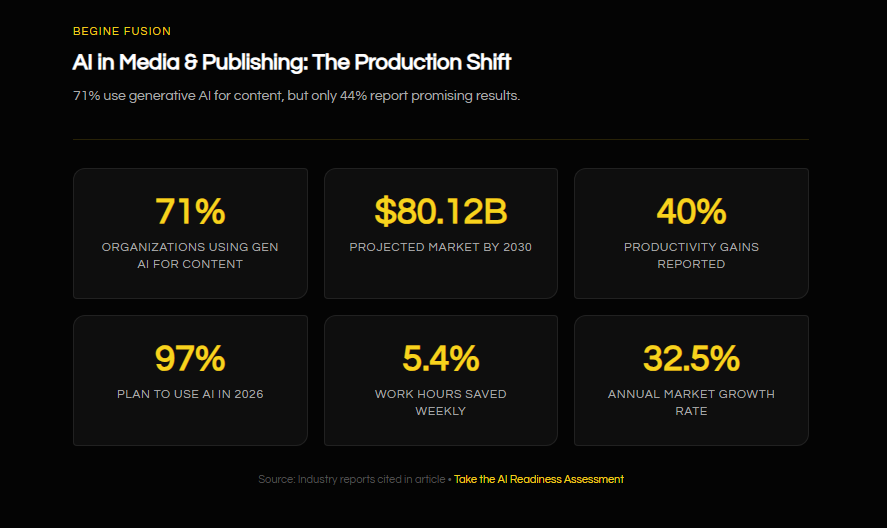
The numbers tell the story of an industry in rapid transition. 71% of organizations now use generative AI for content creation, with employees reporting 40% productivity gains and 5.4% of work hours saved weekly. The AI-powered content creation market was valued at $14.8 billion in 2024 and is projected to reach $80.12 billion by 2030, growing at a 32.5% compound annual growth rate. And 97% of content marketers plan to use AI to support their efforts in 2026, up from 83% in 2024.
But the results gap is significant. Only 44% of media organizations say their AI initiatives have shown “promising” results, while 42% describe the impact as “limited so far.” That gap between adoption and impact is where strategy matters more than technology.
This guide covers the specific AI applications that deliver measurable results for media and publishing businesses, the real performance data behind each one, and a framework for deciding where to start based on your business model.
Content Production and Editorial Workflow
Content production is where AI delivers the most immediate time savings for media organizations, and it is where adoption is highest. 85.1% of AI users in media deploy it for content generation, with additional adoption for email marketing and newsletters (51%), social media content (49%), and SEO content (34%).
The productivity gains are substantial. 58% of marketers say generative AI saves them at least 3 hours of work per piece of content. For a newsroom or publishing team producing 20-50 pieces of content per week, that translates to 60-150 hours of recovered capacity weekly. That is not a marginal improvement. That is the difference between a stretched team that publishes what it can and an organized operation that publishes strategically.
The practical applications across the editorial workflow include first-draft generation for routine content like earnings reports, sports recaps, weather summaries, and event listings. AI produces these at a quality that requires light editing rather than full rewrites. Headline and title optimization, where AI generates multiple variations and predicts performance based on historical engagement data. Metadata generation including tags, categories, SEO descriptions, and social media summaries for every piece of content, a task that is essential for discoverability but tedious for human editors. And transcription and copy editing, used by 64% of newsrooms, which eliminates hours of manual work per audio or video asset.
The workflow that delivers the best results is not AI replacing writers. It is AI handling the mechanical parts of content production so that writers and editors spend their time on the work that requires human judgment: original reporting, analysis, creative storytelling, and source relationships. Newsrooms that use AI to generate first drafts of routine content report that their journalists spend more time on investigative and analytical work, which is the content that builds audience loyalty and brand differentiation.
For publishing houses, AI assists with manuscript assessment, where it analyzes submissions against market trends, comparable titles, and genre conventions to help acquisitions editors prioritize their reading. It does not replace editorial judgment about whether a book is worth publishing. It reduces the time editors spend on manuscripts that clearly do not fit the catalog.
The quality question matters. AI-generated content that reads like AI-generated content damages audience trust. 52% of consumers reduce engagement when they suspect content is AI-generated. The successful approach is using AI to accelerate human work, not to replace the human voice that audiences connect with.
Audience Analytics and Personalization
Media businesses live and die by audience engagement, and AI’s ability to analyze audience behavior at scale is transforming how content is distributed, recommended, and monetized.
Content recommendation engines powered by AI are already the dominant method for content distribution on digital platforms. AI-driven recommendations account for 35% of Amazon’s total sales and drive the majority of content consumption on platforms like Netflix, Spotify, and YouTube. For media publishers, implementing AI-powered recommendations on their own properties increases engagement metrics by 15-30% through personalized article feeds, newsletter content, and homepage layouts.
The personalization extends beyond simple “recommended for you” widgets. Publishers like The New York Times and Medium use AI to create personalized newsletters and article feeds that adapt to individual reader behavior. The AI analyzes reading history, time spent on articles, scroll depth, click patterns, and content preferences to build individual reader profiles that improve over time. AI personalization algorithms can increase sales by up to 30% through tailored content recommendations that deepen reader engagement.
For subscription-based media businesses, AI-powered personalization directly affects the two metrics that determine subscription revenue: conversion and retention. AI models predict which readers are most likely to subscribe based on their engagement patterns, allowing targeted paywall strategies and subscription offers. For existing subscribers, AI identifies engagement patterns that predict churn and triggers retention interventions before the subscriber cancels.
Audience segmentation has also become more sophisticated with AI. Instead of broad demographic segments, AI creates behavioral segments based on content consumption patterns, engagement timing, device preferences, and topic affinities. These granular segments allow media businesses to tailor content strategy, advertising packages, and subscription offers with precision that manual analysis cannot achieve.
The data infrastructure requirement is important. AI personalization only works when you have clean, connected data across your content management system, analytics platform, email system, and subscription management. Media businesses with fragmented data systems get fragmented personalization results.
Advertising and Revenue Optimization
For media businesses that depend on advertising revenue, AI has already transformed the economics. Over 71% of total ad spend will be algorithmically driven by 2026, and programmatic buying accounts for over 80% of all digital ad spend. Media companies that have not optimized their advertising operations for AI-driven buying are leaving revenue on the table.
AI optimizes advertising revenue for publishers across several dimensions. Yield management uses AI to predict the optimal price for each ad impression based on audience data, content context, time of day, device type, and competitive demand. Dynamic pricing that adjusts in real time consistently outperforms fixed-rate pricing by 15-25% in revenue per impression.
Ad placement optimization determines where on a page or within a content feed to position ads for maximum viewability and engagement without degrading the reader experience. AI balances revenue maximization against user experience metrics, finding the placement strategy that generates the most revenue while maintaining the engagement metrics that sustain long-term audience value.
For media companies selling direct advertising, AI assists with audience packaging, creating targetable audience segments that advertisers value. AI analyzes first-party data to identify audience segments with specific behavioral characteristics, purchase intent signals, and demographic profiles that command premium CPMs. Media businesses with strong first-party data and AI-powered audience segmentation report 20-40% higher CPMs compared to standard programmatic inventory.
Sponsored content and native advertising benefit from AI’s ability to match advertiser messages with relevant editorial contexts. AI identifies which content topics, formats, and distribution channels deliver the best performance for specific advertising categories, improving the effectiveness of sponsored content campaigns and increasing renewal rates with advertising clients.
The shift toward AI-powered advertising operations is particularly important for media businesses navigating the deprecation of third-party cookies. First-party data combined with AI-powered audience modeling replaces the targeting capability that third-party cookies provided, but only for publishers who invest in the data infrastructure and AI tools to make it work.
Video and Audio Content Production
Video and audio content represent the fastest-growing segments of media consumption, and AI is reducing the production costs and timelines that have historically made these formats expensive to produce at scale.
AI-generated video is projected to account for 10% of all digital video content by 2026. For media companies, the practical applications include automated video creation from text articles, where AI generates narrated video summaries with graphics, b-roll, and captions. Automated podcast editing that handles noise reduction, silence removal, level balancing, and transcript generation. And short-form video creation for social media distribution, where AI repurposes long-form content into platform-specific clips optimized for each channel’s algorithm.
The production time savings are dramatic. Tasks that previously required a video editor working for hours, like cutting a 60-minute interview into shareable social clips with captions and graphics, can be completed by AI in minutes. For media businesses producing daily video or audio content, this translates to thousands of hours of production capacity annually.
Transcription and captioning, which 64% of newsrooms already use AI for, delivers benefits beyond accessibility compliance. Searchable transcripts make audio and video content discoverable through search engines and internal content management systems. They provide the raw material for derivative content: blog posts, social media quotes, newsletter excerpts, and SEO-optimized articles derived from audio and video sources.
For publishers entering the audiobook market, AI voice synthesis has reached a quality level that makes AI-narrated audiobooks commercially viable for backlist titles and specific genres. The production cost difference is significant: traditional audiobook narration costs $200-400 per finished hour, while AI narration costs a fraction of that. Several major publishers are already using AI narration for selected titles, particularly reference works, technical books, and backlist titles where the economics of traditional narration do not justify the investment.
The quality threshold matters. AI-generated video and audio that feels robotic or generic damages the brand value that media companies depend on. The successful approach uses AI for production efficiency, post-production automation, and format adaptation while maintaining human creative direction for the content itself.
SEO and Content Distribution
Search engine optimization is where AI delivers disproportionate results for publishing businesses because the work is technical, data-intensive, and repetitive, which are exactly the characteristics that AI handles well.
AI SEO tools analyze search trends, competitive content, keyword opportunities, and content gaps to inform editorial strategy. Instead of publishing content and hoping it ranks, AI-driven editorial planning identifies the specific topics, angles, and formats that have the highest probability of capturing search traffic. 34% of media professionals use AI specifically for SEO content, and those who do report measurable improvements in organic traffic.
The application goes beyond keyword research. AI analyzes existing content libraries to identify optimization opportunities: articles that rank on page two and could reach page one with specific improvements, content gaps where competitors rank but your publication does not, and internal linking opportunities that improve the authority signals search engines use for ranking.
For large publishers with content archives of thousands or tens of thousands of articles, AI-powered content auditing is particularly valuable. AI identifies evergreen content that needs updating, seasonal content that should be refreshed before its relevant period, and underperforming content that should be consolidated or redirected. Manual auditing of a large content library takes weeks. AI completes the same analysis in hours.
Content distribution optimization extends beyond search. AI determines the optimal time, channel, and format for distributing each piece of content. Social media scheduling tools powered by AI analyze historical engagement data to identify when specific audience segments are most active and which content formats perform best on each platform. AI can improve click-through rates by up to 30% through personalized distribution optimization.
For newsletter publishers, AI optimizes subject lines, send times, content selection, and audience segmentation. Email marketing was cited by 51% of media AI users as a key application area. The compounding effect of optimizing every element of newsletter performance, open rates, click rates, and conversion rates, delivers substantial revenue improvements for subscription and advertising-supported newsletters.
Subscription and Paywall Management
For media businesses transitioning from advertising-dependent models to subscription revenue, AI is the technology that makes dynamic paywall strategies possible.
Static paywalls, whether hard (all content behind a wall) or metered (a fixed number of free articles), leave money on the table. Hard paywalls exclude potential subscribers who have not yet reached the engagement threshold where they are willing to pay. Metered paywalls give away content to heavy users who would have subscribed anyway while blocking light users who might convert if given more exposure.
AI-powered dynamic paywalls solve this by making individual decisions for each reader based on their behavior. The AI analyzes a reader’s engagement history, content preferences, visit frequency, referral source, and predicted subscription likelihood to determine whether to show a paywall on each page view. Readers who are likely to subscribe see the paywall earlier. Readers who need more exposure to reach the subscription threshold see it later. Readers who are unlikely to subscribe regardless may see advertising-supported content that generates revenue through a different model.
The results from publishers who have implemented dynamic paywalls are consistently positive. Conversion rates improve because the paywall appears at the optimal moment for each reader rather than at an arbitrary threshold. Total subscriber acquisition increases because fewer potential subscribers are lost to premature paywall encounters. And advertising revenue on non-paywalled content is maintained because the AI preserves advertising impressions for readers who are better monetized through ads than subscriptions.
Churn prediction is the other critical AI application for subscription businesses. AI models analyze subscriber behavior patterns, including declining article consumption, reduced newsletter opens, decreased visit frequency, and content preference shifts, to identify subscribers at risk of canceling. Proactive retention interventions triggered by AI predictions are significantly more effective and cheaper than reacquisition campaigns after a subscriber has already left.
Editorial Intelligence and Trend Detection
AI gives media businesses a capability that was previously available only to the largest newsrooms with dedicated research teams: the ability to monitor, analyze, and respond to trends across the entire information landscape in real time.
AI-powered media monitoring tools track thousands of sources simultaneously, identifying emerging stories, trending topics, and competitive coverage gaps. 82% of newsrooms use AI for news gathering, and the capability extends beyond traditional news monitoring to include social media sentiment analysis, public records analysis, and data pattern detection.
For news organizations, AI identifies stories before they become widely covered by detecting unusual patterns in public data: spikes in government filings, anomalies in financial data, geographic clusters of social media activity, or sudden changes in search interest for specific topics. This early detection capability gives newsrooms a head start on coverage that builds their reputation for timely, authoritative reporting.
For publishing companies, trend detection AI identifies emerging reader interests, genre trends, and market opportunities. AI analyzes search data, social media conversations, book sales patterns, and review sentiment to identify topics and themes that are gaining audience interest before they peak. This intelligence informs both editorial planning and acquisitions strategy.
AI also assists with fact-checking and verification, though this application requires careful implementation. AI tools can rapidly cross-reference claims against databases of verified information, identify potential misinformation patterns, and flag content that requires human verification. The AI does not make the final determination about what is true. It accelerates the verification process by handling the research and cross-referencing that would take a human fact-checker hours.
For media companies covering specialized topics, AI monitors regulatory filings, scientific publications, patent applications, and industry databases to surface information that is relevant to their editorial coverage. This monitoring capability transforms reporters from reactive (covering stories after they break) to proactive (identifying stories before competitors do).
Content Localization and Translation
For media businesses operating across multiple markets or serving multilingual audiences, AI translation and localization capabilities have reached a quality level that fundamentally changes the economics of international content distribution.
AI translation quality for news and informational content now approaches human translation quality at a fraction of the cost and timeline. A news article that would take a professional translator 2-4 hours to translate can be processed by AI in seconds, with human review and editing reducing the total time to 15-30 minutes. For media businesses publishing in multiple languages, this reduction in translation time and cost makes it economically viable to translate content that would never justify the investment in traditional translation.
Localization goes beyond translation. AI adapts content for different markets by adjusting cultural references, measurement units, currency, regulatory context, and local relevance. For international media companies, AI-powered localization helps maintain consistent brand voice and editorial quality across markets while adapting content for local audiences.
For publishers with extensive backlist catalogs, AI translation opens new revenue streams by making it economically feasible to translate mid-list titles into additional languages. Previously, only bestsellers justified the translation investment. AI reduces the cost per title to a level where a much larger portion of the catalog can be profitably translated.
The quality control requirement is non-negotiable. AI translations must be reviewed by human editors who understand both the source and target languages and the subject matter. The AI produces a strong working translation that dramatically reduces human effort. It does not produce final copy.
Where to Start: A Decision Framework
Media and publishing is broad, and the right starting point depends on your specific business model and most pressing operational challenge.
Start here if you are a news organization: Editorial workflow automation first. Transcription, metadata generation, and first-draft production for routine content. The time savings free journalists for the original reporting and analysis that differentiates your publication. Expected impact: 20-30% increase in content output without additional headcount within 60 days.
Start here if you are a digital publisher dependent on advertising: Audience analytics and ad yield optimization. AI-powered audience segmentation and dynamic ad pricing improve revenue per impression. Expected impact: 15-25% improvement in programmatic revenue within 90 days.
Start here if you are building a subscription business: Dynamic paywall and churn prediction. AI makes individual paywall decisions and identifies at-risk subscribers before they cancel. Expected impact: measurable improvement in conversion rate and reduction in churn within 90 days.
Start here if you are a book or content publisher: AI-assisted manuscript assessment and content production workflow. Reduce the time from submission to publication decision. Expected impact: 40-60% reduction in editorial processing time within 60 days.
Start here if you are a small media operation with limited staff: AI content production tools for repurposing and distribution. Turn one piece of content into multiple formats for multiple channels. Expected impact: 3-5x increase in content distribution without proportional increase in production time from day one.
The principle across all starting points: pick the area where your team spends the most time on work that does not require human judgment, automate that work first, and measure the impact before expanding.
What Media and Publishing AI Cannot Do (Yet)
AI cannot develop the source relationships that produce exclusive stories. It cannot make the editorial judgment calls about what to publish, what angle to take, or how to handle sensitive topics. It cannot build the brand trust and audience loyalty that come from years of consistent, quality journalism or publishing. And it cannot replace the creative voice that distinguishes great writing, editing, and storytelling from competent content.
AI tools reflect the data they process. If your content management system has poor metadata, your AI recommendations will be poor. If your audience data is fragmented across disconnected systems, your AI personalization will be fragmented. Data quality and system integration are prerequisites for effective AI, not problems AI solves on its own.
The audience trust dimension is particularly important for media businesses. 52% of consumers reduce engagement when they suspect content is AI-generated. Media brands are built on trust, and the perception that AI is replacing human editorial judgment can undermine that trust even when AI is being used responsibly. Transparency about how AI is used, clear editorial standards for AI-assisted content, and maintaining human oversight of all published content are not optional considerations. They are business requirements for media companies that depend on audience trust.
The 42% of media organizations that describe their AI results as “limited so far” share common patterns: they deployed AI tools without clear metrics for success, attempted to automate editorial functions that require human judgment, or implemented AI without investing in the data infrastructure that AI needs to perform well. The technology works when the strategy is right.
Moving Forward
The media and publishing industry is in the middle of a structural transformation. The organizations that implement AI strategically are producing more content, reaching larger audiences, improving engagement, and building more sustainable revenue models. The organizations that do not are trying to compete on volume with tools that cannot keep pace with the demands of multi-platform publishing.
The economic argument is straightforward. AI-generated content reduces production costs by up to 65%. Companies using predictive analytics achieve 73% faster decision-making and 2.9x higher campaign performance. And AI personalization increases engagement and conversion at every stage of the audience relationship.
The cost of AI tools for media and publishing has decreased to the point where even small operations can access capabilities that were previously available only to the largest media companies. Content management platforms, email marketing tools, analytics platforms, and advertising systems are building AI features into their existing products, which means the implementation path for most media businesses starts with activating and configuring tools they already use.
The organizations seeing the best results follow a consistent pattern: they identify their biggest operational bottleneck, measure the current cost in time and money, deploy AI to address that specific bottleneck, measure the results after 90 days, and expand based on data rather than assumptions.
If you want to identify which AI applications would deliver the highest impact for your specific media or publishing operation, start with a structured assessment of where your team spends its time and which activities could be augmented by AI. That assessment reveals both the efficiency opportunities and the strategic priorities for your AI investment.