
Assistance vs. Autonomy: How Much Work Should AI Be Allowed to Do?
Discussions regarding corporate artificial intelligence often polarize into two extremes. Either a human must manually perform every step, or an autonomous agent is unleashed to execute business transactions without supervision.
Real operational governance requires far more nuance. Different business actions carry wildly different degrees of risk and consequence:
- Summarizing meeting minutes carries minimal operational liability; issuing a customer invoice adjustment directly impacts financial audit.
- Drafting a sales proposal requires review; binding the company to custom legal warranties requires executive authority.
- Analyzing server logs is diagnostic; deploying code changes to production databases modifies live customer infrastructure.
The core architectural decision is not whether AI is “autonomous.” The decision is determining the exact authority boundaries granted to an AI system across specific business tasks.
TL;DR
- Autonomy is an authority structure, not a binary toggle: Treating AI as either completely manual or completely autonomous ignores the operational reality of enterprise risk.
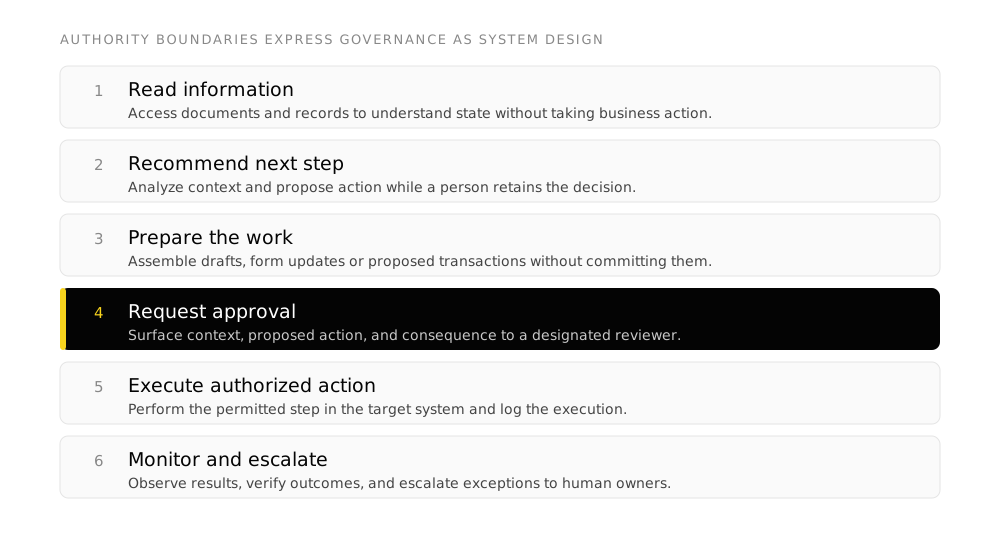
- Implement the six-level delegation ladder: Structure AI involvement through progressive stages: Read, Recommend, Prepare, Request Approval, Execute, and Monitor.
- Approval gates must follow operational consequence: Calibrate human checkpoints based on financial impact, legal liability, data sensitivity, and reversibility.
- Model capability does not grant authority: A system capable of executing an action must still be governed by business permissions, role definitions, and policy constraints.
- Build complete observability: Consequential automated actions must record the source context, model version, approval record, and execution payload for auditing.
The six levels of progressive AI delegation
Organizations can safely scale AI participation by adopting a progressive delegation framework:
1. Read
The system accesses records, reviews documents, and parses communication history without modifying any data. It establishes context and diagnoses current state.
2. Recommend
The system evaluates the context against business rules and proposes a course of action. A human reviews the suggestion and decides whether to accept it.
3. Prepare
The system assembles the tangible assets required to execute the action: populating form fields, assembling contract clauses, drafting customer communications, or structuring database payloads. The transaction remains in draft state.
4. Request approval
The system presents the prepared action to the designated decision-maker, surfacing the context, supporting evidence, potential trade-offs, and downstream impacts required for review.
5. Execute
Once authorized, the system invokes the permitted API or tool to commit the transaction into the target system of record and records the action in an audit log.
6. Monitor and escalate
The system monitors post-execution metrics, verifies that the expected outcome occurred, and escalates exceptions to human specialists if anomalous behaviour is detected.
Approval boundaries must match operational consequence
Human-in-the-loop oversight is often proposed as a universal safety measure. Without deliberate calibration, it creates severe bottlenecks.
If every low-risk, easily reversible administrative update requires managerial sign-off, the organization creates an expensive queue that eliminates the productivity gains of automation. Conversely, if high-value external commitments are executed autonomously, the business exposes itself to severe financial and legal liabilities.
Governance boundaries should be determined by operational consequence:
- Financial materiality: Does the transaction commit company capital or alter billing terms above a specified threshold?
- Reversibility: Can the action be rolled back instantly without customer impact, or does it permanently alter public state?
- Regulatory and compliance liability: Does the workflow handle protected personal data, health records, or formal financial filings?
- Customer trust: Is the communication customer-facing and sensitive, or internal and transactional?
- Data verification: Can the outcome be deterministically verified against an objective schema?
A reversible internal CRM record update can proceed autonomously. A contractual pricing concession or external compliance submission requires explicit human review regardless of how capable the model appears.
The context threshold
An assistant operating with flawed context produces a bad recommendation that an employee can catch. An autonomous agent operating with flawed context executes a bad transaction before anyone notices. Increasing autonomy requires increasing the reliability of underlying data sources.
Observability is mandatory for autonomous operations
An organization cannot responsibly delegate work that it cannot thoroughly inspect. If an autonomous agent alters records or communicates with customers, leadership must possess full audit visibility:
- What specific data records were retrieved as context?
- Which model version and prompt instructions evaluated the decision?
- What internal reasoning path led to the proposed transaction?
- Which governance policy permitted the execution?
- If approval was required, which user approved the action and at what timestamp?
- What exact API response was returned by the destination software?
Logging is not merely a post-incident compliance requirement; it is the primary feedback mechanism used to improve the system. Without deep operational observability, leadership cannot distinguish sound execution from silent degradation.
Exception handling is core architecture
Real business operations are filled with edge cases: expired contracts, conflicting records, ambiguous customer instructions, and network timeouts.
A resilient AI architecture incorporates explicit boundaries for when the machine must stop. Escalation is a designed operating path rather than a system crash. The architecture must specify:
- Which data anomalies trigger an immediate halt
- Which human role receives the escalated ticket
- What contextual evidence must be packaged for the specialist
- How the human resolution feeds back into the system to refine future performance
Without structured escalation pathways, an autonomous agent will attempt to resolve ambiguity through statistical guesswork, creating compounding errors across systems of record.
Progressive authority scaling
Organizations do not need to leap directly from manual drafting to unmonitored agentic execution. The sustainable path introduces delegation gradually:
- Deploy in observation mode. Allow the system to read context and log what it would recommend without exposing results to users.
- Enable human-assisted workflows. Surface recommendations and pre-assembled drafts to frontline staff, measuring acceptance and edit rates.
- Automate low-consequence actions. Grant autonomous execution rights only to low-risk, reversible actions with high validation confidence.
- Establish hardcoded approval checkpoints. Require human approval for consequential tiers, providing rich context cards to streamline review.
- Monitor error and escalation rates. Expand autonomous thresholds only when live operational data proves sustained accuracy.
To understand how to measure these operational milestones effectively, read Activity vs. Outcome. For details on ensuring your broader technical infrastructure is prepared to support this ladder, see AI Capability vs. Business Readiness.
- Treating autonomy as an all-or-nothing software setting across the entire business
- Demanding managerial approval for low-risk, reversible administrative updates
- Granting autonomous write access to critical customer records without audit logging
- Assuming an advanced model will intuitively know your company's risk boundaries
- Deploying autonomous agents without structured escalation protocols for ambiguous edge cases
Frequently asked questions
What is the difference between AI assistance and AI autonomy?
AI assistance supports a human worker by summarizing information, drafting content, or recommending next steps while the human executes the action. AI autonomy grants the software permission to evaluate context and execute permitted actions directly through APIs.
How do you establish approval boundaries for AI agents?
Define criteria based on consequence: financial limits, customer impact, data sensitivity, and reversibility. Actions below the risk threshold can execute autonomously; actions above it require human approval.
What happens when an AI agent encounters an exception?
A well-architected system halts execution, logs the anomalous condition, packages the full contextual state, and routes the task to a designated human specialist through an escalation protocol.
How does Begine Fusion help companies govern AI autonomy?
Begine Fusion designs custom governance layers: defining role-based tool permissions, implementing human-in-the-loop review interfaces, and building end-to-end audit pipelines through FusionGuard and FusionBuild.
Takeaways
- Autonomy is a graduated spectrum of operational authority, not a binary technical capability.
- Introduce AI authority through progressive steps: Read, Recommend, Prepare, Request Approval, Execute, and Monitor.
- Calibrate human approval checkpoints based on financial impact, reversibility, and regulatory liability.
- Autonomous systems require comprehensive audit trails detailing context, reasoning, authorization, and execution payloads.
- Design explicit escalation protocols so the system halts and alerts specialists whenever it encounters edge cases.