
AI Capability vs. Business Readiness: Your Model May Be Ready Before Your Company Is
For years, organizations could reasonably claim that artificial intelligence was not capable enough to handle complex, mission-critical business operations.
That rationale has largely dissolved. Modern frontier models analyze massive document stores, write and debug software code, parse multi-modal inputs, execute complex reasoning chains, call external APIs, and coordinate multi-step workflows.
Model capability continues to advance at extraordinary speed. However, inside most enterprises, the fundamental bottleneck has shifted. The model may be technically prepared to execute work; the business is simply not organized to allow it.
An advanced reasoning system cannot resolve organizational ambiguity that the business has never settled. Deploying AI across messy data, undocumented handoffs, and undefined permissions produces compounding errors faster than any human team could. The primary competitive advantage is no longer model access; it is operational readiness.
TL;DR
- The constraint has shifted from model to business: Foundation models possess substantial analytical capability, but broken data and unmapped processes prevent real deployment.
- AI cannot navigate unorganized information: If company policies, customer records, and operational rules conflict, an AI agent cannot divine which source is true.
- Process legibility is mandatory for agents: Automated workflows require explicit rules detailing standard paths, exception branches, and escalation authorities.
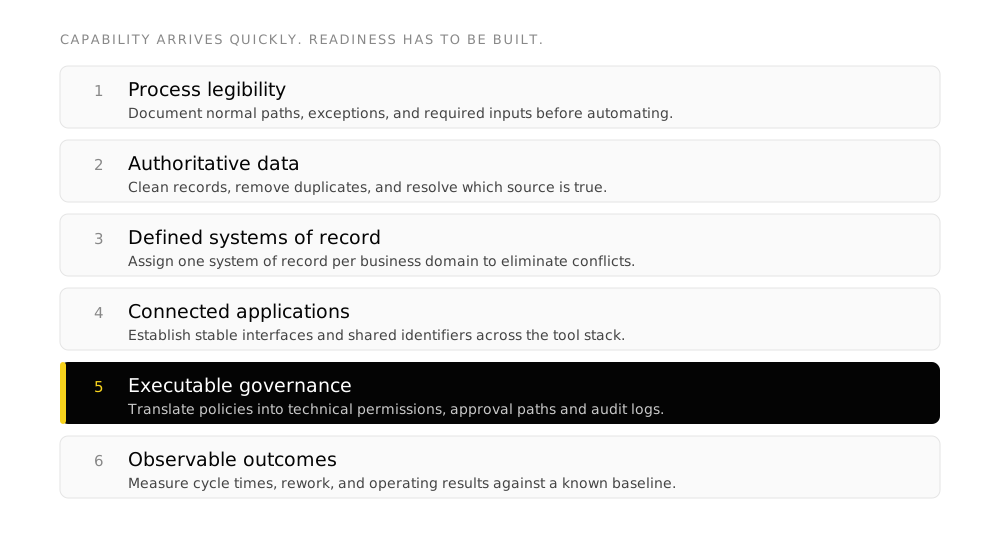
- Readiness spans six operational layers: Process clarity, authoritative data, defined systems of record, connected applications, executable governance, and observable outcomes.
- Readiness creates compounding enterprise value: Cleaning data, clarifying processes, and integrating software pays dividends across daily operations even before deploying advanced AI.
AI cannot interpret information the enterprise cannot organize
Consider a business deploying an autonomous agent to handle incoming client inquiries. The initiative immediately collides with operational disorganization:
- The public marketing website outlines one version of the service policy.
- The sales team uses an outdated pitch deck with conflicting pricing terms.
- A PDF stored in an internal shared folder holds the current discount matrix.
- The CRM contains custom terms negotiated informally with individual accounts.
- Senior account managers carry the real operational rules in their heads.
The AI model may possess state-of-the-art reasoning capabilities. Yet the information environment it is asked to navigate is contradictory.
An algorithm cannot resolve institutional contradictions that management has allowed to persist for years. AI does not eliminate the requirement for information architecture; it exposes the absence of it immediately.
Informal processes must become operationally legible
Many companies function through undocumented tribal knowledge. An experienced coordinator knows that when a certain client flags an issue, a specific director must be notified privately. A billing specialist knows which spreadsheet must be adjusted before an invoice can be issued. An account executive knows which official CRM stages are routinely skipped.
Human employees compensate for broken systems through personal relationships, institutional memory, and informal coordination. Software agents cannot.
An autonomous system requires operational legibility:
- What specific event initiates the workflow?
- What exact data inputs must be validated before moving forward?
- Which operational conditions trigger an alternate branch?
- What are the explicit authority thresholds for human sign-off?
- Where is the true transaction state recorded?
- What constitutes an exception, and who owns the escalation?
Documenting these rules does not make a business rigid; it makes operations repeatable and automatable. For a complete breakdown of why technology must follow workflow design, review Tools vs. Systems.
The six layers of the operational readiness stack
Converting model capability into dependable business performance requires six connected infrastructure layers:
1. Process legibility
Documenting the core business sequences, required inputs, handoff criteria, and known edge cases before introducing automation.
2. Authoritative data
Deduplicating customer and product records, establishing standardized taxonomies, and resolving data conflicts across legacy databases.
3. Defined systems of record
Assigning single, definitive sources of truth for each business domain: CRM for customer relationships, accounting for financial ledger entries, ERP for inventory.
4. Connected applications
Building reliable API interfaces and data pipelines that allow systems to exchange information without manual human copying. See Prompting vs. Agentic Workflows.
5. Executable governance
Translating high-level company policies into technical permissions, approval gates, rate limits, and audit logging pipelines. Consult Assistance vs. Autonomy for authority frameworks.
6. Observable outcomes
Establishing clear baselines and tracking real cycle time, rework rates, and operational capacity rather than vanity usage metrics. Refer to Activity vs. Outcome.
Governance must transition from policy documents to executable code
Most enterprises have written security and AI policies. These documents typically declare broad principles: “Protect confidential client information,” “Ensure fair outcomes,” or “Prevent unauthorized commitments.”
Principles are helpful guides for humans. Autonomous systems require executable constraints:
- Which specific customer data fields must be redacted before sending payloads to an external model?
- Which foundation model endpoints are authorized for confidential financial data?
- What maximum dollar value can an automated agent approve without managerial sign-off?
- What exact payload must be written to the central audit log upon execution?
- Who receives an automated escalation when an API connector returns an error?
Governance becomes reliable when encoded directly into the orchestration software. For strategies on maintaining independent control over your enterprise governance layer, read Vendor Dependency vs. Owned Orchestration.
The readiness test
Select your highest-volume customer process. Could a newly hired employee execute that process flawlessly on day one using only your documented procedures and software systems, without asking a colleague for informal advice? If the answer is no, your process is not ready for autonomous AI agents.
Purchasing software licenses does not create operational readiness
A common strategic mistake is equating technology procurement with organizational capability:
- A leadership team buys generative copilot licenses for every employee and assumes productivity will surge.
- An enterprise signs an enterprise contract with an AI agent platform while customer records remain fragmented across three legacy CRMs.
- A company deploys automated customer service bots while product pricing rules remain undocumented.
Procuring access to a model is not the same as preparing the business to use it. A reasoning engine cannot overcome broken operational foundations. To understand how to bridge the gap between technical launch and actual adoption, review Implementation vs. Adoption.
Operational readiness creates compounding enterprise value
Preparing an organization for artificial intelligence is not administrative overhead; it is foundational operational improvement.
Every investment made in readiness yields immediate business returns:
- Cleaning customer databases improves executive reporting accuracy and sales conversion immediately.
- Eliminating duplicate data entry frees hundreds of employee hours each month.
- Establishing clear process handoffs cuts onboarding time for new hires.
- Centralizing systems of record prevents costly cross-departmental miscommunications.
- Enforcing role-based access permissions hardens cybersecurity posture.
The organization improves its daily operating efficiency while building the structural launchpad for advanced automation.
The emerging competitive advantage is organizational
Access to frontier models is widely distributed. Every company has access to the same world-class foundation models through standard APIs.
Over time, model access alone will provide zero competitive differentiation. The true differentiator is an organization’s structural ability to connect that intelligence to its proprietary context, verified databases, and execution workflows.
One enterprise will deploy AI primarily as a conversational drafting tool for individual workers. A competitor will connect models to an integrated operating system, executing complex cross-departmental transactions with auditable governance and human accountability. For guidance on structuring human decision-making alongside machine generation, see Assembly vs. Judgment.
The models are ready. The imperative now is building the business systems capable of putting them to work.
- Purchasing AI software licenses before resolving underlying data quality issues
- Expecting an AI model to navigate contradictory, undocumented business policies
- Granting autonomous write permissions without role-based access controls and audit trails
- Treating data cleanup and process documentation as unnecessary administrative overhead
- Assuming foundation model access will compensate for missing operational infrastructure
Frequently asked questions
What does it mean for a business to be AI-ready?
Business AI readiness means having documented processes, authoritative systems of record, clean structured data, connected software APIs, and enforceable governance rules that allow models to participate safely in daily operations.
Why do most enterprise AI pilots stall before production?
Most AI pilots stall because the underlying business data is fragmented, processes are undocumented, and the organization lacks the permission and approval architecture required to let models take live actions.
Can a company achieve AI readiness without hiring a large data science team?
Yes. Readiness is primarily an operational and systems architecture discipline rather than pure machine learning research. It involves mapping processes, cleaning data, and integrating existing software.
Where should our organization begin preparing for AI systems?
Begin by diagnosing your operational architecture: identify where data is siloed, where handoffs stall, and which processes carry the highest manual coordination overhead. That evaluation is the focus of FusionMap and Systems Readiness Assessment.
Takeaways
- The primary bottleneck in enterprise AI has shifted from model capability to organizational readiness.
- AI models amplify the effectiveness of sound systems, but accelerate the chaos of broken processes and bad data.
- Operational readiness requires six layers: process clarity, data quality, systems of record, integrations, governance, and metrics.
- Translate high-level corporate policies into executable technical permissions, rate limits, and audit logging.
- The enduring competitive advantage is the business architecture that connects intelligence to enterprise execution.