
Prompting vs. Agentic Workflows: Business AI Is Moving Beyond Chat
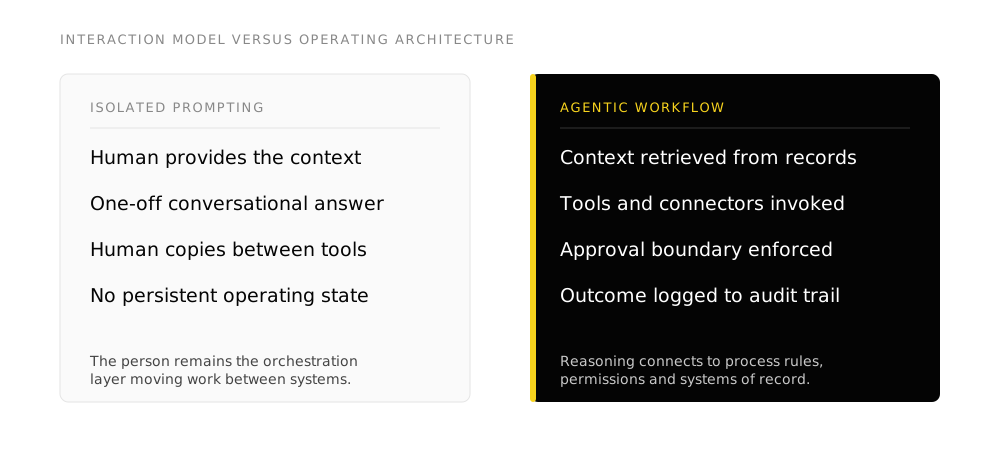
The initial wave of generative artificial intelligence inside companies was chat-based. An employee opens a browser tab, types a prompt, reviews the generated text, edits the phrasing, and pastes the result into an email or document.
That interaction model provides accessible personal assistance. An individual can draft a message faster, summarize notes, or analyze tabular data. However, real business processes do not conclude with a block of text on a screen.
Work moves across platforms. A customer inquiry must query account status in the CRM, check inventory levels in the ERP, verify policy terms, generate a draft response, create an internal task, and log an audit trail. Prompting leaves the burden of moving that work entirely on the employee. Agentic workflows connect model reasoning directly to business infrastructure.
TL;DR
- Prompting leaves the human as the integration layer: Typing into a chat window requires a person to gather context, evaluate results, and manually paste data between enterprise tools.
- Agentic workflows connect reasoning to execution: An agentic architecture ingests triggers, queries systems of record, calls authorized tools, enforces approval gates, and writes updates back to databases.
- The model is not the operating system: Reliable execution depends on the surrounding system architecture: data permissions, state management, audit logging, and exception escalation.
- Agentic does not mean unconstrained autonomy: Complex multi-step reasoning can prepare recommendations and execute minor steps while routing high-stakes decisions through human approvals.
- Automate repeatable multi-system coordination: Begin with processes where staff spend hours retrieving context across multiple screens to make standard business decisions.
The limits of the conversational prompt
Prompting provides an interface to a language model. The human remains the orchestration layer:
- The human locates the relevant source documents.
- The human pastes the business context into the prompt box.
- The human verifies whether the model hallucinated details.
- The human copies the output into the target software.
- The human executes the next step in the operational sequence.
This approach creates individual productivity gains, but it leaves the operating architecture untouched. The organization remains reliant on individuals remembering the right prompt phrasing and manually transferring records between disconnected tabs. To move beyond individual prompts toward institutional infrastructure, review our guide on building AI workers and workflow automation.
How agentic workflows alter operational structure
An agentic workflow embeds model reasoning into a structured operational sequence. Rather than waiting for manual prompts, the architecture listens for business events, evaluates context, invokes approved tools, requests human validation where necessary, and commits updates to systems of record.
Consider an inbound customer dispute:
- An inbound dispute notification arrives via customer support email.
- The agent parses the communication and identifies the customer record.
- The system queries the billing system and retrieves invoice history.
- The system inspects contract terms and refund eligibility rules.
- The model assesses the claim against documented operating guidelines.
- The system drafts a customer resolution and populates a proposed credit note.
- If the refund amount exceeds an established threshold, the system routes the request to a supervisor.
- Upon approval, the agent triggers the credit transaction in the billing system.
- The CRM timeline is updated with the resolution and audit summary.
- The confirmation email is sent to the client.
The generative model performs the contextual interpretation and language synthesis. The business architecture provides data access, validation rules, transactional tools, authorization controls, and audit logs.
The model is only one piece of the architecture
Organizations often discuss deploying an advanced foundation model as if the model itself constitutes an operating system. A model cannot run an enterprise process in isolation.
A high-performing reasoning engine will produce flawed results if supplied with incomplete context. It can recommend an accurate commercial action but fail if it lacks an API connection to the system of record. It can trigger unauthorized database updates if security permissions are undefined.
An enterprise agentic system requires a coordinated architecture:
- Systems of record: Authoritative databases for customer, financial, and operational truth.
- Context retrieval: Knowledge stores that feed current policy and operational records into the reasoning loop.
- Orchestration layer: Logic that dictates state, task delegation, and execution order.
- Tool interfaces: Secure API connectors that allow the model to query data and execute approved tasks.
- Identity and permissions: Role-based access controls defining what tools each agent may invoke.
- Approval gates: Hardcoded human review checkpoints for sensitive or irreversible actions.
- Audit logging: Comprehensive records detailing context ingested, reasoning steps taken, and tools called.
- Exception handling: Explicit protocols for escalating ambiguous cases to human specialists.
When enterprise AI fails, the failure almost always originates in the surrounding architecture rather than the underlying model weights. For strategies on maintaining architectural ownership across platforms, see Vendor Dependency vs. Owned Orchestration.
The context test
If an AI agent requires an employee to spend ten minutes searching files and formatting context before it can produce a reliable result, the workflow has not been automated. The context retrieval and data pipelines must be engineered into the system.
Agentic execution does not require complete autonomy
A common misconception assumes that an agentic workflow must operate without human supervision. Real operational systems require calibrated authority boundaries.
An agent can analyze complex datasets, prepare comprehensive recommendations, and assemble draft transactions while leaving the final approval to a human operator. In commercial lending, an agent might evaluate applicant financials, verify collateral documentation, cross-reference policy guidelines, and assemble the credit memorandum. A credit officer reviews the memorandum and signs the approval.
The system remains agentic because the AI coordinates the multi-step information gathering and preparation. The business preserves governance by maintaining an explicit human approval boundary. For an operating framework on designing these controls, read Assistance vs. Autonomy.
Identifying candidate workflows for agentic design
Not every administrative task warrants an agentic system. Many routine steps are executed more reliably through deterministic automation, such as standard webhook triggers or database rules. Other tasks remain best suited for human judgment.
Agentic systems deliver maximum value where workflows require contextual interpretation across multiple systems:
- Cross-system data synthesis: Routine operations requiring an employee to pull information from three or four separate software suites before making a decision.
- Semi-structured customer intake: Inquiries arriving via email or free-form text that require classification, verification against policy, and routing.
- Complex document assembly: Proposals, reports, or audits that draw upon historical customer records, product technical sheets, and variable pricing rules.
- Exception triage: Initial analysis of operational anomalies, comparing live data against operating thresholds to propose remediations.
The diagnostic question to ask your operations team is straightforward:
Where do skilled employees spend their hours acting as human copy-paste bridges between our software applications?
That coordination burden is where agentic architecture creates compounding leverage.
- Relying on staff memory and custom prompt collections to execute core business processes
- Granting autonomous write permissions to an AI model without strict schema validation and audit trails
- Deploying chat interfaces and assuming enterprise workflow automation has been achieved
- Allowing AI agents to make irreversible commitments without human approval checkpoints
- Failing to log intermediate reasoning steps and tool execution payloads for audit review
Frequently asked questions
What makes an AI workflow agentic?
An AI workflow is agentic when the model can evaluate state, determine intermediate steps, call external software tools to gather data or take actions, and iterate toward a defined goal rather than simply outputting a single text response.
Do agentic workflows replace existing automation platforms?
No. Agentic workflows incorporate existing automation tools, APIs, and databases. The agent provides reasoning, interpretation, and dynamic tool selection, while underlying automation engines execute the verified transactions.
How do you prevent an AI agent from making costly operational mistakes?
Implement strict authority boundaries: restrict database permissions to read-only where possible, establish human approval gates for external actions, and require validation schemas before committing changes to systems of record.
Where does Begine Fusion fit into agentic AI deployment?
Begine Fusion designs the end-to-end operational architecture: connecting business databases, configuring orchestration pipelines, defining permission boundaries, and integrating agentic workflows through FusionBuild and Systems Build.
Takeaways
- Prompting provides personal conversational assistance; agentic workflows connect AI reasoning to operational execution.
- Leaving employees to copy data between models and enterprise tools limits productivity and prevents system-level scale.
- Enterprise reliability depends on system architecture: data access, tool permissions, state management, and audit logging.
- Agentic workflows can execute multi-step research and preparation while preserving human authority for consequential decisions.
- Target agentic engineering at operations where staff currently spend hours gathering context across disconnected software.