
Case Study: Burger King's Stevenage Challenge - How a £50K Sponsorship Generated Billions of Impressions
- Evangel Oputa
- Mar 27
- 6 min read

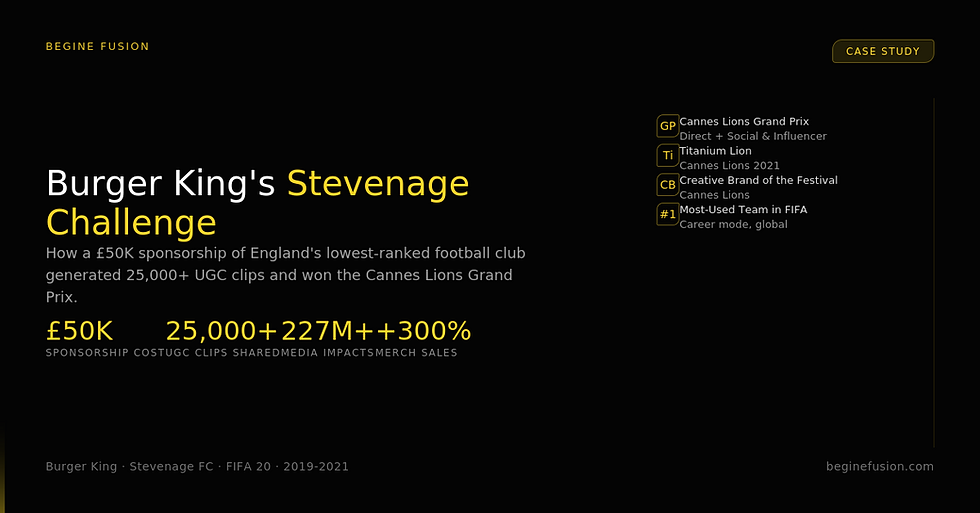
Burger King spent an estimated £50,000 to sponsor Stevenage FC, a club in England's fourth-tier League Two, and turned that into one of the most awarded marketing campaigns in recent history.
The 2019 campaign exploited a specific mechanic in EA Sports' FIFA 20: every licensed club's kit appears in the game, regardless of league position. Burger King's logo on Stevenage's shirt meant its brand appeared in a game played by tens of millions globally.
A two-week challenge drove 25,000+ user-generated goal clips across social media, made Stevenage the most-used team in FIFA career mode, and generated over 150 media placements.
The campaign won the Cannes Lions Grand Prix in both Direct and Social & Influencer categories, plus a Titanium Lion.
Campaign Snapshot
Brand: Burger King (Restaurant Brands International)
Year / Location: 2019-2021 / Global (originated UK)
Campaign Type: Gaming-native sponsorship activation
Core Innovation: Exploiting video game licensing mechanics to get world-class player endorsements at zero endorsement cost
Headline Result: £50K spend, 25,000+ UGC clips, 150+ media placements, Grand Prix at Cannes Lions, jerseys sold out for first time in club history
Background
Football sponsorship operates on a simple economic model: the bigger the club, the bigger the audience, the bigger the price tag. Chevrolet paid Manchester United £64 million per year for front-of-shirt placement. Even mid-table Premier League clubs command eight-figure deals. For a fast-food brand competing for attention among millennials and Gen Z, who made up roughly 50% of Burger King's traffic according to the brand's own Cannes submission, the math on traditional football sponsorship did not work.
But EA Sports' FIFA video game series introduced a variable that the sponsorship market had not priced in. FIFA licenses every professional English football club, from the Premier League down to League Two. Every club's kit appears in the game exactly as it looks in real life, sponsors included. A League Two shirt sponsorship costing five figures puts a brand in the same digital environment as sponsors paying eight figures.
Stevenage FC, based in Hertfordshire, averaged around 3,000 fans per home match. They had no international profile. They had just finished near the bottom of League Two. Their shirt sponsorship slot was available for a fraction of what top-tier clubs charge.
Problem Identification
Burger King faced several constraints:
Budget asymmetry. Competitors and attention-rivals (Nike, Adidas, major betting firms) were outspending Burger King in sports marketing by orders of magnitude.
Audience migration. The 18-30 demographic was shifting attention from broadcast football coverage to gaming and social media.
Endorsement economics. Getting a single top-tier footballer to wear or promote the brand would cost millions in image rights alone.
Organic reach decline. Social platforms were throttling brand content. Burger King needed a mechanism that generated user content, not brand content.
Strategy
The strategy rested on one structural insight: FIFA's transfer mechanic lets any player sign any footballer to any club. If Burger King's logo was on Stevenage's shirt, gamers could sign Lionel Messi to Stevenage, and Messi would appear wearing the Burger King crest. No endorsement deal required. No image rights negotiation. The game's own mechanics did the work.
The target audience was FIFA gamers globally, skewing male, 12-30 years old, with heavy overlap with Burger King's core customer base. The positioning leaned into the underdog story. The appeal of putting the world's best players in a fourth-division kit tapped directly into FIFA's existing career mode challenge culture, where players already enjoyed building weak teams into powerhouses.
The incentive mechanic was straightforward: score a goal as Stevenage in FIFA 20, share the clip on social media, receive Burger King food rewards. Challenges escalated from basic goals to scoring from corners, free kicks, and past the halfway line, creating tiered difficulty and repeat participation.
Implementation
Phase 1: Sponsorship (2019 pre-season)
Burger King signed a front-of-shirt sponsorship deal with Stevenage FC, reported at approximately £50,000 for the season. The deal ensured Burger King's logo appeared on Stevenage's kit in FIFA 20 when the game launched in September 2019.
Phase 2: Challenge Launch (October 2019)
Burger King released a video on social media explaining the play. They had deliberately sponsored a bottom-tier club to get into FIFA. The transparency was part of the appeal. The video invited gamers to sign star players to Stevenage, complete scoring challenges, and share clips for rewards.
Phase 3: Community Amplification
FIFA streamers and YouTubers picked up the challenge organically. Twitch creators played as Stevenage on stream, some wearing the physical Stevenage home shirt. The challenge aligned with existing content formats so creators did not need to break their format to participate.
Phase 4: Media Crossover
The campaign crossed over from gaming media into mainstream sports and marketing press. High-profile football personalities, including Gary Lineker, publicly praised the campaign, driving a second wave of coverage.
Phase 5: Extension (2020-2021)
The partnership extended to a second year. Additional activations included a Burger Queen campaign with the Stevenage women's team to promote the women's game.
Results
25,000+ user-generated goal clips shared on social media
150+ media placements (Warc / Cannes submission)
227 million+ media impacts (Warc / Cannes submission)
+8 percentage points increase in UK app awareness
+300% Stevenage merchandise sales growth
First jersey sellout in the club's 43-year history
#1 most-used team in FIFA career mode during the campaign
Awards
Cannes Lions Grand Prix in Direct
Cannes Lions Grand Prix in Social & Influencer
Titanium Lion at Cannes Lions
Creative Brand of the Festival at Cannes Lions
D&AD recognition
Challenges and Solutions
When the partnership was announced, some Stevenage supporters booed the Burger King branding. A fast-food logo on a local football club's shirt felt incongruent to match-going fans. The campaign's success and the global attention it brought to the club shifted sentiment. Jersey sales, media coverage, and the cultural moment outweighed the initial resistance. The partnership ran for two full years.
Burger King could not control user-generated content quality. Clips ranged from spectacular goals to routine tap-ins. The volume strategy absorbed this. With 25,000+ clips, the sheer quantity ensured thousands of high-quality, shareable moments surfaced. The tiered challenge structure also pushed participants toward more dramatic content.
The 2019/20 season was disrupted by COVID-19, which could have ended the campaign's momentum. But gaming consumption increased during lockdowns. The FIFA-native campaign was immune to stadium closures because it lived entirely in a digital environment. The partnership extended through the 2020/21 season.
Key Takeaways
Exploit platform mechanics, not platform budgets
Burger King did not pay FIFA or EA Sports anything. They used the game's existing licensing system, a mechanic designed for authenticity rather than advertising, as a distribution channel.
Make the audience the campaign
The 25,000+ clips were not produced by Burger King. They were produced by gamers doing something they already enjoyed. The brand provided structure and incentive. The audience provided scale.
Sponsor the asset, not the audience
Traditional sponsorship buys access to an audience (stadium fans, TV viewers). Burger King sponsored an asset (the shirt) that traveled into a larger ecosystem (FIFA) where the audience already existed.
Transparency can be the hook
Burger King's launch video openly admitted the strategy. That honesty became part of the story people wanted to share.
Build on existing behavior
FIFA career mode rebuilds were already a popular content genre. Burger King gave existing behavior a brand layer and a reward structure. They did not ask anyone to do something new.
Lessons for Other Brands
Audit existing platforms for underpriced access points. Every industry has ecosystems where small investments can unlock disproportionate visibility. The question is where the licensing, mechanics, or distribution channels have not been priced to reflect their actual reach.
Design for user-generated content at the structural level. The Stevenage Challenge worked because the output (a goal clip) was something people already knew how to create and already wanted to share. UGC campaigns fail when they ask people to produce content outside their normal behavior.
Separate the brand vehicle from the brand destination. The shirt was the vehicle. The app was the destination. The campaign drove brand engagement (food rewards, app downloads) without making the engagement mechanism feel like an ad.
This model applies anywhere a brand can find an undervalued asset that exists inside a high-traffic digital environment. The principle is the same: find where the licensing gap between real-world cost and digital-world distribution is widest.
Sources
Warc / Cannes Lions case documentation
Ogilvy - Stevenage Challenge work page
Ads of the World (Clio Network) - BK Stevenage Challenge
Goal.com - Burger King reveals the FIFA ploy behind Stevenage sponsorship
Campaign US - Stevenage Challenge is the best BK campaign at Cannes
The Football Week - How Burger King Made Stevenage Famous on FIFA
WPP - DAVID Madrid: Stevenage Challenge
MiMedia - The Stevenage Challenge case analysis
Data Notes
The £50,000 sponsorship figure is an industry estimate widely cited but never officially confirmed by Burger King or Stevenage FC. Some sources report 1.25 billion earned media impressions while the Warc/Cannes submission reports 227 million impacts. These likely measure different things. Both figures are included for transparency, with the Warc figure treated as the more verifiable number.


Comments