
TL;DR
- The objective: begin by asking what you are trying to achieve as a company.
- The old way: growth that depends on how many people you can hire is how companies used to grow.
- One test: a proof of concept, one process and one agent, shows the company what is possible.
- SOPs: AI writes the first draft of a standard operating procedure, and you spend your time reviewing it.
- Tools: paying for each tool separately adds up; one ecosystem brings the technology cost down.
A business leader tells us their costs keep climbing. The overhead is technology and people, and every step of growth means another hire. Here is how we look at it.
Ask what your objective is as a company
We look at the company’s objective first. What are you trying to achieve as a company? Do you want to get more people through your doors? Do you want to save money? The answer decides which process we build.
Growth tied to hiring is the old way
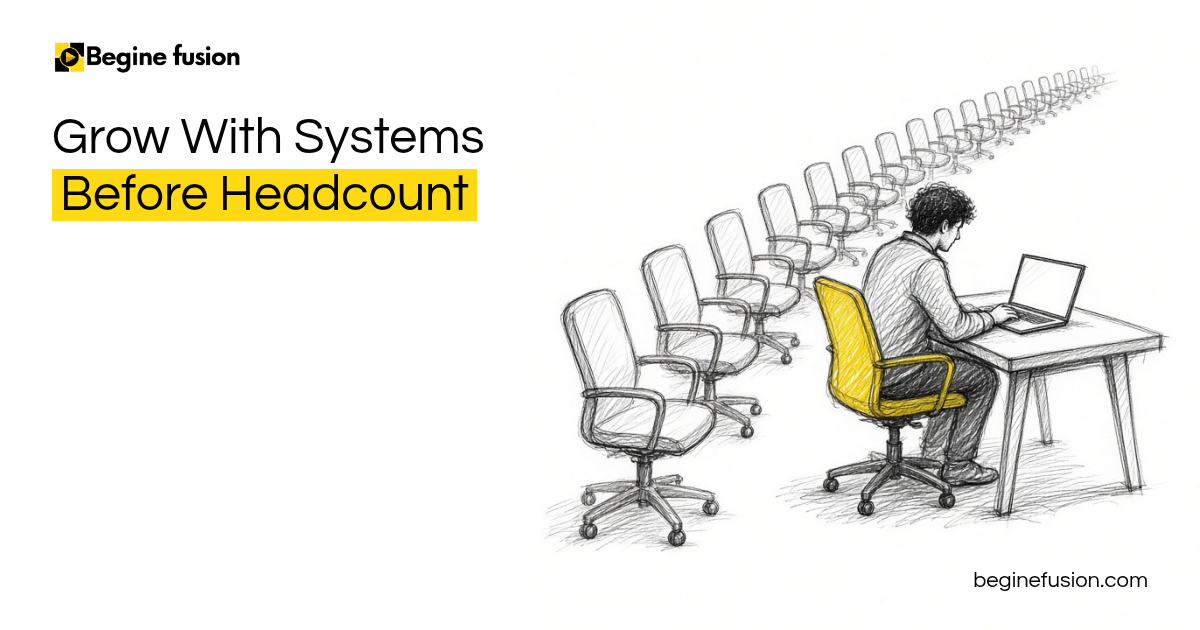
When your growth depends on how many people you can hire, every new customer means a new salary. Companies grow another way now. You put AI systems in place inside the company, and the people you already have get more done.

Begin with one process and one agent
We typically begin with a proof of concept to show the company that something is possible. One process, one agent, so you can test AI on your own work. Our post on piloting with one team first covers why one test comes before the rollout.
AI writes the SOP, and you review it
Take one clear example: a business leader who spends a lot of time writing standard operating procedures. Writing every SOP from scratch is a thing of the past. AI can write an SOP quickly, and you spend your time reviewing what it wrote.
That saves money, and the staff you already have get more done. As they do, the extra cost you were planning around shrinks.

Bring your tools into one ecosystem
Next, look at your technology. Set out every tool you use. Many businesses pay for a long list of separate tools, each one billed on its own. Bringing that ecosystem into one platform cuts down your technology cost. We bring it into Zoho, and Zoho One puts those tools in one place.
Your systems carry the growth
Put the two together. Your staff get more done with AI, and your technology cost comes down. That is how we approach it, and it comes back to the first question: what is your objective as a company? Our post on half the manual work done by your system covers what the system can take on.
If you pay for many tools separately: Try Zoho One.
Takeaways and next steps
- Ask what you are trying to achieve as a company before you build anything.
- Growth tied to hiring is the old way; AI systems help the team you have get more done.
- Begin with a proof of concept: one process and one agent.
- Let AI write the first draft of each SOP, and spend your time reviewing it.
- List your tools and bring them into one ecosystem to cut technology cost.
Common mistakes when growth means hiring
1. Hiring for every new step of growth.
Why it fails: Costs climb with every customer you add.
Better approach: Put AI systems in place so your current team gets more done.
2. Writing every SOP from scratch.
Why it fails: Hours go into documents AI can draft quickly.
Better approach: Let AI write the draft, and spend your time reviewing it.
3. Paying for each tool on its own.
Why it fails: The technology bill grows with every tool you add.
Better approach: Bring your tools into one ecosystem.
Frequently asked questions
Where does this begin?
With your objective as a company: more people through your doors, saving money, or something else.
How do we test AI before committing?
With a proof of concept: one process and one agent, tested on your own work.
Does AI replace the person who writes our SOPs?
AI writes the draft quickly, and that person spends their time reviewing it.
How does one ecosystem cut cost?
You stop paying for many separate tools, each billed on its own.
Which ecosystem do we bring businesses into?
We bring them into Zoho One, which puts the tools in one place.
Glossary
- SOP
- Standard operating procedure: the written steps for how a task gets done.
- Proof of concept
- A quick test, often one process and one agent, that shows something is possible.
- Ecosystem
- A set of tools from one platform that share data with each other.
- Overhead
- The running costs of the business, such as technology and staff.



 The Back-Office AI List for Owners Whose Clients Want a Person
 AI Readiness Checklist: 7 Questions Before You Build