
Vendor Dependency vs. Owned Orchestration: Who Controls Your AI Operating Layer?
Artificial intelligence is being embedded across every enterprise software application. CRM suites add autonomous sales representatives. Productivity suites introduce workspace copilots. Customer support platforms offer automated ticket resolution. Accounting engines deploy invoice reconciliation assistants.
These native vendor features offer immediate convenience. They also introduce a fundamental architectural challenge.
If every SaaS vendor provides an isolated AI layer, who coordinates the business processes that span across them? A customer journey does not exist entirely inside your CRM, your finance system, or your project management software. An operational workflow moves through all of them.
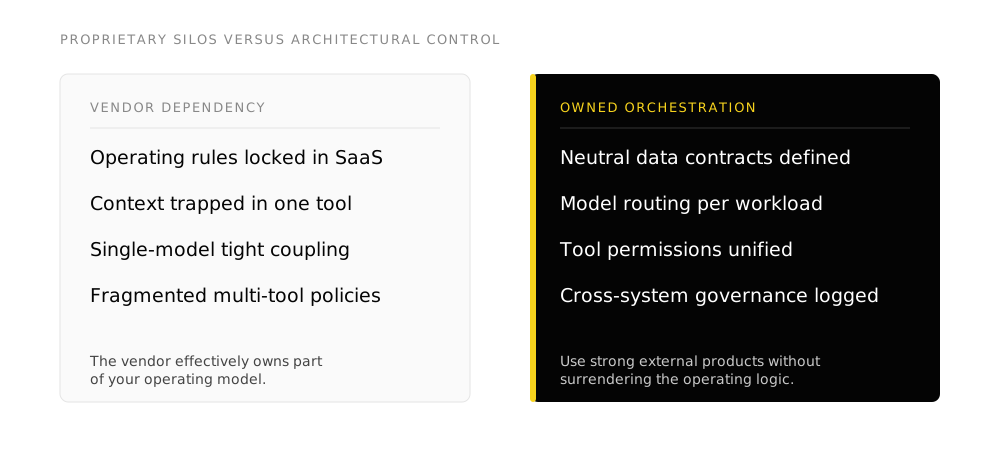
When leadership allows each vendor to own an isolated pocket of automation, the enterprise ends up with fragmented data silos, inconsistent security policies, and deep proprietary lock-in. Retaining architectural control through owned orchestration allows companies to leverage external technology without surrendering their operating model.
TL;DR
- Vendor AI is optimized for the vendor's product: SaaS providers design agents to keep your data and operations anchored within their specific software ecosystem.
- Owned orchestration does not mean building everything: Buy leading SaaS products and external models, but own the routing, data contracts, and permission boundaries that connect them.
- Decouple business processes from specific models: Model capabilities, context limits, and pricing evolve rapidly. Maintain an orchestration layer that allows swapping underlying models without rewriting workflows.
- Prevent context lock-in: Ensure organizational knowledge, decision histories, and operational policies reside in neutral, accessible data stores rather than proprietary vendor features.
- Implement unified cross-vendor governance: Enforce consistent access permissions, audit logging, and human approval gates across all platforms from an independent orchestration layer.
Vendor AI serves the vendor’s commercial priorities
Software vendors build AI capabilities to maximize the value, stickiness, and usage of their own applications.
A CRM vendor designs agents that prioritize CRM records. An enterprise messaging suite optimizes for interactions occurring inside its chat channels. A help desk vendor concentrates automation within its proprietary ticket database.
Within their individual boundaries, these tools can perform well. The architectural failure occurs when a business assumes that one application’s embedded AI can serve as the neutral operating brain for the entire company.
Vendors maintain their own commercial models, closed APIs, proprietary permissions, and feature limitations. Your enterprise has operating processes that cross those corporate walls. Surrendering workflow coordination to a single application creates a structural dependency that makes future operational evolution difficult and expensive.
Architectural ownership versus proprietary engineering
A frequent misconception assumes that avoiding vendor lock-in requires a company to engineer all of its software from scratch.
Organizations should continue to buy mature SaaS products. They should license commercial foundation models, use cloud-hosted databases, and deploy specialized APIs where economically sensible.
Owned orchestration is about governance and control over the operating logic:
- Authoritative data contracts: Defining the exact data schema and shared identifiers that connect systems of record.
- Dynamic model routing: Directing simple tasks to cost-effective models while routing complex reasoning to high-capability engines.
- Independent workflow definitions: Documenting and orchestrating multi-step operational logic outside proprietary visual workflow builders.
- Centralized permissions: Enforcing uniform role-based access controls across all tools called by autonomous agents.
- Standardized audit trails: Maintaining an independent, cross-platform record of agent context, tool executions, and user approvals.
- Component modularity: Preserving the capability to replace an individual application or AI model without redesigning the underlying business process.
The enterprise maintains control of the system design while using vendor software as swappable components. To understand how agentic workflows connect across enterprise infrastructure, read Prompting vs. Agentic Workflows.
Decouple business processes from model providers
Foundation model capabilities, latency profiles, context window sizes, and pricing structures evolve every quarter.
An organization that hardcodes a single proprietary model into every internal workflow creates an expensive technical debt. When a more capable or cost-effective model launches, migrating the workflow demands extensive engineering rewrites.
A durable architecture separates the operational workflow from the specific model:
- An inbound customer triage workflow can invoke a fast, low-cost model for classification.
- An exception analysis can invoke a deep reasoning model for root-cause diagnosis.
- A sensitive workload handling personal client data can route to an isolated private endpoint.
The business process remains stable. The orchestration layer routes each task to the optimal model based on latency, expense, and data governance policies.
The context portability test
If your vendor increased prices by fifty percent tomorrow, could your organization extract its workflow definitions, customer history, and decision memory to run on another platform within thirty days? If not, you have outsourced your operating architecture rather than licensing software.
Prevent business context from being trapped in SaaS features
Artificial intelligence systems gain operational leverage from institutional context. Over months of operation, agents accumulate workflow histories, customer preferences, resolved exceptions, and organizational knowledge.
Leadership must ensure that this context resides in accessible, owned stores:
- Institutional memory: Company operating policies and knowledge bases should live in open, structured formats rather than closed vendor knowledge engines.
- Execution state: The history of actions taken by agents should be written back to authoritative enterprise databases via standard APIs.
- Workflow logic: Business decision trees and authority limits should be documented independently rather than locked inside proprietary drag-and-drop automation builders.
When a company allows its operating logic and contextual memory to be locked inside a single vendor’s closed feature, migrating away becomes nearly impossible. The vendor effectively holds the company’s operating system hostage.
Enforce cross-vendor governance and security
Fragmented AI deployment inevitably leads to fragmented corporate governance:
- One SaaS vendor retains prompt history for thirty days; another vendor uses inputs for model training by default.
- One tool allows automated external emails without approval; another provides no audit logging for automated database changes.
- Permissions assigned in one application do not carry over when an agent calls an external integration.
Enterprise governance cannot be administered on a tool-by-tool basis. The company requires a centralized control architecture:
- Egress policies: Explicit rules governing which classes of customer and financial data may be processed by third-party models.
- Standardized approval gates: Enforcing human sign-off on high-impact transactions across all connected software.
- Attribution and auditing: Logging every automated action to an independent ledger that records the user identity, model reasoning, and system response.
Vendor tools provide the execution endpoints; your orchestration layer enforces the organizational policy. For an end-to-end framework on preparing your business infrastructure for scalable automation, see AI Capability vs. Business Readiness.
- Relying on a single SaaS application to serve as the automation brain for the entire company
- Hardcoding proprietary model endpoints directly into core operational workflows
- Allowing company knowledge and decision histories to become trapped in closed vendor platforms
- Permitting different software vendors to dictate contradictory security and data retention rules
- Building brittle point-to-point integrations that break when an underlying API changes
Frequently asked questions
What is owned orchestration in enterprise AI?
Owned orchestration is the practice of designing and controlling the data routing, workflow definitions, model selections, and governance rules that connect enterprise software, rather than outsourcing that logic to a single proprietary SaaS vendor.
Does owned orchestration require building our own AI models?
No. Owned orchestration uses commercial APIs and leading foundation models. The ownership applies to the architecture that connects those models to your databases, tools, and human approval processes.
How do we avoid vendor lock-in when deploying AI agents?
Maintain clean data contracts, store company context in neutral formats, define business logic independently of SaaS automation builders, and use an orchestration layer that allows swapping underlying models without refactoring the process.
How does Begine Fusion assist with AI architecture?
Begine Fusion designs vendor-flexible architectures across systems of record, data connectors, and governance frameworks through Systems Build and FusionBuild.
Takeaways
- Vendor AI is optimized to protect the vendor's software ecosystem rather than coordinate your entire business.
- Owned orchestration means controlling the data contracts, routing logic, and permissions that connect your platforms.
- Decouple business processes from model providers to prevent expensive rewrites as underlying AI technology advances.
- Keep organizational knowledge, decision logs, and customer context in accessible, owned data repositories.
- Enforce centralized security, audit logging, and human approval checkpoints across all vendor applications.