
Assembly vs. Judgment: AI Can Produce the Work Without Owning the Decision
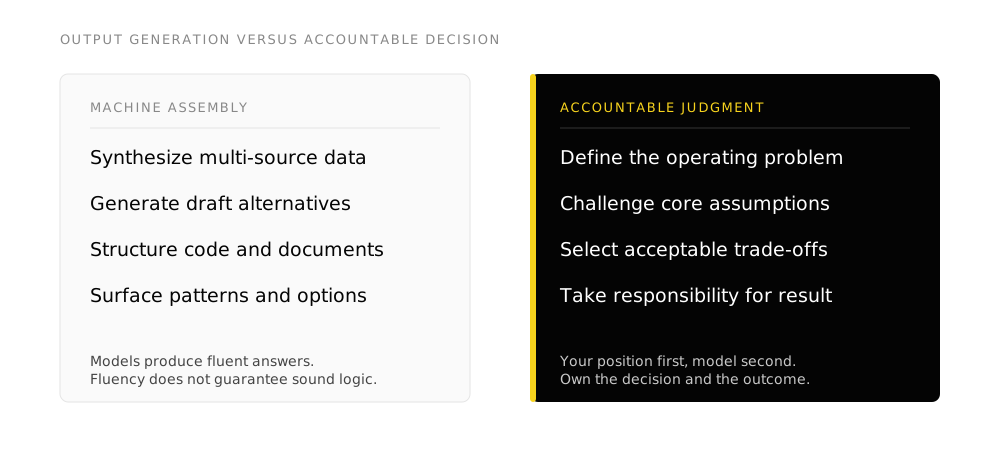
Throughout the history of professional knowledge work, assembling information required much of the same expertise used to evaluate it.
An analyst preparing a market assessment had to find the relevant filings, extract the balance sheet metrics, structure the comparative model, and draft the explanatory memorandum. A software engineer spent hours writing boilerplate scaffolding before verifying architecture. A marketer gathered customer interviews, organized qualitative quotes, and drafted campaign narratives.
Generative artificial intelligence has decoupled assembly from evaluation.
An advanced model can assemble massive volumes of operational work in seconds. It can summarize industry reports, synthesize competitor pricing, generate software prototypes, draft contractual clauses, and produce structured recommendations.
This technological shift changes the organizational bottleneck. The challenge is no longer assembling the draft; the challenge is exercising accountable judgment over the output.
TL;DR
- Assembly has been commoditized: Foundation models assemble research, drafts, data syntheses, and code rapidly and cheaply.
- Fluent language disguises weak logic: AI models generate grammatically polished deliverables that can mask flawed premises, hallucinated context, and circular assumptions.
- Form your position before consulting the model: Uncritical prompting leads teams to adopt machine-generated framing. Anchor your operational premise first, then use AI to challenge it.
- Establish an institutional judgment infrastructure: Provide teams with authoritative data sources, clear decision boundaries, and structured escalation protocols.
- Human value is concentrated at the decision point: Framing the problem, challenging assumptions, selecting trade-offs, and accepting accountability remain the irreplaceable human responsibilities.
The commoditization of information assembly
Consider a comprehensive competitive analysis. An AI model can crawl public industry sources, extract feature matrices, summarize public customer reviews, identify pricing bands, and draft a clean sixty-page brief.
That assembly previously demanded forty hours of junior analyst effort. Yet having sixty pages of structured analysis does not answer the strategic business questions:
- Which feature gaps represent genuine buying criteria for our target market?
- Which competitor pricing change demands a response, and which can be ignored?
- Which market segment offers sustainable operating margins?
- What strategic trade-offs is the executive team prepared to own?
The document was assembled automatically. The strategic decision still has to be made.
Fluent presentation can disguise operational errors
Generative language models are engineered to predict plausible sequences of text. They produce well-structured prose with convincing syntax. That polish often creates an illusion of thorough analytical rigor.
An AI report can present an orderly layout, professional executive summaries, and authoritative tone while concealing critical flaws:
- Citing industry benchmarks that do not apply to the company’s operating environment
- Treating superficial correlations as verified causal relationships
- Ingesting an unverified assumption from the user’s prompt and amplifying it uncritically
- Confusing common industry practices with effective business strategies
- Omitting high-impact operational risks that lie outside its training data
Because the output looks complete, employees can be tempted to accept the recommendation without inspecting the reasoning chain. This dynamic raises the required standard of human scrutiny rather than reducing it.
Establish your thesis before prompting the model
The common approach to corporate AI literacy focuses primarily on crafting better prompts. While clear instructions are helpful, a more critical cognitive discipline is forming a structured hypothesis before consulting the model.
Ask yourself these foundational questions before opening a prompt window:
- What is the fundamental business problem we are attempting to resolve?
- What initial position does our team hold based on firsthand operational evidence?
- What key assumptions underpin that position?
- What specific data or counter-evidence would cause us to revise our view?
- What trade-offs are we unwilling to accept?
When an employee prompts a model without an anchored perspective, they surrender the analytical framing. The model dictates the questions, provides the data, and structures the conclusions.
A more effective operating methodology is:
Your position first. The model second.
Formulate your initial thesis. Then instruct the model to attack your logic:
- “Identify the three weakest assumptions in this proposal.”
- “Find historical counter-examples where this operational strategy failed.”
- “What regulatory, technical, or financial variables have we omitted from this plan?”
- “Act as an aggressive competitor and identify the vulnerabilities in this pricing model.”
This approach uses machine generation to expand intellectual rigor while keeping accountability firmly anchored in human judgment. This methodology is explored in detail in our Thinking With AI practice program.
The delegation test
If an employee cannot explain why a particular AI recommendation was selected over two viable alternatives, they have outsourced judgment rather than delegating assembly. The worker must be able to justify the decision without referencing the model's authority.
Organizations require an institutional judgment infrastructure
Exercising sound judgment is not merely an individual trait; it is an organizational capability supported by system design.
If a company expects employees to make high-velocity decisions using AI assistance, it must build the surrounding infrastructure:
- Authoritative sources: Ensuring staff know which internal databases contain verified facts versus working drafts.
- Defined authority boundaries: Establishing clear guidelines on which decisions require managerial sign-off. For operational frameworks on setting these boundaries, read Assistance vs. Autonomy.
- Decision logging: Capturing the rationale, evaluated trade-offs, and supporting evidence behind consequential business choices.
- Escalation pathways: Creating psychological safety and clear protocols for staff to pause automated sequences when outputs appear suspicious.
When internal knowledge is disorganized and systems of record disagree, human judgment is undermined by conflicting context.
The migration of professional value
As artificial intelligence takes over first-draft creation, data synthesis, and routine document assembly, the nature of knowledge work evolves.
Professionals spend less time staring at a blank page or manually aggregating numbers. Value concentrates at the decision-making checkpoints:
- Problem framing: Defining the operational objective before work begins
- Evaluation criteria: Determining what constitutes acceptable quality and safety
- Assumption testing: Challenging the premises embedded in automated drafts
- Trade-off negotiation: Balancing competing priorities such as cost, speed, and reliability
- Operational accountability: Standing behind the final deliverable and accepting responsibility for the business outcome
These are not administrative chores left behind after technology takes the rest. They are the essential governing functions that determine whether machine-assembled work translates into sound business decisions.
- Accepting polished, well-formatted AI outputs as substitute evidence of sound reasoning
- Prompting a model for strategic direction before formulating an internal point of view
- Allowing staff to cite "the AI suggested it" as justification for operational decisions
- Treating human oversight as an unexamined rubber stamp on automated proposals
- Deploying AI tools without providing teams with verified, authoritative enterprise knowledge
Frequently asked questions
What is the difference between assembly and judgment?
Assembly is the technical collection, structuring, and formatting of data, prose, or code. Judgment is the intellectual evaluation that determines whether the output is accurate, what trade-offs are acceptable, and whether the business should act upon it.
Why does AI fluency make evaluating outputs more challenging?
Generative models write grammatically sophisticated prose and plausible explanations. This professional formatting makes flawed assumptions, outdated information, and subtle hallucinations harder to detect at a glance.
How can managers ensure employees do not blindly trust AI outputs?
Require staff to present the supporting evidence, underlying trade-offs, and rejected alternatives whenever submitting a recommendation, enforcing the principle of "Your position first, the model second."
How does Begine Fusion support organizational judgment?
Begine Fusion delivers structured training through the Thinking With AI program and AI Systems Mastery, while designing enterprise architectures that connect models to verified business context.
Takeaways
- Generative AI has commoditized the assembly of research, drafts, and code while making evaluation scarce.
- Fluent syntax and structured layouts can easily disguise weak premises, unverified data, and circular reasoning.
- Formulate an independent point of view before consulting models, using AI to stress-test your thesis rather than dictate it.
- Organizations must support judgment by establishing clear decision boundaries and authoritative data sources.
- Human professional value resides in framing problems, evaluating trade-offs, and taking accountability for outcomes.