
Case Study: Coca-Cola's "Share a Coke" Campaign
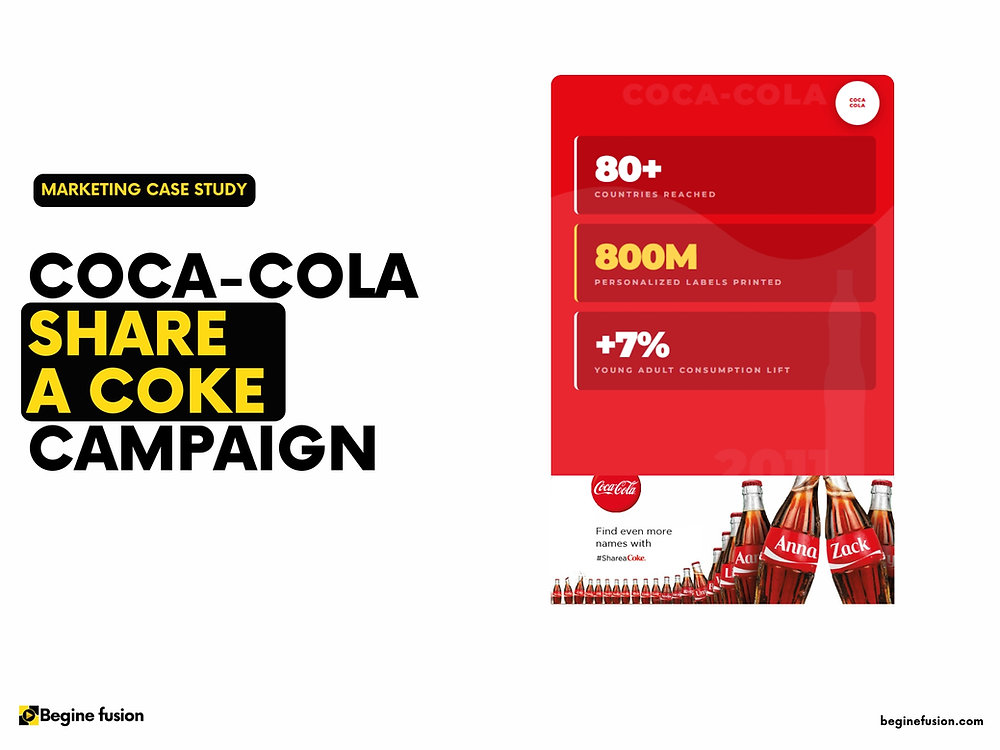
In 2011, Coca-Cola replaced its iconic logo with 150 of the most popular names in Australia and it worked so well that it rolled to 80+ countries, generated 500,000+ Instagram posts, and reversed a decade of declining consumption among young adults.
Table of Content
- Summary
- Background
- Problem Identification
- Objectives
- Strategy
- Technology Integration
- Implementation
- User Experience
- Results
- Challenges and Solutions
- Key Takeaways
Summary
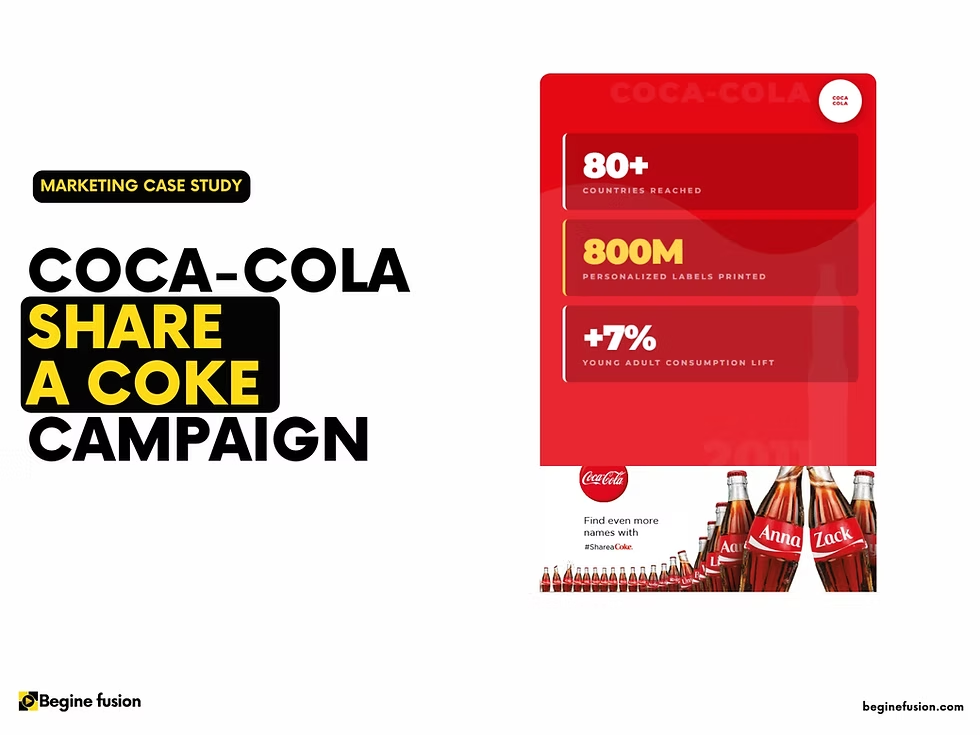
On October 1, 2011, Coca-Cola Australia launched “Share a Coke” replacing the Coca-Cola logo on bottles and cans with 150 of the most popular Australian first names. The concept was radical: the world’s most recognized brand temporarily debranded itself to put consumers at the center. The campaign reversed declining consumption among young adults, driving a 7% increase in young adult consumption and a 4% increase in category share in Australia. It eventually expanded to 80+ countries, adapted across five alphabets and 10+ languages, and generated 800 million personalized bottle labels in Europe alone. The campaign remains one of the most successful personalization strategies in marketing history, proving that even the world’s biggest brand could grow by making each customer feel individually recognized.
Background
By 2011, Coca-Cola was facing a challenge that seemed paradoxical for the world’s most recognized beverage brand: declining relevance among younger consumers. Teen and young adult consumption had been eroding for years as health consciousness grew and competitors multiplied. The brand needed to reignite personal connection with consumers who took Coca-Cola for granted a generation that had grown up with the brand everywhere but felt no personal attachment to it. The campaign was developed under the internal code name “Project Connect” by Ogilvy Sydney, reflecting the core insight: Coca-Cola needed to connect with individuals, not audiences.
Problem Identification
- Declining consumption among teens and young adults the demographic that establishes lifelong brand preferences
- Brand ubiquity had created invisibility consumers saw Coca-Cola everywhere but felt no personal connection
- Health-conscious consumers were actively choosing alternatives, and functional arguments (taste, refreshment) weren’t enough to reverse the trend
- The brand needed a reason for consumers to actively choose Coca-Cola rather than defaulting to it or away from it
Objectives
- Reignite daily Coca-Cola consumption among young adults
- Drive social sharing and word-of-mouth that positioned Coca-Cola as personal and relevant
- Create a repeatable campaign framework that could scale globally across different cultures and languages
- Demonstrate that mass personalization could drive measurable commercial results at global scale
Strategy
Ogilvy Sydney designed a strategy that turned the world’s most uniform product into a personalized one:
- Mass Debranding: Replace the iconic Coca-Cola logo with individual first names a radical act of brand confidence that put consumers ahead of corporate identity
- Name Selection Science: Chose the 150 most popular names in Australia for the initial launch, ensuring maximum personal resonance across the broadest possible audience
- Social Sharing Design: Made bottles inherently shareable finding your name (or a friend’s) on a Coke creates an impulse to photograph, share, and gift
- Multi-Channel UGC Engine: Built campaign touchpoints across retail, social media, and experiential activations to multiply the organic sharing effect
- Kiosk Customization: Installed in-store kiosks where consumers could print custom names on Coke cans, extending personalization beyond the pre-printed selection
For brands looking to implement personalization at scale, GetResponse enables personalized email marketing automation, while Moosend provides dynamic content personalization across email campaigns.
Technology Integration
- HP Indigo Digital Printing: Variable data printing technology enabled mass production of personalized labels at industrial scale: 800 million unique labels across Europe using 12 HP Indigo WS6000 presses running 24 hours a day for 3 months
- Custom Ink Development: Developed a special mixed ink specifically for the HP Indigo presses to maintain Coke Red brand consistency across all machines and label variations
- In-Store Kiosks: Deployed customization kiosks that printed individual names on cans in real-time, generating 378,000 custom cans in Australia alone
- Social Media Integration: Built microsites and social tools that enabled digital sharing alongside physical product personalization
- Online Customization Platform (2015): Introduced web-based ordering that allowed consumers to order bottles with any name
For businesses implementing similar digital printing or e-commerce personalization, Shopify provides customizable product pages and order management, while Unbounce enables landing pages for personalized product campaigns.
Implementation
The campaign rolled out globally through a phased expansion:
- Australia Launch (October 2011): Debuted with 150 names on Coca-Cola bottles and cans across Australian retail
- In-Store Kiosks: Installed print-on-demand kiosks where consumers could personalize cans with any name
- Social Media Activation: Launched #ShareaCoke campaign across Facebook, Instagram, and Twitter to amplify organic sharing
- New Zealand and Asia Expansion (2013): Extended to select Asian markets following Australian success
- European Rollout (April 2013): Launched across European markets with localized name sets across multiple languages and alphabets
- US Launch (June 2014): Debuted in the United States with 250 of the most popular American names
- Name Expansion (2015): Grew from 150 to 1,000+ names; launched online customization platform for direct ordering
- Lyrics Variation (2016): Evolved the concept by replacing names with lyrics from 70 popular songs
User Experience
- Consumers encountered personalized Coca-Cola bottles in stores, creating an instant “find your name” treasure-hunt experience
- Finding a bottle with your name or the name of someone you cared about triggered a natural impulse to photograph, share, and gift
- In-store kiosks allowed consumers to create personalized cans when their name wasn’t in the standard selection
- Social media provided a platform to share discoveries, with #ShareaCoke becoming a global trending hashtag
- The online customization platform (2015) enabled direct ordering for any name, removing the randomness of retail discovery
Results
The Share a Coke campaign produced measurable commercial results across every market:
- Australia (Launch Market): 7% increase in young adult consumption; 4% increase in category share; 250 million named bottles and cans sold in a nation of 23 million people
- United States (2014): 11% increase in Coca-Cola package sales; 2% increase in unit price; best four-week sales period since early 2009; 1.25 million additional teens tried Coke
- United Kingdom (2013): 2.9% year-over-year volume lift in the three months after launch
- Social Media: 500,000+ Instagram posts with #ShareaCoke; 1 billion Facebook impressions; 998 million Twitter impressions; 870% increase in Facebook traffic
- Production Scale: 800 million personalized bottle labels produced across Europe; 378,000 custom cans printed at Australian kiosks
- Awards: 7 Cannes Lions including Gold for Creative Effectiveness and Gold for Outdoor
- Global Reach: Expanded to 80+ countries across five alphabets and 10+ languages
Challenges and Solutions
- Name Inclusivity: Consumers with unique or non-Western names felt excluded from the campaign. Coca-Cola addressed this by progressively expanding the name database from 150 to 1,000+, adding non-name terms (“Bestie,” “Mom,” “Dad,” “BFF”), and launching online customization for any name
- Discriminatory Filter Issues: In some markets, auto-generation tools rejected certain terms (for example, South Africa’s website wouldn’t accept “Gay” but accepted “Straight”). These incidents generated social media backlash and required rapid policy corrections
- Operational Complexity: Producing personalized packaging at global scale required coordinating multiple label converters, printers, languages, and distribution networks simultaneously. Standardized equipment configurations and specialized ink development maintained brand consistency
- Cross-Functional Coordination: The campaign required alignment across executive, marketing, legal, design, product, and operations teams from exact ink colors to banned word lists. Solid project management infrastructure was essential
For managing complex multi-market campaigns with many moving parts, Monday.com provides cross-functional project management, Zoho CRM helps manage partner and customer relationships, and Constant Contact enables localized email campaigns across markets.
Key Takeaways
- Personalization that’s visible in public triggers shares: A name on a Coke bottle is visible to everyone around you it’s a conversation starter, a gift opportunity, and a photo moment. Digital personalization is private; physical personalization is social
- Debranding takes brand confidence: Removing the Coca-Cola logo one of the most valuable brand assets on earth was a radical act that signaled the brand valued its customers more than its own identity. That inversion of priorities was the campaign’s emotional core
- Make the treasure hunt part of the experience: The randomness of finding your name in a store created excitement and drove repeat visits. Not finding your name immediately made the eventual discovery more rewarding
- Any SKU with a printable surface can adapt this model: The concept isn’t limited to beverages. Any product with packaging, labels, or visible surfaces cosmetics, food, clothing, electronics can implement personalization that drives social sharing
- Technology enables scale, but the insight is human: HP Indigo printing made 800 million unique labels possible, but the campaign worked because of a simple human truth: people love seeing their own name. Technology was the enabler, not the idea
To implement personalization in your own marketing, consider Anyword for AI-generated personalized copy, OptiMonk for on-site personalization and conversion optimization, and Zoho PageSense for testing which personalization approaches perform best.
Sources
- Coca-Cola Company How a Groundbreaking Campaign Got Its Start “Down Under”
- Packaging World Coca-Cola Personalizes 800 Million Bottle Labels
- Campaign Brief Australian Campaigns of the Decade: Share a Coke
- Wrike The Winning Coca-Cola Formula for a Successful Campaign