
CRM for Professional Services: When the Person Selling Is the Person Delivering
A product company can sell more without immediately being able to deliver more. A firm that bills time cannot. The senior people who win the work are the same senior people who do it, which means every deal in the pipeline is a claim on the capacity that would deliver it.
That is one sentence, and almost everything unusual about running a CRM in a professional services firm follows from it.
TL;DR
- Pipeline and capacity are the same constraint. A forecast that ignores who would deliver the work is a forecast of work you cannot take.
- The relationship outlives the engagement. A closed deal is the start of delivery, and the next engagement usually comes from the same client rather than a new one.
- The client is an organization and a set of people. Your sponsor moves firms, and both the relationship you keep and the one that walks out with them need to be in the record.
- Referral source is the field most often missing in the firms where referral is most of the business.
- Fee-earners will not do data entry, and telling them to will not change that. Design for two or three fields they actually fill in, and take the rest from systems.
- Conflicts, confidentiality and record ownership are configuration decisions in a regulated firm, not afterthoughts.
What the client record has to hold
The standard CRM fields cover perhaps half of what a firm needs, and the missing half is the half that matters.
Two linked records, as with any B2B relationship, and here for a specific reason: your relationship is usually with an individual who will eventually move. When they do, you want both the client you keep and the person you follow.
A deal closes. An engagement runs, has a scope, a fee basis, a lead partner and an end date, and the client may have three at once. If the only object is a deal, the firm has no record of what it is currently doing for anyone.
Hourly, fixed, retainer, contingent, capped. This determines what the revenue figure on a deal even means, and a pipeline mixing all five without distinguishing them cannot be summed.
Named, on the opportunity, before it closes. This is the field that turns a pipeline into a capacity plan and it is absent from almost every default CRM configuration.
Not a channel. The person. In firms where most work arrives by referral, this is the most commercially valuable field in the system and it is usually a free-text box nobody fills in.
Distinct from whoever last worked on something. The person accountable for the client existing next year, which is not always the person delivering this month.
Pipeline is a capacity question
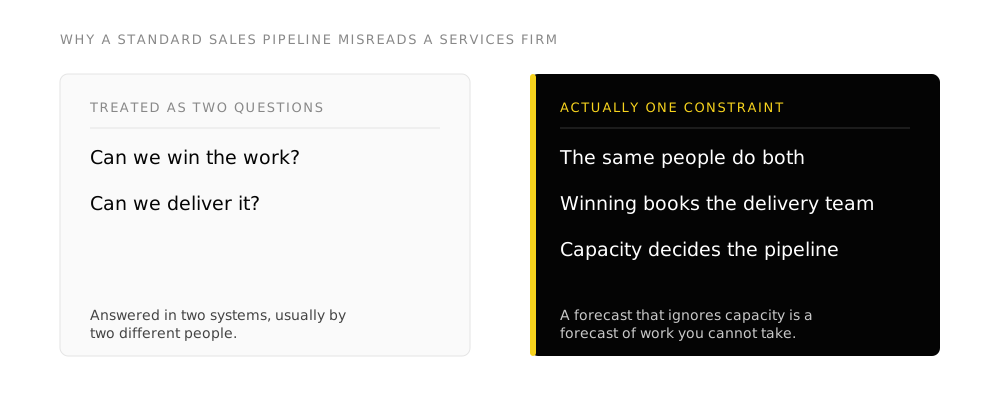
In a product business the pipeline answers one question: what will we sell. In a firm that bills time it has to answer two, and the second one changes the first.
Three consequences worth designing for:
Weight the pipeline by delivery, not only by probability. Two opportunities at the same value are not equivalent if both need the same partner in the same month. A pipeline view grouped by proposed lead, not just by stage, is often the single most useful report a firm builds.
Qualification includes “should we”. Professional services has a category of work that is winnable and not worth winning: wrong fit, wrong fee basis, wrong client, wrong month. That judgement is a real stage in the process and most CRM configurations have no place to record it, so the reason a partner declined something is lost.
Deals stay open longer, and the stages are slower. A twelve-month sales cycle with two touchpoints is normal and it looks identical, in a default CRM, to a deal that has gone dead. Without a distinction between slow and stalled, either the reports are wrong or somebody is manually closing things that are still alive.
The stage definition that fixes most firms' forecasting
Add a stage between "proposal sent" and "won" that means the client has said yes and we have not yet agreed when. In firms billing time, the gap between those two is where most of the forecasting error lives. The work is won, the revenue is real, and it lands in a quarter nobody has decided on yet. Making it a visible stage stops it being counted as this month's and stops it being forgotten.
The engagement outlives the deal
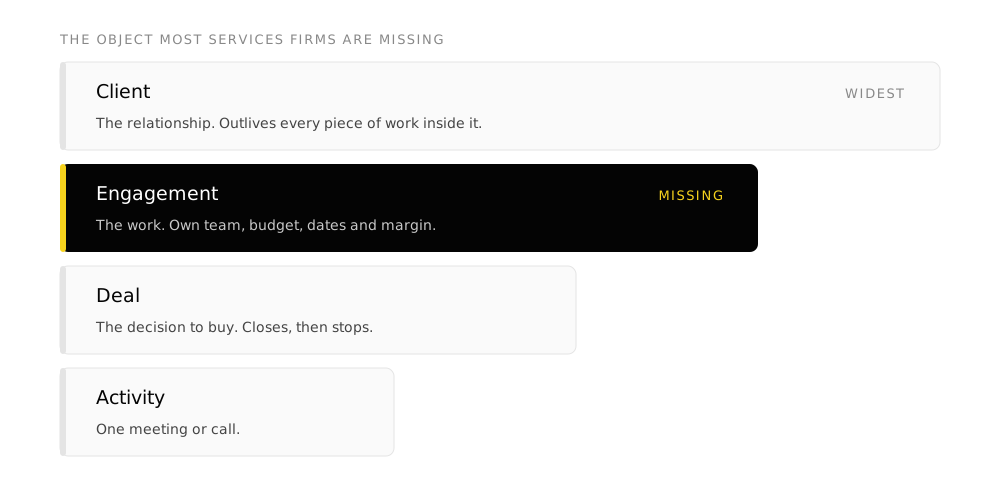
The default CRM assumption is that a closed-won deal is the end of the sales object’s life. In professional services it is the beginning of the relationship’s most important phase, and how the firm handles the transition decides whether there is a second engagement.
-
The handoff, even when it is to yourself
What was promised, what was scoped, what the client actually said they cared about. In a firm where the seller delivers, this feels unnecessary and is exactly the moment the promise made in a proposal stops being written down anywhere.
-
Delivery status, visible to the relationship owner
Not project management inside the CRM. Enough that the person accountable for the client can see whether the work is going well before they have a conversation about the next thing.
-
The end of the engagement as an event
An engagement completing should create something: a follow-up, a review, a next-engagement conversation. Left unmarked, a firm's most reliable source of new work quietly becomes nobody's job.
-
The dormant client
A client with no active engagement is not a lost client and should not look like one. They need a different view and a different cadence, and most firms have neither, which is why past clients get contacted when someone happens to remember them.
Fee-earners and the data entry problem
Every professional services CRM project meets the same wall. The people whose activity the system needs are the people whose time is the product, and asking them to spend it on data entry is asking them to bill less.
The responses that do not work are well known: mandating it, training harder, reporting on compliance. They fail for a structural reason rather than an attitude one, in that the time genuinely is worth more elsewhere.
What does work:
- Take activity from systems, not people. Email and calendar integration captures most of what a CRM needs about a relationship without anyone typing. This is the single highest-return configuration decision in a firm.
- Two or three fields, mandatory, and no more. Usually next step, next date, and confidence. Anything beyond that is aspiration and it will be filled in with whatever passes validation.
- Let someone else do the entry. A practice manager or coordinator updating records from a fifteen-minute conversation is cheaper than a partner doing it badly, and produces better data.
- Give it back before you ask for more. A fee-earner who gets a useful client brief before a meeting will keep the record current. One who only ever puts data in will not.
- Report on the client, not on the person. The moment the CRM is used to measure individual activity, the data becomes a performance artifact and stops being true.
The regulated-firm questions
For firms with professional obligations in law, accounting, financial advice or engineering, three configuration decisions arrive early and are expensive to retrofit.
Conflicts. If the firm runs conflict checks, the CRM is either part of that process or a second list of client names that disagrees with the authoritative one. Decide which, deliberately. A CRM that is nearly the conflicts list is the worst of the options.
Confidentiality between teams. Not everyone should see every client. This is what a role hierarchy and record-level permissions are for, and it is far easier to configure at the start than to impose after two years of open access. In Zoho this is the role and profile structure, with data sharing rules opening up access where teams genuinely need it.
Retention. Client data has a defined life in a regulated firm. If the CRM has no view on how long records are kept and what happens at the end, it becomes the one system in the firm with no retention policy, holding exactly the data most subject to one.
How this maps onto Zoho
There is no professional services module, in the same way there is no donor module and no association module. What you are buying is a set of products configured into a firm system.
Organizations and people as linked records, opportunities carrying fee basis and proposed delivery lead, referral source as a real field, and a relationship owner distinct from the deal owner.
The object a standard CRM does not have. Scope, fee basis, lead, dates and status, linked to the client and to the opportunity that created it. This is usually the main piece of configuration work.
Where the work is actually run and time is recorded. The CRM does not need the detail. It needs the status and the end date visible on the client record.
Fees, invoices and what is outstanding. The relationship owner should be able to see whether a client is current before they have a conversation about more work.
The configuration effort is concentrated in one place: the engagement object and its relationship to opportunities and clients. Get that shape right and the rest is ordinary CRM setup. Get it wrong and the firm spends two years describing engagements in the notes field.
Where these projects go wrong
- Running a sales pipeline with no view of who would deliver the work, so the forecast describes work the firm cannot staff
- Treating closed-won as the end of the record, leaving the firm with no system view of what it is currently doing for anyone
- Mandating data entry from fee-earners instead of capturing activity from email and calendar
- Leaving referral source as free text in a firm where referral is most of the revenue
- Modelling the client as a person, so the relationship leaves when the contact changes jobs
- Summing a pipeline that mixes hourly, fixed and retainer work without distinguishing the fee basis
- Building a CRM that is almost the conflicts list
- Using the CRM to measure individual activity, which reliably makes the data untrue
Frequently asked questions
Do we need a CRM if all our work comes from referrals?
That is the strongest case for one, not the weakest. A referral business runs on a network whose value is invisible until it is recorded: who introduced whom, which relationships have produced work, who has not been contacted in two years. Held as institutional memory, that network belongs to individuals and leaves with them. The firms that get the most from a CRM are frequently the ones that thought they did not need one because they do not do outbound sales.
Should we use a CRM or practice management software?
Practice management systems arrive knowing what a matter, an engagement and a billable hour are, which saves substantial configuration. They are usually weaker at the pre-client relationship: the contact you have known for three years who has not instructed you yet. If most of your problem is delivery and billing, take practice management. If most of it is that nobody knows what is in the pipeline or who knows whom, a CRM is the right tool, and the two can coexist provided you decide which one owns the client record.
How do we get partners to actually use it?
Reduce what you ask for and increase what you return. Ask for next step, next date and confidence, take everything else from email and calendar integration, and make sure that before any client meeting the system produces something genuinely useful: the history, the last conversation, what is outstanding, what the firm is currently doing for them. Adoption among senior people follows usefulness, and no amount of mandate substitutes for it.
How should we handle a client contact who moves to a new firm?
As two things at once, which is why the organization and the person must be separate records. The client organization stays, with a relationship that now needs a new sponsor. The individual becomes a warm contact at a new organization, which is one of the highest-value leads a professional services firm ever gets. A system that models the client as a person handles neither well and typically loses both.
What should the pipeline stages be?
Whatever they are in your firm, defined by things that have happened rather than by how anyone feels. A workable default is initial conversation, qualified as worth pursuing, proposal or scope issued, agreed in principle, and engaged. The stage most firms are missing is the fourth, agreed but not yet scheduled, because that gap is where forecasting error concentrates when the work is delivered by the people who sold it.
Can one system cover both sales and delivery?
It can, and it is usually a mistake to make the CRM do the delivery detail. Time recording, resourcing and project structure belong in a tool built for them. What the CRM needs from delivery is small and specific: is there active work, is it going well, when does it end. Keeping that boundary clear is what stops a CRM implementation turning into a firm-wide systems project that never finishes.
Takeaways
- Pipeline and capacity are one constraint. Put the proposed delivery lead on the opportunity and group the pipeline by it.
- Model engagements as their own object. A closed deal is the start of the relationship's most important phase.
- Keep the organization and the individual as separate linked records, because your sponsor will eventually move.
- Make referral source a real field, especially if referral is most of your revenue.
- Ask fee-earners for two or three fields, take the rest from email and calendar, and give something useful back.
- Decide conflicts, confidentiality and retention at configuration time. All three are expensive to retrofit.
Sources
This article describes design and configuration practice rather than reporting research, and makes no statistical claims.
The Zoho product boundaries referenced, being role hierarchy, profiles and data sharing rules for record visibility, are documented in Zoho CRM’s own online help and summarised in how to set up Zoho CRM, read 8 August 2026. Zoho revises product boundaries without notice; confirm before committing a design to them.
Related reading: how to choose a CRM, the implementation guide, and AI use cases in professional services.