
Zoho CRM vs HubSpot vs Salesforce: What a Canadian Buyer Is Actually Choosing
These three get compared as though they were three versions of the same thing at three price points. They are not. They are three different businesses with three different models, and the model tells you more about whether a product will suit you than any feature grid will.
Where this sits
This is a head-to-head on the three most-compared names. For a wider set of options priced for a Canadian SME, including Pipedrive, Capsule, monday and OnePageCRM, see the CRM buyer's guide. For how to run the decision, how to choose a CRM.
TL;DR
- Only Zoho quotes a Canadian buyer in Canadian dollars. Salesforce's own Canadian pricing page offers six currencies and CAD is not one of them.
- HubSpot's higher tiers carry a required one-time onboarding fee: US$1,500 on Professional, US$3,500 on Enterprise. Required, not optional, and absent from every per-seat comparison.
- At five seats that fee adds more than a quarter to HubSpot's first year on Professional. It is the single most commonly missed number in this comparison.
- Zoho sells breadth, HubSpot sells the funnel, Salesforce sells the platform. That is the actual choice.
- All three have a real free or entry tier, and the entry tiers are not comparable to each other in any useful way.
- Currency exposure is a term of the contract, not a detail. A USD-denominated per-seat subscription is a multi-year foreign exchange position.
The three models
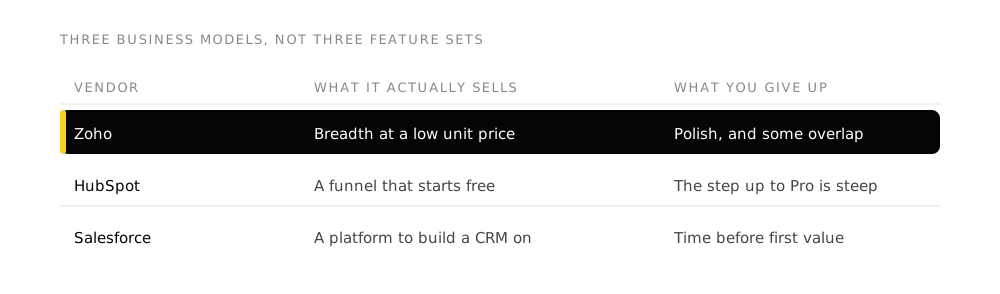
The CRM is one product in a catalogue of dozens, and the commercial strategy is to be cheap enough that buying more of the catalogue is easy. It prices in local currency in most markets, Canada included. What you give up is polish in places, and you will occasionally find two Zoho products that overlap.
The model is to make entry frictionless and let the marketing side pull you upward. The free tier is genuinely useful, the interface is the best of the three, and the step from Starter to Professional is where the economics change sharply.
It is less a CRM than a place to build one, with an ecosystem of consultants and applications around it. That is why large organizations standardise on it and why it is usually the wrong first CRM for a twelve-person company.
Pricing, verified
Read from each vendor’s own pricing page on 8 August 2026, from a Canadian connection, with the annual-billing toggle in its default state. Currencies are as each vendor presents them to a Canadian buyer.
Zoho CRM, quoted in Canadian dollars
| Plan | Price | Basis |
|---|---|---|
| Free | C$0, max 3 users | Free forever |
| Standard | C$19 /user/month | Billed annually |
| Professional | C$31 /user/month | Billed annually |
| Enterprise | C$50 /user/month | Billed annually |
| Ultimate | C$65 /user/month | Billed annually |
Zoho’s page notes that local taxes are charged in addition.
HubSpot Sales Hub, quoted in US dollars
| Plan | Price | Basis |
|---|---|---|
| Free | $0, up to 2 users | No card required |
| Starter | from $7 /seat/month | Annual. $20 monthly. A promotional rate. |
| Professional | from $90 /seat/month | Annual, plus a required one-time onboarding fee of $1,500 |
| Enterprise | from $150 /seat/month | Annual, plus a required one-time onboarding fee of $3,500 |
Salesforce, quoted in US dollars
| Plan | Price | Basis |
|---|---|---|
| Starter Suite | $25 /user/month | Monthly or annual |
| Pro Suite | $100 /user/month | Billed annually |
| Enterprise | $175 /user/month | Billed annually |
| Unlimited | $350 /user/month | Billed annually |
| Agentforce 1 Sales | $550 /user/month | Billed annually |
The currency finding
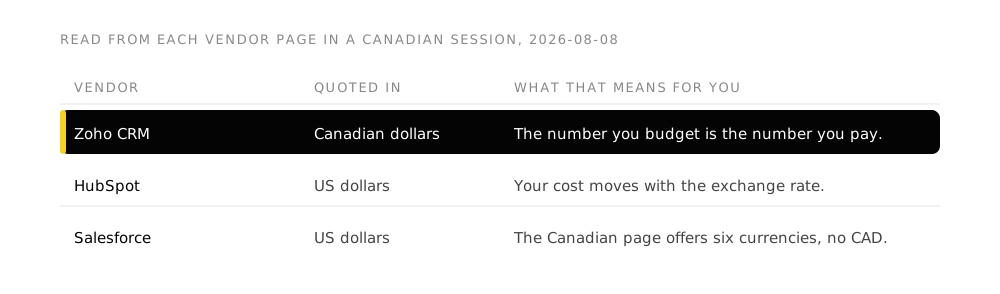
salesforce.com/ca/sales/pricing/ is Salesforce’s Canadian pricing page. Its currency selector offers US Dollar, Australian Dollar, British Pound, Euro, Japanese Yen and Swedish Krona.
It does not offer Canadian dollars.
This is not a rounding detail. A multi-year per-seat subscription denominated in US dollars is a foreign exchange exposure that grows with your headcount, and it sits in an operating budget that is almost certainly planned in Canadian dollars. Nobody in the sales process will describe it that way.
We deliberately do not convert the USD figures above into Canadian dollars anywhere in this article. Any conversion would be accurate for one day and misleading afterwards, and the fact that the rate moves is precisely the point being made.
The onboarding fee
HubSpot’s pricing page states that the displayed cost “does not include the required, one-time Professional Onboarding for a fee of $1,500”, with the equivalent $3,500 note on Enterprise.
Required. Not a recommended service, not an optional package.
What that does to a first-year total, at the vendors’ published rates:
| Scenario | Licences, year one | One-time fee | Year one total |
|---|---|---|---|
| HubSpot Professional, 5 seats | US$5,400 | US$1,500 | US$6,900 |
| HubSpot Enterprise, 5 seats | US$9,000 | US$3,500 | US$12,500 |
| Salesforce Enterprise, 5 seats | US$10,500 | None | US$10,500 |
| Zoho Enterprise, 5 seats | C$3,000 | None | C$3,000 |
At five seats on Professional, the onboarding fee adds more than a quarter to HubSpot’s first year. It appears in no per-seat comparison table anywhere, including the ones HubSpot’s competitors publish.
To be fair to HubSpot: paid onboarding is not nothing. A structured start is one of the better predictors of a CRM actually getting used, and plenty of organizations pay for equivalent help alongside a cheaper licence. The objection is not that the fee exists. It is that a required cost does not belong outside the price.
What each one is genuinely better at
Nothing else here is close on price at the same tier, and no other vendor gives you the rest of a business software catalogue behind the same login. Strongest when you need several systems and have somebody willing to configure them.
It is the easiest of the three to get people to use, which is not a small thing given how most CRM projects fail. If marketing automation and sales sitting in one system is central to how you operate, this is its home ground.
Anything you can describe can be built, and there is a market of people who build it. That value is real at a size where you have unusual processes and a budget for specialists. It is dead weight below that.
What each one costs you
- Zoho: the configuration is on you. It arrives flexible and unopinionated, which means an unconfigured Zoho is a worse experience than an unconfigured HubSpot. Interface polish is inconsistent across the catalogue.
- HubSpot: the price step from Starter to Professional is severe, and the required onboarding fee lands in the same jump. USD pricing for a Canadian buyer. The free tier is designed to make the paid tier feel inevitable, which is good product design and worth going in aware of.
- Salesforce: the highest per-seat cost here, USD-only pricing on the Canadian page, and a strong likelihood of needing paid help to configure it. Most small organizations use a fraction of what they buy.
Which one, in practice
- Under about ten people, budget-sensitive, willing to configure: Zoho. The price difference at equivalent tiers is large and it compounds every month.
- Marketing and sales genuinely operating as one motion: HubSpot, with the onboarding fee written into the business case from the start rather than discovered in it.
- Unusual processes, a real IT function, or an enterprise customer requiring it: Salesforce. Below that, the platform's value is a cost you carry without collecting.
- Testing whether a CRM habit will stick at all: any of the three free or entry tiers, but decide the upgrade trigger before you start. All three entry tiers are designed as a route to a paid tier.
- Already running other Zoho products: the answer is probably decided. Integration already solved is worth more than most feature differences.
Our position, stated plainly
We are a Zoho Authorized Partner, so treat our view on Zoho as the interested one it is. The verifiable facts in this article are sourced and dated and you can check every one of them against the vendors' own pages. Where HubSpot and Salesforce are the better fit, and the section above says where that is, we will tell you so rather than sell you a Zoho project that will not stick.
Frequently asked questions
Is Zoho CRM as good as Salesforce?
For the way most small and mid-sized businesses run a sales process, the honest answer is that the difference does not show up. Salesforce's advantage is what happens at the edges: deep customization, unusual object models, a large ecosystem of specialists and applications. If you cannot describe a specific thing you need that sits at those edges, you would be paying for capability you have no plan to use, at roughly three and a half times the per-seat rate before the currency difference.
Is HubSpot really free?
The free tier is real, works without a card and supports up to two users on Sales Hub. It is also built to make the paid tiers feel necessary, which is legitimate and worth knowing. The number to plan against is not the free tier or the Starter rate but Professional at $90 per seat per month plus the required $1,500 onboarding, because that is the tier most growing teams end up at and the jump is where the business case is actually decided.
Why does the Canadian price matter so much?
Because a per-seat subscription in a foreign currency is an exposure you hold for the length of the contract, and it scales with headcount. A ten-seat US-dollar subscription is a small standing FX position in an operating budget planned in Canadian dollars. It is manageable and it should be a decision rather than a surprise. Zoho quoting in CAD removes it entirely; Salesforce not offering CAD on its Canadian page means you cannot remove it there at all.
Can we migrate later if we choose wrong?
Yes, and it costs more than people expect, not in export fees but in field mapping, deduplication, retraining and the reporting history that does not survive the move. See CRM data migration for what is actually involved. The practical implication is to weight the trial heavily in the decision, because a fortnight of testing with your own data is much cheaper than a migration in year two.
What about the AI features all three are advertising?
Treat them as a tiebreaker rather than a criterion, for two reasons. They change substantially every few months, so anything written about them now describes a product that will have moved by the time you buy. And they operate on your CRM data, which means their value is downstream of having a well-configured system with clean records in it. An AI feature on top of a half-adopted CRM produces confident output from incomplete data, which is worse than no output.
Do the entry tiers compare to each other?
Not usefully. Zoho's free tier allows three users and is the same product with limits. HubSpot's free tier allows two users on Sales Hub and is a genuine on-ramp to a much larger platform. Salesforce's Starter Suite at $25 is a paid product rather than a free tier. Comparing them as though they were three versions of one offer is the fastest way to a wrong conclusion; compare the tier that actually holds your must-have features instead.
Takeaways
- Only Zoho quotes Canadian buyers in CAD. Salesforce's Canadian pricing page does not offer Canadian dollars at all.
- HubSpot Professional and Enterprise carry required one-time onboarding fees of US$1,500 and US$3,500, outside the per-seat price.
- At five seats, that fee adds over a quarter to HubSpot Professional's first year.
- Zoho sells breadth, HubSpot sells the funnel and the interface, Salesforce sells the platform. Choose the model, not the feature grid.
- Salesforce's advantage is at the edges. If you cannot name the edge you need, you are paying for it and not using it.
- Currency exposure is a contract term. Decide on it deliberately.
Sources
All figures read on 8 August 2026 from each vendor’s own pricing page, in a browser session originating in Canada, reading the rendered page rather than a cached fetch, with the annual-billing toggle in its default state. Method note: a server-side fetch of Zoho’s pricing page returned Indian rupees because the request egressed from India, which is why every figure here was read from a Canadian session.
- Zoho CRM:
zoho.com/crm/zohocrm-pricing.html. Free (max 3 users), Standard C$19, Professional C$31, Enterprise C$50, Ultimate C$65, all per user per month billed annually. The page states local taxes are charged in addition. - HubSpot Sales Hub:
hubspot.com/pricing/sales. Free up to 2 users; Starter from $7 per seat per month annual, $20 monthly, described as a promotional rate; Professional from $90; Enterprise from $150. The required onboarding fees of $1,500 and $3,500 are stated on that page as a footnote to the displayed cost. - Salesforce:
salesforce.com/ca/sales/pricing/. Starter Suite $25, Pro Suite $100, Enterprise $175, Unlimited $350, Agentforce 1 Sales $550, per user per month. The currency selector on that page offers USD, AUD, GBP, EUR, JPY and SEK, and does not offer CAD.
The year-one totals table is arithmetic on those published rates, in each vendor’s own currency. No exchange rate is applied anywhere in this article, and no figure in it is estimated.
No CRM adoption or failure statistic appears here. Every available “X% of CRM implementations fail” figure traces back to a consultancy citing another consultancy with no recoverable primary study, so this cluster describes the mechanism instead of quoting the number.
Vendor pricing changes without notice and promotional rates expire. Re-verify before relying on any figure above.