
CRM for Associations: Building for a Relationship That Renews
An association relationship starts at the point a sales CRM treats as the finish. The deal closes, the stage advances one final time, and for an association that is the moment the actual relationship begins. Its whole life from there is the question of whether it renews.
That single difference is why associations keep buying CRM systems and keep running the association from a spreadsheet next to them.
TL;DR
- The member record is the product. Status, renewal date, dues position, the organization and the people inside it, participation history and what the membership entitles them to.
- Renewals are driven by a date, not by a pipeline. A deal advances when somebody moves it. A renewal arrives whether anyone touches it or not, which makes it an automation problem rather than a discipline problem.
- Most associations run four systems that disagree: a member list, an accounting system, an email platform and an events tool. The member exists in all four and is current in none.
- Organizational membership needs two records, not one. The firm holds the membership; individuals hold the participation. Systems that model only one of those break at the first staff change at a member firm.
- In Zoho this is CRM for the record, Billing for dues and renewals, Campaigns and Survey for the member relationship, and Books for the money. The work is deciding what each one owns.
- Sequence matters. Get the member record and the renewal date right first. Events, portals and automation are worth building on top of that and worth nothing underneath it.
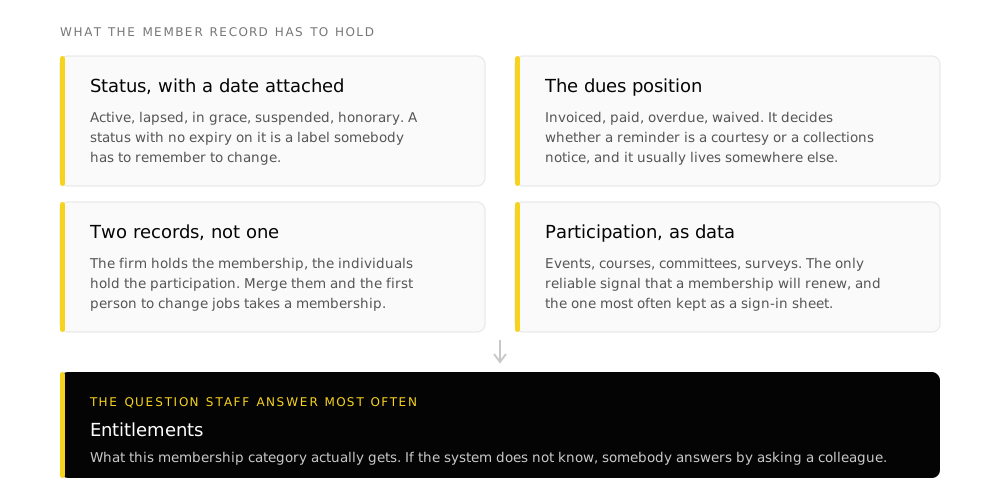
What the member record has to hold
Status, with a date attached. Active, lapsed, in grace, suspended, honorary, retired. Each one is a different set of rights and a different message. A status with no expiry date on it is a label somebody has to remember to change.
The dues position. Invoiced, paid, partially paid, overdue, waived. This is the field that decides whether a renewal reminder is a courtesy or a collections notice, and it usually lives in the accounting system where the person sending the reminder cannot see it.
Two records where a sales CRM has one. In an organizational membership the firm holds the membership and the individuals hold the participation. The person who attends the training, sits on the committee and reads the newsletter is not the entity being invoiced. Model that as one record and the first time a contact leaves a member firm, you lose either the member or the history.
Participation, as data. Events attended, courses completed, committees served, surveys answered. This is the only reliable signal of whether a membership is going to renew, and it is the thing most commonly held as a photo of a sign-in sheet.
Entitlements. What this membership category actually gets. Member pricing, directory listing, voting rights, access to a resource. If the system does not know, staff answer the question by asking a colleague.
Renewal runs on the calendar, and that changes the design
This is the design point that decides whether the system helps.
A sales pipeline moves when a human moves it. Nothing happens to a deal in stage three unless somebody advances it, and the discipline of moving deals is the discipline of using the CRM at all. Renewals are the reverse. The date arrives on its own. The work is entirely in what the system does about it before it gets there, and after it passes.
That means the renewal process is defined as a sequence of dates relative to the expiry, not as stages somebody drags a record through:
-
The advance notice
Far enough ahead that a member firm can put it in a budget. This is where organizational memberships are won or lost, because the person who receives it is often not the person who values it.
-
The invoice
Issued automatically against the membership category and the term. If somebody creates this by hand, the renewal cycle has a headcount attached to it.
-
The reminders, and what they know
A reminder that does not check the payment status will go to somebody who has already paid, which is the single fastest way to make a member trust the association's systems less.
-
The grace period, defined
What a lapsed member still has access to and for how long. Undefined, this becomes a judgement call made differently by different staff.
-
The lapse, and what it turns off
Directory listing, member pricing, portal access. If nothing actually changes when a membership lapses, the renewal deadline is a suggestion.
-
The win-back
A separate, later sequence aimed at people who were members and stopped. It is a different message from a renewal reminder and it almost never gets built.
The test for whether your renewal process is a system
Take the person who runs renewals out of the picture for a month. If the notices still go out, the invoices still issue, the reminders still skip the people who have paid and the lapses still happen on the right day, you have a system. If any of that stops, you have a person with a calendar and a spreadsheet, and the association's revenue depends on them not being ill.
The four systems that disagree
Nearly every association arrives at this conversation with the same architecture, assembled one tool at a time by people solving one problem at a time.
A spreadsheet, or a CRM used as one. Holds names and categories. Usually the most complete record of who is a member, and usually silent on whether they have paid.
Holds dues, invoices and payments, which makes it the only place the truth about membership status actually exists. Nobody sending a member email has access to it.
Holds a list that was uploaded at some point. Segments are frozen at the moment of upload, so a lapsed member keeps receiving member communications and a new one receives nothing.
Holds registrations, which makes it the home of participation history and the best renewal signal the association owns. It is also the system most likely to be a different product each year.
The failure is that the member exists as a separate record in each one, with no shared identifier. So the answer to “is this person a member in good standing” depends on which staff member you ask and which screen they happen to have open.
How this maps onto Zoho
Zoho covers this well, with one caveat worth stating plainly: there is no association module. As with donor management, what you are buying is a set of products that can be configured into a membership system, and the configuration is the work.
The member organization, the individuals inside it, the membership category and status, and the full interaction history. This is the system of record and everything else defers to it.
Zoho Billing is built for exactly this shape: multiple membership tiers with their own pricing, automated billing cycles, renewal notifications, reminder emails, payment collection and custom fields on the member profile. It is the closest thing Zoho has to a membership engine.
Segmented communication by membership type, region and engagement, and structured member feedback rather than anecdote. Both only work if they read segments from the CRM instead of from an uploaded list.
Dues revenue, event income and expenses, categorized by event, project or fund. Decide where Billing stops and Books starts before either is configured.
What we have built on this
We deployed Zoho Marketing Plus for the Sales and Service Safety Association, with segmentation built on membership type, engagement, region and training history, and structured member surveys feeding it. We ran the same shape of work for the Manitoba motor dealer association across eight or more channels. In both cases the segmentation was only possible because the member record held the fields to segment on.
The order to build it in
- First, the member record. One record per member organization, one per individual, and the relationship between them. Every membership category defined, with what each one is entitled to.
- Second, status and the renewal date. Every member carries a status and an expiry. This is the field the entire system runs on.
- Third, dues visible where the member is. Whatever the accounting arrangement, the person looking at a member has to be able to see whether they have paid.
- Fourth, the renewal sequence. Automated against the date, checking payment status before every send.
- Fifth, events and participation writing back. Attendance lands on the member record, not in a separate export.
- Sixth, self-service. A portal where a member can update their own details, see their invoices and register for events. Build this last, because it exposes every inconsistency in everything above it.
Where association projects go wrong
- Modelling members as Contacts only, so an organizational membership has no record and the membership follows a person who leaves
- Running renewals from a spreadsheet of expiry dates that is a copy of the real ones
- Sending renewal reminders that do not check whether the invoice was already paid
- Leaving the lapse with no consequence, so the renewal date carries no weight
- Uploading a member list into the email platform instead of connecting to the record, so every segment is out of date the day after it is built
- Building the member portal before the data behind it is trustworthy, which teaches members that the association's systems are wrong
- Treating event registrations as an event problem rather than as the participation history that predicts renewal
Frequently asked questions
Do we need association management software, or will a CRM do?
Purpose-built association management software arrives knowing what a membership term is. A CRM has to be taught. The trade is between configuring a general platform to your own model and accepting somebody else's model in exchange for it working sooner. The question that settles it is how unusual your membership structure is: tiered organizational memberships with seat counts, chapters, or categories with different entitlements push toward a configured platform, and a flat individual membership does not.
Can Zoho CRM handle memberships and renewals?
Yes, with configuration and usually with Zoho Billing alongside it. CRM holds the member record, the categories and the history. Billing handles tiered pricing, recurring terms, automated renewal notices, reminders and payment collection. Neither ships with a membership model already built, so the definition of status, term, grace and entitlement is work you do at the start.
How should we handle organizational members with multiple contacts?
Two linked records. The organization holds the membership, the term, the dues and the entitlement. Individuals link to it and hold participation, communication preferences and roles. When somebody leaves a member firm, you deactivate a contact rather than losing a membership, and the history stays with the organization that paid for it.
What data do we need before we start?
A current list of members with their category and expiry date, the dues position for each, and the participation history you can recover. The expiry dates are the ones to verify hardest, because they are usually maintained in more than one place and the copies have drifted.
Should the member portal come first?
Last. A portal is a window onto the member record, so it publishes whatever state that record is in. Launched over data members can see is wrong, it does lasting damage to their confidence in the association, and the fix is not a portal change.
How do we know whether a membership is going to renew?
Participation, recorded as data rather than remembered. A member who attended nothing, opened nothing and answered nothing is a different renewal conversation from one who sat on a committee. Neither of those is visible unless events, training and communications write back to the member record.
Takeaways
- An association relationship renews rather than closes, which makes status and expiry date the fields the whole system runs on.
- Model the organization and the individual as separate linked records. This is the decision that is most expensive to reverse.
- Build renewals as date-driven automation that checks payment status before it sends anything.
- Get the member record trustworthy before you build events, portals or automation on top of it.
- In Zoho, expect CRM for the record and Billing for the renewal cycle. There is no association module, and the configuration is the project.
Sources
Zoho pages read 8 August 2026.
- Zoho Billing membership management solution, covering membership tiers, automated billing cycles, renewal notifications, reminder emails and payment collection,
zoho.com/billing/ - Zoho CRM product documentation,
zoho.com/crm/ - Begine Fusion case studies for the Sales and Service Safety Association and the Manitoba motor dealer association, both published on this site
Zoho repackages its products without notice. Confirm current product boundaries before committing a design to them.