
Implementation vs. Adoption: Going Live Is Not the Finish Line
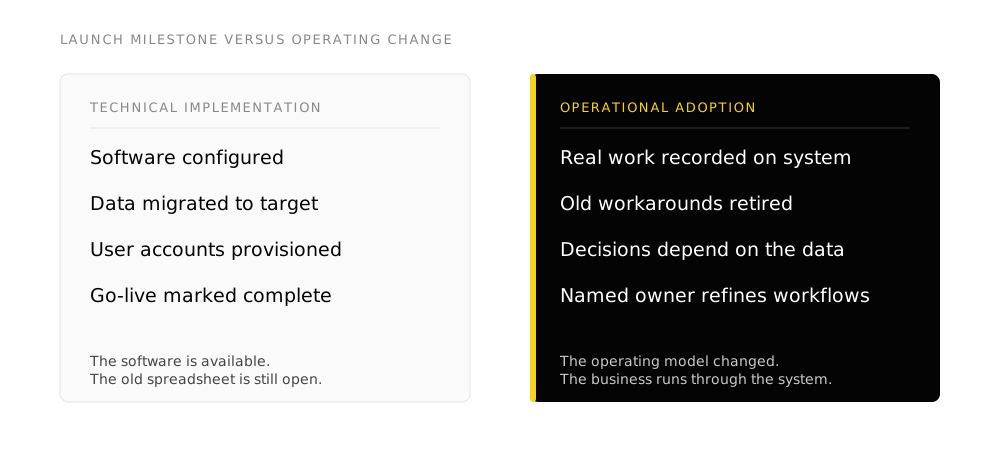
The software has been configured. The database records have been migrated. User accounts have been provisioned. The training seminar was held on schedule. The project status report shows green, and the implementation team marks the deployment complete.
Three months later, employees are still recording customer interactions in private spreadsheets. Vital notes remain locked inside email threads. Managers plead for updates before pipeline reviews. Staff maintain quiet workarounds because the official workflow clashes with daily realities.
The technology launched on schedule. The operating model never changed.
TL;DR
- Implementation delivers software; adoption changes behaviour: Launching a platform makes technology available, but adoption determines whether work actually runs through it.
- Logins and seat counts are vanity metrics: True adoption is measured by operational dependence, such as whether leadership makes decisions exclusively from system data.
- Workarounds are diagnostic evidence: When staff bypass a new tool, they are highlighting rigid designs, missing integrations, or unaddressed operational requirements.
- Training cannot rescue bad system design: Feature tours cannot compensate for duplicate entry, unclear ownership, or broken process handoffs.
- Plan for the post-launch correction window: Real operational success happens when leadership retires old spreadsheets on an agreed date and iterates based on live usage.
Technical deployment versus operational adoption
Implementation is technical. It focuses on functional deliverables: database schema, custom fields, data migration scripts, security roles, API connectors, and user provisioning. These engineering milestones are necessary requirements. They simply do not guarantee that business operations will improve.
Adoption is operational. It asks how daily execution shifts once the new software exists:
- Which legacy habits and private spreadsheets permanently stop?
- Where must employees enter customer data for it to count as real?
- What specific behaviours are rewarded by team leadership?
- Who is personally accountable for data cleanliness and record updates?
- What happens when a complex client request violates the default workflow?
- Which leadership decisions now rely exclusively on the system’s reporting?
A company can execute a flawless technical implementation while leaving every operational question unanswered. The result is an expensive platform running parallel to the informal methods the business has used for years.
Login rates are weak evidence of operational adoption
Organizations frequently evaluate new software through surface activity:
- Active user accounts
- Daily login frequency
- Total records generated
- Automation events triggered
- Training session attendance
These counts indicate platform access, not operational health. An account executive can log into a CRM every morning to fulfill an administrative requirement while maintaining the true client history in a personal document. A support department can generate thousands of tickets while entering conflicting status tags. An employee can attend three onboarding sessions without changing how they manage customer deliverables.
Real adoption appears as operational dependence:
- Can operations fulfill an order without reverting to offline notes?
- Does executive leadership review pipeline solely from system dashboards?
- Do downstream teams trust the data enough to act without verifying in secondary channels?
- Have staff retired their personal tracking sheets because the shared system is faster?
When the answers to those questions are negative, the company has paid for software usage without achieving digital adoption. To understand how to evaluate real progress rather than surface metrics, see Activity vs. Outcome.
Every software rollout alters the operating model
Technology projects fail when treated as isolated software swaps. Introducing a new operating platform reshapes the organization:
- It moves where information lives and who enters it.
- It changes visibility into team productivity and sales pipelines.
- It alters handoff boundaries between sales, operations, and finance.
- It shifts approval authorities and compliance checkpoints.
- It exposes process inconsistencies previously hidden by informal conversations.
Because software touches every handoff, an implementation project is inherently a process design and organizational governance initiative. For a breakdown of how fragmented software stacks destabilize operations, review Tools vs. Systems.
Workarounds are operational diagnostic data
When employees avoid a new tool, leadership often assumes resistance to change. More often, the workaround provides valuable diagnostic feedback:
- The configured workflow is too rigid for client edge cases.
- Mandatory fields demand information the employee does not have at that stage.
- The interface requires double data entry because a required integration is absent.
- Security permissions block staff from completing their assigned tasks.
- The documented process diverges sharply from how value is actually delivered.
Adoption requires observing these friction points and correcting the software configuration. Forcing staff into an unworkable design damages operational performance. The objective is establishing a reliable system that employees can use without unnecessary overhead.
The retirement test
Pick a specific date thirty days after go-live to revoke write access to the old spreadsheet or legacy tool. If revoking that access triggers immediate panic across the department, the new system has not achieved operational adoption.
Training supports adoption; it is not the strategy
When teams struggle with a newly deployed tool, managers frequently schedule remedial training. Additional training helps when employees do not understand a clean process. It fails when the software itself is poorly configured.
No volume of training will make duplicate data entry efficient. Training cannot resolve ambiguous record ownership, contradictory approval rules, or untrustworthy database records. Training should educate staff on how the business operating system functions; it cannot compensate for structural defects in system design.
For practical steps on structuring user enablement, consult the guides on what digital adoption is and how to drive digital adoption.
Management behaviour anchors the new standard
Employees quickly recognize what leadership truly values:
- If a sales manager accepts revenue forecasts submitted via chat messages, the CRM pipeline remains optional.
- If operations leadership reviews project deadlines from a whiteboard, the project management system will not be updated.
- If executives treat data accuracy as administrative trivia, frontline workers will treat it the same way.
Adoption becomes permanent when organizational decisions depend strictly on the system of record. Leadership must establish the operating standard, managers must enforce it by declining offline submissions, and engineering must ensure the platform remains reliable enough to justify that reliance.
Architect adoption before the launch date
A dependable rollout integrates adoption considerations into the project architecture from the first week:
- Map future-state workflows. Establish the sequence of tasks, exceptions, and required inputs before touching configuration screens.
- Define data standards. Decide which records are authoritative and remove duplicate or obsolete data prior to migration. Refer to the CRM data migration guide.
- Train around job roles. Train employees on the specific three to five screens their role requires rather than delivering generic platform tours.
- Establish the retirement date. Announce the exact calendar date when legacy systems, spreadsheets, and offline forms will be permanently locked.
- Run a dedicated correction window. Dedicate four to six weeks following go-live to adjust fields, fix permission bottlenecks, and streamline cumbersome views based on live team feedback.
- Declaring success at the go-live milestone while parallel spreadsheets stay open
- Treating employee workarounds as insubordination rather than architectural feedback
- Relying on generic platform feature tours instead of role-specific workflow training
- Allowing managers to accept reports and pipeline updates outside the system of record
- Abandoning the project budget before the post-launch refinement window is complete
Frequently asked questions
What is the core difference between implementation and adoption?
Implementation is the technical project that builds, configures, and launches software. Adoption is the operational transition where the organization permanently runs its daily work through that software.
How do you measure whether a new system has achieved adoption?
Measure operational dependence: whether old workarounds are retired, data completeness meets standard, and management decisions rely exclusively on system records.
Why do employees revert to spreadsheets after a CRM rollout?
Employees revert to spreadsheets when the new tool adds unnecessary administrative friction, requires information not yet available, or fails to provide the custom views needed to complete daily work. Read Why CRM Implementations Fail for root causes.
How long should the post-launch adoption phase last?
A typical operational adoption window lasts between thirty and ninety days. This period provides sufficient time to refine screen layouts, resolve permission edge cases, and ensure clean habits take root across the team.
Takeaways
- Technical implementation makes software available; digital adoption changes how work is performed.
- High login numbers and active seat metrics often mask deep operational disengagement.
- Workarounds are diagnostic proof of friction in the configured workflow or missing system integrations.
- Training cannot compensate for poor system architecture, duplicate data entry, or ambiguous ownership.
- Set a firm retirement date for legacy tools and run an active post-launch correction window to cement adoption.