
TL;DR
- Work has changed: people now direct an AI agent to get the work done, then review what it did and pass it on.
- Every role: everybody now becomes a supervisor in their own individual role.
- Personal agents: say five of us are on the sales team. Each of us has our own personal AI agent helping us do the work.
- Growth: the question becomes what AI can take on, so people have time to do more.
- Foundation first: clean up the data and map the process before you go any further.
Last year I was telling a couple of friends in leadership roles at different companies that work has changed.
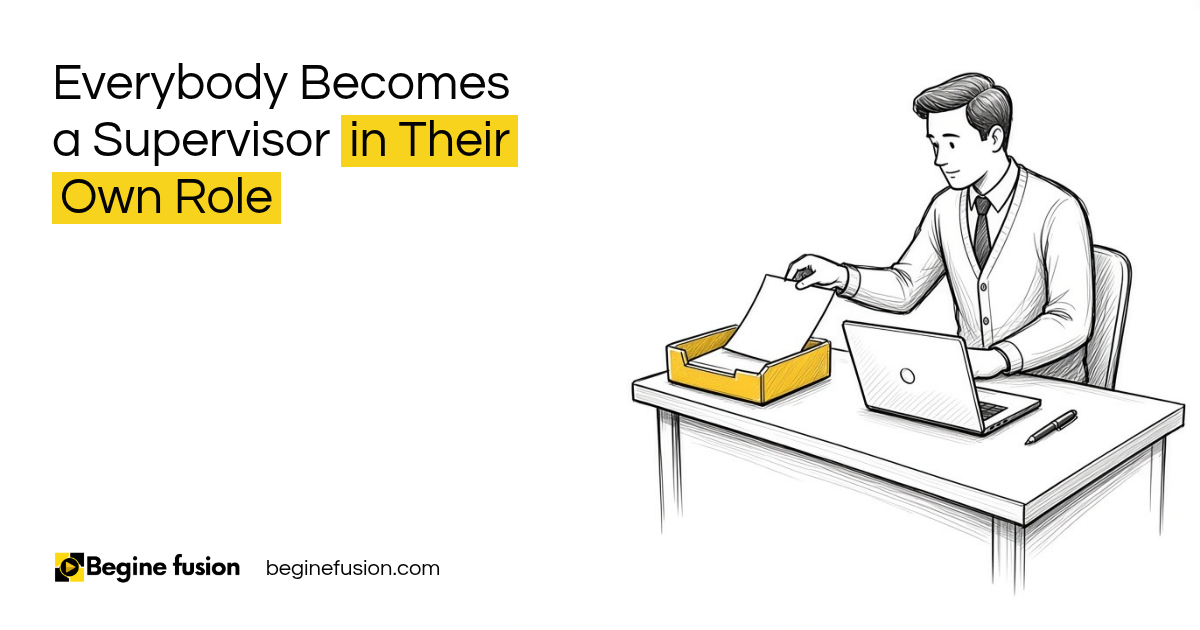
We used to come in and do the work by hand. Now human beings are responsible for directing an AI agent to get that work done. So everybody now becomes a supervisor in their own individual role.
What supervising an agent looks like
You direct the agent and say, this is what you need to do. Then you review what it has done and pass it on.
The skill of knowing how to do that is what people don’t know right now.
We are building AI agents for marketing, sales, HR and other functions of a company. With the rise of personal AI agents, companies will need to get personal agents for their staff as well. Say five of us are on the sales team. Each of us has our own personal AI agent helping us do the work.
The review step is the same one we cover in keeping a human in the loop.

How a company grows now
You used to grow a company by employing a thousand more people. Now the questions are different. What can we automate? What processes can we put in place? What can AI take on so that we free people’s time to do more things?
That is how it is changing.
The foundation comes first
A lot of companies are still struggling with having a basic CRM, because they are still on Excel sheets. So how do you take people from pen and paper to AI agents when they have not gone through the first level of basic automation?

The very first thing we always do is clean up the data. Then we map out the process, before we go any further. We wrote about why the CRM comes before the AI and why you explain it before you automate it.
A common trap is jumping to stage three technology without building the stage two foundation. Build your foundations before you move to the next stage.

Where you are as an individual
I get asked this a lot by people working within companies. How do we prepare for AI? How do we build our skills and stay relevant, so nobody comes in tomorrow and says, we have an AI agent doing your work, thank you for coming?
Here is how I lay out the stages for individuals:
- AI consumer. You use a chat assistant to create emails and that kind of thing. That is a very basic use of it.
- Builder. You have an agent in your team helping you with things like lead qualification and automated competitive intelligence.
- Orchestrator. Your department or company needs to implement AI across the board, and you are the one championing it. Even if you are working with external vendors to deliver it, you know exactly what to do.
To become a builder, you need the skills for each stage. Know how to map the process. Know how to test and iterate. Understand the different integrations.

What changes in how the work runs
Each person on the team directs their agent, reviews what it did and passes it on. The work they used to do by hand goes to the agent, and they spend their time checking it and on the work that needs a person.
Takeaways and next steps
- Treat directing and reviewing an agent as part of every role on the team.
- Clean up the data and map the process before anyone gets an agent.
- Get the CRM and basic automation running before stage three technology.
- Work out which stage each person on your team is at today.
- Build the skills for the next stage: mapping the process, testing and iterating, and integrations.
Our guide on AI capability versus business readiness covers what a business needs in place before an agent goes live.
Common mistakes when bringing AI agents into a team
1. Giving people agents before the data is clean.
Why it fails: The agent works from records nobody trusts.
Better approach: Clean up the data, then map the process.
2. Jumping to stage three technology without the stage two foundation.
Why it fails: There is nothing underneath for the agent to work from.
Better approach: Get the CRM and basic automation running before the agents.
3. Passing on the agent’s output without reading it.
Why it fails: Mistakes go straight to the next person or the client.
Better approach: Review what the agent did before you pass it on.
4. Hiring more people before asking what can be automated.
Why it fails: The same manual work grows with the headcount.
Better approach: Ask what AI can take on, then decide who you need.
Frequently asked questions
What does it mean that everybody becomes a supervisor?
People direct an AI agent to get the work done, review what it did and pass it on, inside their own role.
What is a personal AI agent?
An agent assigned to one person on the staff that helps them do their own work.
What skills do people need to work with AI agents?
Mapping the process, testing and iterating, and understanding the different integrations. After that, orchestrating AI across the department or company.
Should we add AI agents before we have a CRM?
Build the foundation before that. Clean up the data, map the process and get basic automation running.
What is the common trap when adopting AI?
Jumping to stage three technology without building the stage two foundation.
Glossary
- Personal AI agent
- An AI agent assigned to one person to help with their own work.
- AI consumer
- Someone using a chat assistant for basic tasks, such as writing emails.
- Builder
- Someone with an agent in their team, who can map the process, test and iterate.
- Orchestrator
- The person who champions AI across a department or company and knows what to do with vendors.
- Process mapping
- Writing down each step of how a piece of work gets done, before anything is automated.
 AI Readiness Checklist: 7 Questions Before You Build
 The Agent Never-Do List