
TL;DR
- The pain point: when I worked with different agencies, the changing invoice was the one clients always had a problem with.
- The pattern: by the time the project was ending, there was always an additional thing on the invoice.
- The fixed fee: when you sign the agreement, the price stays the same from beginning to end.
- Clarity: clients can tell how much they will pay before the project starts.
- Ongoing work: anything after the project goes on a service retainer, or we train your team to do it.
Every project I take on with a client has a fixed fee. Here is where that came from.
The changing invoice
Before this business, I worked with different agencies. One of the main pain points we always had with clients was the changing invoices that we always sent.
We start up a project. By the time we are ending the project, there is always an additional thing on the invoice. Clients did not always like that.

The price is set when you sign
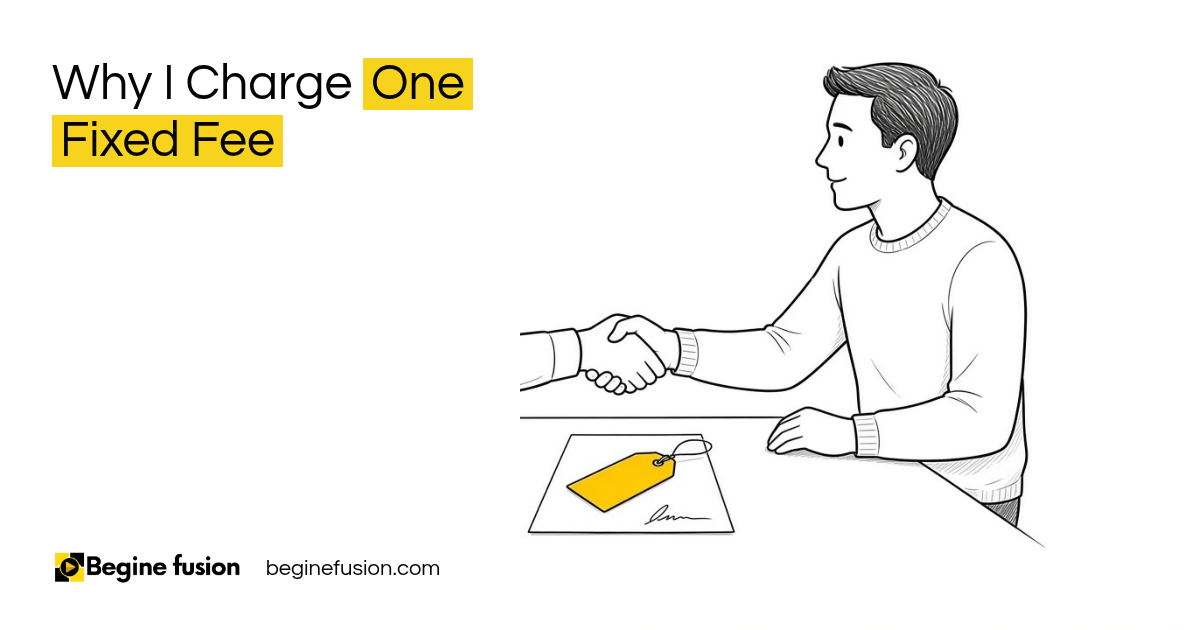
In this business, I decided that for any project we work on with clients, we guarantee them a fixed price.
When you sign the agreement to get the project going, the price is going to remain the same from beginning to end. That is why we have the fixed fee.

A fixed fee only holds if your own pricing is written down. Our post on the questions I ask before I touch a sales process covers why a sales system needs your pricing too.
Clients can tell what they will pay
The feedback we have gotten is about clarity. When clients work with other people, they cannot tell how much they are going to be charged by the end of the project.
With a fixed fee, it is clear. This is how much we are going to charge, and it is not going to change.
What happens after the project
The project has a fixed fee. Work that keeps going after it goes on a service retainer.
Sometimes a client says, “Down the line, after a year, we are going to hire an internal person to manage this.” They want us on service for one year. If any issue comes up, we are there. An AI agent, for example, is going to need updates.
There are two ways. We can train you to do the updates yourself. If you do not want to deal with them, we can manage them for you. When you have a new policy you want updated, you tell us and we can do it quickly. We wrote about getting your team to run the system without us.

If proposals and quotes are part of your sales system, our post on AI for proposal development covers that side.
Takeaways and next steps
- You can see where your invoices change between the start and the end of a project.
- The price is set when the agreement is signed.
- The price stays the same from beginning to end.
- Ongoing updates go on a service retainer.
- You can decide whether we train your team or manage the updates for you.
Common mistakes with project pricing
1. Adding items to the invoice as the project goes.
Why it fails: Clients cannot tell what they will pay by the end of the project.
Better approach: One fixed fee, agreed when the agreement is signed.
2. Mixing ongoing updates into the project price.
Why it fails: The project never ends, and neither does the invoice.
Better approach: A service retainer for anything that keeps going after the project.
Frequently asked questions
What does a fixed fee mean?
The price you agree when you sign is the price at the end of the project.
Why not bill as the project goes?
Changing invoices were the main pain point clients had when I worked with agencies.
What about updates after the project?
Those go on a service retainer, often for a year, until an internal person takes over.
Can our own team handle the updates?
Yes. We can train your team to do them, or we can manage them for you.
Glossary
- Fixed fee
- One price for the whole project, agreed at signing and the same at the end.
- Service retainer
- An ongoing agreement for updates and issues after the project, such as a new policy or an agent update.


 Minimum Sales System Checklist: Before You Buy AI
 The Company Vault Checklist: One Folder Every AI Tool Reads